

4.2 Magnetostructural Correlations
115
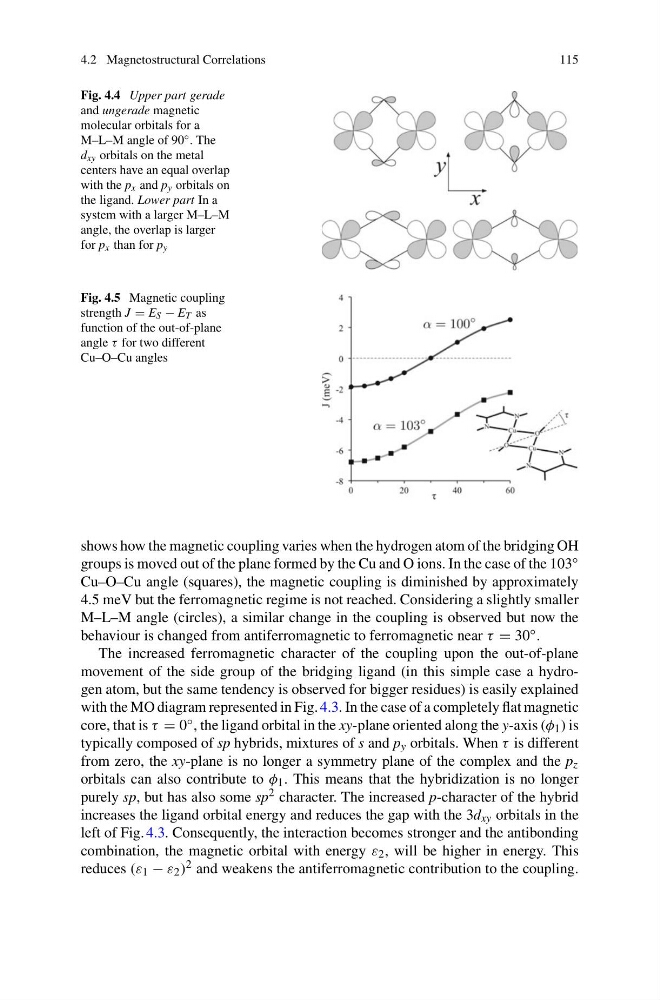
Fig. 4.4 Upper part gerade
and ungerade magnetic
molecular orbitals for a
M–L–M angle of 90 ◦ .The
d xy orbitals on the metal
centers have an equal overlap
with the p x and p y orbitals on
the ligand. Lower part In a
system with a larger M–L–M
angle, the overlap is larger
for p x than for p y
Fig. 4.5 Magnetic coupling
strength J = E S − E T as
function of the out-of-plane
angle τ for two different
Cu–O–Cu angles
shows how the magnetic coupling varies when the hydrogen atom of the bridging OH
groups is moved out of the plane formed by the Cu and O ions. In the case of the 103 ◦
Cu–O–Cu angle (squares), the magnetic coupling is diminished by approximately
4.5 meV but the ferromagnetic regime is not reached. Considering a slightly smaller
M–L–M angle (circles), a similar change in the coupling is observed but now the
behaviour is changed from antiferromagnetic to ferromagnetic near τ = 30 ◦ .
The increased ferromagnetic character of the coupling upon the out-of-plane
movement of the side group of the bridging ligand (in this simple case a hydrogen atom, but the same tendency is observed for bigger residues) is easily explained
with the MO diagram represented in Fig. 4.3. In the case of a completely flat magnetic
core, that is τ = 0 ◦ , the ligand orbital in the xy-plane oriented along the y-axis (φ 1 )is
typically composed of sp hybrids, mixtures of s and p y orbitals. When τ is different
from zero, the xy-plane is no longer a symmetry plane of the complex and the p z
orbitals can also contribute to φ 1 . This means that the hybridization is no longer
purely sp, but has also some sp 2 character. The increased p-character of the hybrid
increases the ligand orbital energy and reduces the gap with the 3d xy orbitals in the
left of Fig. 4.3. Consequently, the interaction becomes stronger and the antibonding
combination, the magnetic orbital with energy ε 2 , will be higher in energy. This
reduces (ε 1 − ε 2 ) 2 and weakens the antiferromagnetic contribution to the coupling.
115
Fig. 4.4 Upper part gerade
and ungerade magnetic
molecular orbitals for a
M–L–M angle of 90 ◦ .The
d xy orbitals on the metal
centers have an equal overlap
with the p x and p y orbitals on
the ligand. Lower part In a
system with a larger M–L–M
angle, the overlap is larger
for p x than for p y
Fig. 4.5 Magnetic coupling
strength J = E S − E T as
function of the out-of-plane
angle τ for two different
Cu–O–Cu angles
shows how the magnetic coupling varies when the hydrogen atom of the bridging OH
groups is moved out of the plane formed by the Cu and O ions. In the case of the 103 ◦
Cu–O–Cu angle (squares), the magnetic coupling is diminished by approximately
4.5 meV but the ferromagnetic regime is not reached. Considering a slightly smaller
M–L–M angle (circles), a similar change in the coupling is observed but now the
behaviour is changed from antiferromagnetic to ferromagnetic near τ = 30 ◦ .
The increased ferromagnetic character of the coupling upon the out-of-plane
movement of the side group of the bridging ligand (in this simple case a hydrogen atom, but the same tendency is observed for bigger residues) is easily explained
with the MO diagram represented in Fig. 4.3. In the case of a completely flat magnetic
core, that is τ = 0 ◦ , the ligand orbital in the xy-plane oriented along the y-axis (φ 1 )is
typically composed of sp hybrids, mixtures of s and p y orbitals. When τ is different
from zero, the xy-plane is no longer a symmetry plane of the complex and the p z
orbitals can also contribute to φ 1 . This means that the hybridization is no longer
purely sp, but has also some sp 2 character. The increased p-character of the hybrid
increases the ligand orbital energy and reduces the gap with the 3d xy orbitals in the
left of Fig. 4.3. Consequently, the interaction becomes stronger and the antibonding
combination, the magnetic orbital with energy ε 2 , will be higher in energy. This
reduces (ε 1 − ε 2 ) 2 and weakens the antiferromagnetic contribution to the coupling.