

112
4 From Orbital Models to Accurate Predictions
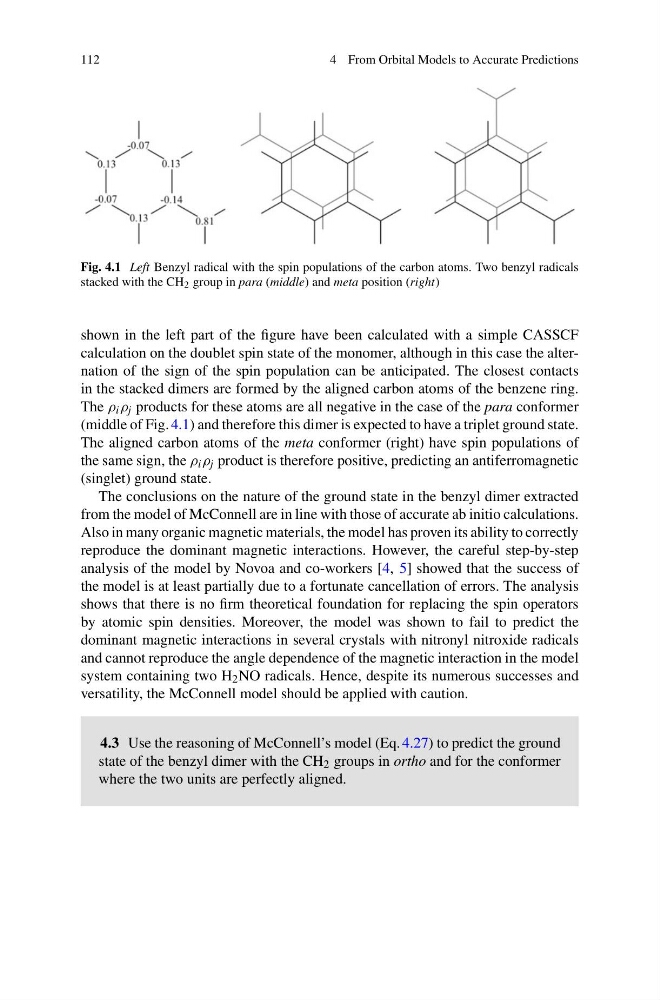
Fig. 4.1 Left Benzyl radical with the spin populations of the carbon atoms. Two benzyl radicals
stacked with the CH 2 group in para (middle)andmeta position (right)
shown in the left part of the figure have been calculated with a simple CASSCF
calculation on the doublet spin state of the monomer, although in this case the alternation of the sign of the spin population can be anticipated. The closest contacts
in the stacked dimers are formed by the aligned carbon atoms of the benzene ring.
The ρ i ρ j products for these atoms are all negative in the case of the para conformer
(middle of Fig. 4.1) and therefore this dimer is expected to have a triplet ground state.
The aligned carbon atoms of the meta conformer (right) have spin populations of
the same sign, the ρ i ρ j product is therefore positive, predicting an antiferromagnetic
(singlet) ground state.
The conclusions on the nature of the ground state in the benzyl dimer extracted
from the model of McConnell are in line with those of accurate ab initio calculations.
Also in many organic magnetic materials, the model has proven its ability to correctly
reproduce the dominant magnetic interactions. However, the careful step-by-step
analysis of the model by Novoa and co-workers [4, 5] showed that the success of
the model is at least partially due to a fortunate cancellation of errors. The analysis
shows that there is no firm theoretical foundation for replacing the spin operators
by atomic spin densities. Moreover, the model was shown to fail to predict the
dominant magnetic interactions in several crystals with nitronyl nitroxide radicals
and cannot reproduce the angle dependence of the magnetic interaction in the model
system containing two H 2 NO radicals. Hence, despite its numerous successes and
versatility, the McConnell model should be applied with caution.
4.3 Use the reasoning of McConnell’s model (Eq. 4.27) to predict the ground
state of the benzyl dimer with the CH 2 groups in ortho and for the conformer
where the two units are perfectly aligned.
4 From Orbital Models to Accurate Predictions
Fig. 4.1 Left Benzyl radical with the spin populations of the carbon atoms. Two benzyl radicals
stacked with the CH 2 group in para (middle)andmeta position (right)
shown in the left part of the figure have been calculated with a simple CASSCF
calculation on the doublet spin state of the monomer, although in this case the alternation of the sign of the spin population can be anticipated. The closest contacts
in the stacked dimers are formed by the aligned carbon atoms of the benzene ring.
The ρ i ρ j products for these atoms are all negative in the case of the para conformer
(middle of Fig. 4.1) and therefore this dimer is expected to have a triplet ground state.
The aligned carbon atoms of the meta conformer (right) have spin populations of
the same sign, the ρ i ρ j product is therefore positive, predicting an antiferromagnetic
(singlet) ground state.
The conclusions on the nature of the ground state in the benzyl dimer extracted
from the model of McConnell are in line with those of accurate ab initio calculations.
Also in many organic magnetic materials, the model has proven its ability to correctly
reproduce the dominant magnetic interactions. However, the careful step-by-step
analysis of the model by Novoa and co-workers [4, 5] showed that the success of
the model is at least partially due to a fortunate cancellation of errors. The analysis
shows that there is no firm theoretical foundation for replacing the spin operators
by atomic spin densities. Moreover, the model was shown to fail to predict the
dominant magnetic interactions in several crystals with nitronyl nitroxide radicals
and cannot reproduce the angle dependence of the magnetic interaction in the model
system containing two H 2 NO radicals. Hence, despite its numerous successes and
versatility, the McConnell model should be applied with caution.
4.3 Use the reasoning of McConnell’s model (Eq. 4.27) to predict the ground
state of the benzyl dimer with the CH 2 groups in ortho and for the conformer
where the two units are perfectly aligned.