

4.1 Qualitative Valence-Only Models
111
directly apply. Traditionally the magnetism caused by through-space interactions in
such organic materials is rationalized with the McConnell I model [3]. To describe
the interaction between two radicals, the model takes an atomic viewpoint and starts
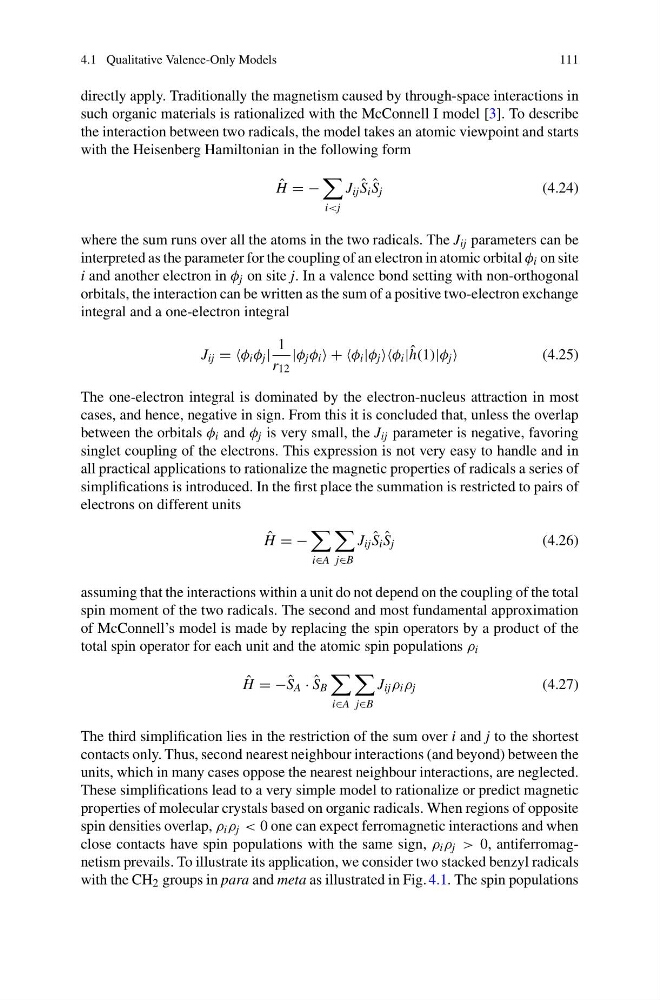
with the Heisenberg Hamiltonian in the following form
ˆ
H =−
i
S i ˆ
S j
(4.24)
where the sum runs over all the atoms in the two radicals. The J ij parameters can be
interpreted as the parameter for the coupling of an electron in atomic orbital φ i on site
i and another electron in φ j on site j. In a valence bond setting with non-orthogonal
orbitals, the interaction can be written as the sum of a positive two-electron exchange
integral and a one-electron integral
J ij ==φ i φ j |
1
r 12
|φ j φ i ++φ i |φ j φ i | ˆ
h(1)|φ j
(4.25)
The one-electron integral is dominated by the electron-nucleus attraction in most
cases, and hence, negative in sign. From this it is concluded that, unless the overlap
between the orbitals φ i and φ j is very small, the J ij parameter is negative, favoring
singlet coupling of the electrons. This expression is not very easy to handle and in
all practical applications to rationalize the magnetic properties of radicals a series of
simplifications is introduced. In the first place the summation is restricted to pairs of
electrons on different units
ˆ
H =−
i∈A
j∈B
J ij ˆ
S i ˆ
S j
(4.26)
assuming that the interactions within a unit do not depend on the coupling of the total
spin moment of the two radicals. The second and most fundamental approximation
of McConnell’s model is made by replacing the spin operators by a product of the
total spin operator for each unit and the atomic spin populations ρ i
ˆ
H =− ˆ
S A · ˆ
S B
i∈A
j∈B
J ij ρ i ρ j
(4.27)
The third simplification lies in the restriction of the sum over i and j to the shortest
contacts only. Thus, second nearest neighbour interactions (and beyond) between the
units, which in many cases oppose the nearest neighbour interactions, are neglected.
These simplifications lead to a very simple model to rationalize or predict magnetic
properties of molecular crystals based on organic radicals. When regions of opposite
spin densities overlap, ρ i ρ j < 0 one can expect ferromagnetic interactions and when
close contacts have spin populations with the same sign, ρ i ρ j > 0, antiferromagnetism prevails. To illustrate its application, we consider two stacked benzyl radicals
with the CH 2 groups in para and meta as illustrated in Fig. 4.1. The spin populations
111
directly apply. Traditionally the magnetism caused by through-space interactions in
such organic materials is rationalized with the McConnell I model [3]. To describe
the interaction between two radicals, the model takes an atomic viewpoint and starts
with the Heisenberg Hamiltonian in the following form
ˆ
H =−
i
S i ˆ
S j
(4.24)
where the sum runs over all the atoms in the two radicals. The J ij parameters can be
interpreted as the parameter for the coupling of an electron in atomic orbital φ i on site
i and another electron in φ j on site j. In a valence bond setting with non-orthogonal
orbitals, the interaction can be written as the sum of a positive two-electron exchange
integral and a one-electron integral
J ij ==φ i φ j |
1
r 12
|φ j φ i ++φ i |φ j φ i | ˆ
h(1)|φ j
(4.25)
The one-electron integral is dominated by the electron-nucleus attraction in most
cases, and hence, negative in sign. From this it is concluded that, unless the overlap
between the orbitals φ i and φ j is very small, the J ij parameter is negative, favoring
singlet coupling of the electrons. This expression is not very easy to handle and in
all practical applications to rationalize the magnetic properties of radicals a series of
simplifications is introduced. In the first place the summation is restricted to pairs of
electrons on different units
ˆ
H =−
i∈A
j∈B
J ij ˆ
S i ˆ
S j
(4.26)
assuming that the interactions within a unit do not depend on the coupling of the total
spin moment of the two radicals. The second and most fundamental approximation
of McConnell’s model is made by replacing the spin operators by a product of the
total spin operator for each unit and the atomic spin populations ρ i
ˆ
H =− ˆ
S A · ˆ
S B
i∈A
j∈B
J ij ρ i ρ j
(4.27)
The third simplification lies in the restriction of the sum over i and j to the shortest
contacts only. Thus, second nearest neighbour interactions (and beyond) between the
units, which in many cases oppose the nearest neighbour interactions, are neglected.
These simplifications lead to a very simple model to rationalize or predict magnetic
properties of molecular crystals based on organic radicals. When regions of opposite
spin densities overlap, ρ i ρ j < 0 one can expect ferromagnetic interactions and when
close contacts have spin populations with the same sign, ρ i ρ j > 0, antiferromagnetism prevails. To illustrate its application, we consider two stacked benzyl radicals
with the CH 2 groups in para and meta as illustrated in Fig. 4.1. The spin populations