

4.1 Qualitative Valence-Only Models
109
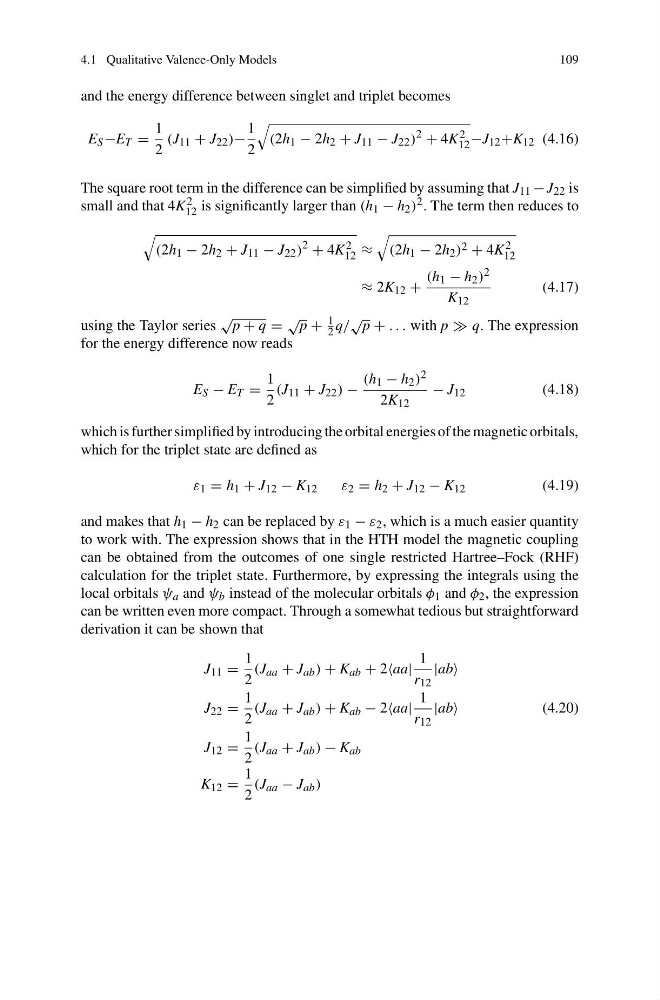
and the energy difference between singlet and triplet becomes
E S −E T =
1
2
(J 11 + J 22 )−
1
2
(2h 1 − 2h 2 + J 11 − J 22 )
2 + 4K 2
12 −J 12 +K 12 (4.16)
The square root term in the difference can be simplified by assuming that J 11 − J 22 is
small and that 4K 2
12 is significantly larger than (h 1 − h 2 ) 2 . The term then reduces to
(2h 1 − 2h 2 + J 11 − J 22 )
2 + 4K 2
12 ≈
(2h 1 − 2h 2 ) 2 + 4K 2
12
≈ 2K 12 +
(h 1 − h 2 ) 2
K 12
(4.17)
using the Taylor series
√
p + q =
√
p +
1
2 q/
√ p + ... with p ≫ q. The expression
for the energy difference now reads
E S − E T =
1
2
(J 11 + J 22 ) −
(h 1 − h 2 ) 2
2K 12
− J 12
(4.18)
which is further simplified by introducing the orbital energies of the magnetic orbitals,
which for the triplet state are defined as
ε 1 = h 1 + J 12 − K 12
ε 2 = h 2 + J 12 − K 12
(4.19)
and makes that h 1 − h 2 can be replaced by ε 1 − ε 2 , which is a much easier quantity
to work with. The expression shows that in the HTH model the magnetic coupling
can be obtained from the outcomes of one single restricted Hartree–Fock (RHF)
calculation for the triplet state. Furthermore, by expressing the integrals using the
local orbitals ψ a and ψ b instead of the molecular orbitals φ 1 and φ 2 , the expression
can be written even more compact. Through a somewhat tedious but straightforward
derivation it can be shown that
J 11 =
1
2
(J aa + J ab ) + K ab + 2aa|
1
r 12
|ab
J 22 =
1
2
(J aa + J ab ) + K ab − 2aa|
1
r 12
|ab
(4.20)
J 12 =
1
2
(J aa + J ab ) − K ab
K 12 =
1
2
(J aa − J ab )
109
and the energy difference between singlet and triplet becomes
E S −E T =
1
2
(J 11 + J 22 )−
1
2
(2h 1 − 2h 2 + J 11 − J 22 )
2 + 4K 2
12 −J 12 +K 12 (4.16)
The square root term in the difference can be simplified by assuming that J 11 − J 22 is
small and that 4K 2
12 is significantly larger than (h 1 − h 2 ) 2 . The term then reduces to
(2h 1 − 2h 2 + J 11 − J 22 )
2 + 4K 2
12 ≈
(2h 1 − 2h 2 ) 2 + 4K 2
12
≈ 2K 12 +
(h 1 − h 2 ) 2
K 12
(4.17)
using the Taylor series
√
p + q =
√
p +
1
2 q/
√ p + ... with p ≫ q. The expression
for the energy difference now reads
E S − E T =
1
2
(J 11 + J 22 ) −
(h 1 − h 2 ) 2
2K 12
− J 12
(4.18)
which is further simplified by introducing the orbital energies of the magnetic orbitals,
which for the triplet state are defined as
ε 1 = h 1 + J 12 − K 12
ε 2 = h 2 + J 12 − K 12
(4.19)
and makes that h 1 − h 2 can be replaced by ε 1 − ε 2 , which is a much easier quantity
to work with. The expression shows that in the HTH model the magnetic coupling
can be obtained from the outcomes of one single restricted Hartree–Fock (RHF)
calculation for the triplet state. Furthermore, by expressing the integrals using the
local orbitals ψ a and ψ b instead of the molecular orbitals φ 1 and φ 2 , the expression
can be written even more compact. Through a somewhat tedious but straightforward
derivation it can be shown that
J 11 =
1
2
(J aa + J ab ) + K ab + 2aa|
1
r 12
|ab
J 22 =
1
2
(J aa + J ab ) + K ab − 2aa|
1
r 12
|ab
(4.20)
J 12 =
1
2
(J aa + J ab ) − K ab
K 12 =
1
2
(J aa − J ab )