

108
4 From Orbital Models to Accurate Predictions
4.1.2 The Hay–Thibeault–Hoffmann Model
The second valence-only model starts from a molecular orbital viewpoint and was
derived in the mid 1970s by Hay, Thibeault and Hoffmann (HTH) [2], approximately
at the same time as the Kahn–Briat model. The magnetic orbitals are defined as linear
combinations of orthogonal atomic-like orbitals
φ 1 =
1
√
2
(ψ a + ψ b )
φ 2 =
1
√
2
(ψ a − ψ b )
(4.11)
Similar to φ a and φ b of the Kahn–Briat model, the atomic-like orbitals of the HTH
model have the largest amplitudes on the magnetic centers, but in contrast ψ a and ψ b
show delocalization tails on the ligands to ensure the orthogonality between them.
Therefore, in general ψ a and ψ b are slightly more delocalized than the nonorthogonal
φ a and φ b .
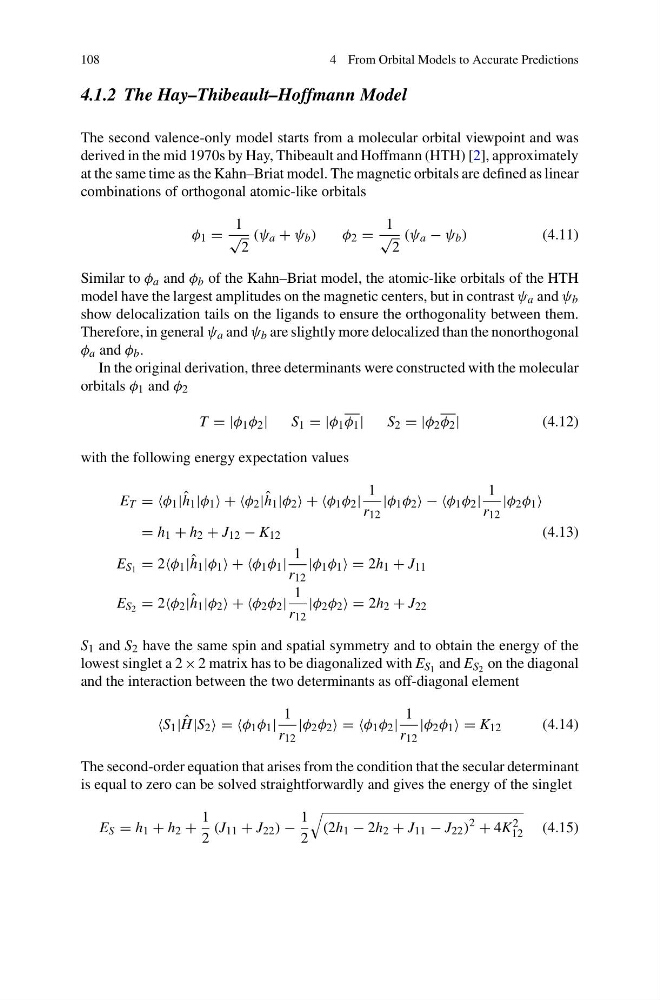
In the original derivation, three determinants were constructed with the molecular
orbitals φ 1 and φ 2
T =|φ 1 φ 2 |
S 1 =|φ 1 φ 1 |
S 2 =|φ 2 φ 2 |
(4.12)
with the following energy expectation values
E T ==φ 1 | ˆ
h 1 |φ 1 ++φ 2 | ˆ
h 1 |φ 2 ++φ 1 φ 2 |
1
r 12
|φ 1 φ 2 −−φ 1 φ 2 |
1
r 12
|φ 2 φ 1
= h 1 + h 2 + J 12 − K 12
(4.13)
E S 1 = 2φ 1 | ˆ
h 1 |φ 1 ++φ 1 φ 1 |
1
r 12
|φ 1 φ 1 =2h 1 + J 11
E S 2 = 2φ 2 | ˆ
h 1 |φ 2 ++φ 2 φ 2 |
1
r 12
|φ 2 φ 2 =2h 2 + J 22
S 1 and S 2 have the same spin and spatial symmetry and to obtain the energy of the
lowest singlet a 2 × 2 matrix has to be diagonalized with E S 1 and E S 2 on the diagonal
and the interaction between the two determinants as off-diagonal element
S 1 | ˆ
H|S 2 ==φ 1 φ 1 |
1
r 12
|φ 2 φ 2 ==φ 1 φ 2 |
1
r 12
|φ 2 φ 1 =K 12
(4.14)
The second-order equation that arises from the condition that the secular determinant
is equal to zero can be solved straightforwardly and gives the energy of the singlet
E S = h 1 + h 2 +
1
2
(J 11 + J 22 ) −
1
2
(2h 1 − 2h 2 + J 11 − J 22 )
2 + 4K 2
12
(4.15)
4 From Orbital Models to Accurate Predictions
4.1.2 The Hay–Thibeault–Hoffmann Model
The second valence-only model starts from a molecular orbital viewpoint and was
derived in the mid 1970s by Hay, Thibeault and Hoffmann (HTH) [2], approximately
at the same time as the Kahn–Briat model. The magnetic orbitals are defined as linear
combinations of orthogonal atomic-like orbitals
φ 1 =
1
√
2
(ψ a + ψ b )
φ 2 =
1
√
2
(ψ a − ψ b )
(4.11)
Similar to φ a and φ b of the Kahn–Briat model, the atomic-like orbitals of the HTH
model have the largest amplitudes on the magnetic centers, but in contrast ψ a and ψ b
show delocalization tails on the ligands to ensure the orthogonality between them.
Therefore, in general ψ a and ψ b are slightly more delocalized than the nonorthogonal
φ a and φ b .
In the original derivation, three determinants were constructed with the molecular
orbitals φ 1 and φ 2
T =|φ 1 φ 2 |
S 1 =|φ 1 φ 1 |
S 2 =|φ 2 φ 2 |
(4.12)
with the following energy expectation values
E T ==φ 1 | ˆ
h 1 |φ 1 ++φ 2 | ˆ
h 1 |φ 2 ++φ 1 φ 2 |
1
r 12
|φ 1 φ 2 −−φ 1 φ 2 |
1
r 12
|φ 2 φ 1
= h 1 + h 2 + J 12 − K 12
(4.13)
E S 1 = 2φ 1 | ˆ
h 1 |φ 1 ++φ 1 φ 1 |
1
r 12
|φ 1 φ 1 =2h 1 + J 11
E S 2 = 2φ 2 | ˆ
h 1 |φ 2 ++φ 2 φ 2 |
1
r 12
|φ 2 φ 2 =2h 2 + J 22
S 1 and S 2 have the same spin and spatial symmetry and to obtain the energy of the
lowest singlet a 2 × 2 matrix has to be diagonalized with E S 1 and E S 2 on the diagonal
and the interaction between the two determinants as off-diagonal element
S 1 | ˆ
H|S 2 ==φ 1 φ 1 |
1
r 12
|φ 2 φ 2 ==φ 1 φ 2 |
1
r 12
|φ 2 φ 1 =K 12
(4.14)
The second-order equation that arises from the condition that the secular determinant
is equal to zero can be solved straightforwardly and gives the energy of the singlet
E S = h 1 + h 2 +
1
2
(J 11 + J 22 ) −
1
2
(2h 1 − 2h 2 + J 11 − J 22 )
2 + 4K 2
12
(4.15)