

4.1 Qualitative Valence-Only Models
107
E S =
4ε + 4βS + 2J C + 2K
2 + 2S 2
=
2ε + 2βS + J C + K
1 + S 2
(4.6a)
E T =
4ε − 4βS + 2J C − 2K
2 − 2S 2
=
2ε − 2βS + J C − K
1 − S 2
(4.6b)
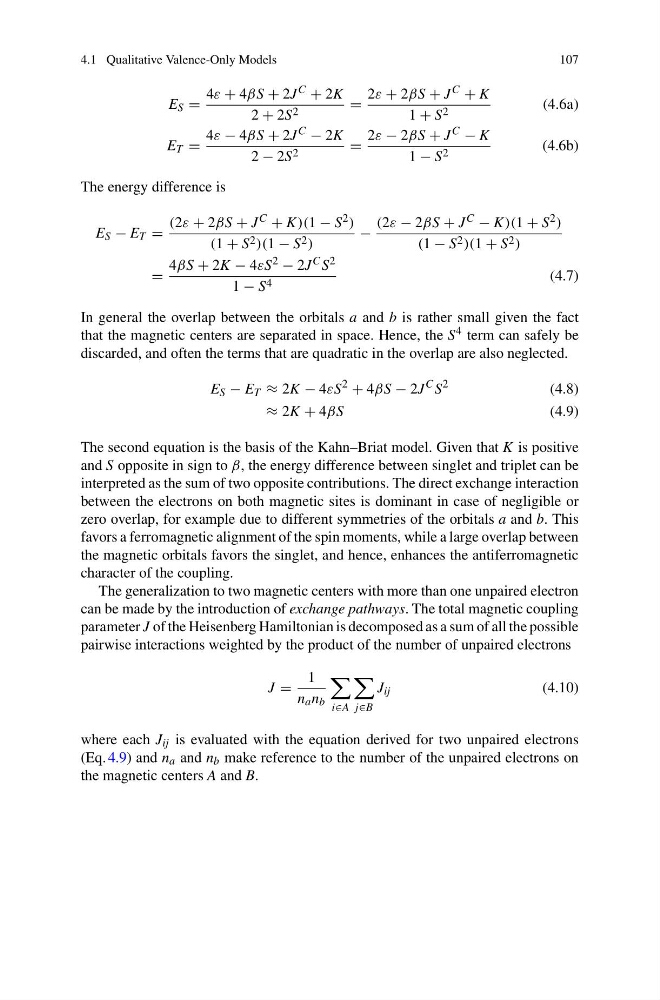
The energy difference is
E S − E T =
(2ε + 2βS + J C + K)(1 − S 2 )
(1 + S 2 )(1 − S 2 )
−
(2ε − 2βS + J C − K)(1 + S 2 )
(1 − S 2 )(1 + S 2 )
=
4βS + 2K − 4εS 2 − 2J C S 2
1 − S 4
(4.7)
In general the overlap between the orbitals a and b is rather small given the fact
that the magnetic centers are separated in space. Hence, the S 4 term can safely be
discarded, and often the terms that are quadratic in the overlap are also neglected.
E S − E T ≈ 2K − 4εS
2 + 4βS − 2J
C S
2
(4.8)
≈ 2K + 4βS
(4.9)
The second equation is the basis of the Kahn–Briat model. Given that K is positive
and S opposite in sign to β, the energy difference between singlet and triplet can be
interpreted as the sum of two opposite contributions. The direct exchange interaction
between the electrons on both magnetic sites is dominant in case of negligible or
zero overlap, for example due to different symmetries of the orbitals a and b.This
favors a ferromagnetic alignment of the spin moments, while a large overlap between
the magnetic orbitals favors the singlet, and hence, enhances the antiferromagnetic
character of the coupling.
The generalization to two magnetic centers with more than one unpaired electron
can be made by the introduction of exchange pathways. The total magnetic coupling
parameter J of the Heisenberg Hamiltonian is decomposed as a sum of all the possible
pairwise interactions weighted by the product of the number of unpaired electrons
J =
1
n a n b
i∈A
j∈B
J ij
(4.10)
where each J ij is evaluated with the equation derived for two unpaired electrons
(Eq. 4.9) and n a and n b make reference to the number of the unpaired electrons on
the magnetic centers A and B.
107
E S =
4ε + 4βS + 2J C + 2K
2 + 2S 2
=
2ε + 2βS + J C + K
1 + S 2
(4.6a)
E T =
4ε − 4βS + 2J C − 2K
2 − 2S 2
=
2ε − 2βS + J C − K
1 − S 2
(4.6b)
The energy difference is
E S − E T =
(2ε + 2βS + J C + K)(1 − S 2 )
(1 + S 2 )(1 − S 2 )
−
(2ε − 2βS + J C − K)(1 + S 2 )
(1 − S 2 )(1 + S 2 )
=
4βS + 2K − 4εS 2 − 2J C S 2
1 − S 4
(4.7)
In general the overlap between the orbitals a and b is rather small given the fact
that the magnetic centers are separated in space. Hence, the S 4 term can safely be
discarded, and often the terms that are quadratic in the overlap are also neglected.
E S − E T ≈ 2K − 4εS
2 + 4βS − 2J
C S
2
(4.8)
≈ 2K + 4βS
(4.9)
The second equation is the basis of the Kahn–Briat model. Given that K is positive
and S opposite in sign to β, the energy difference between singlet and triplet can be
interpreted as the sum of two opposite contributions. The direct exchange interaction
between the electrons on both magnetic sites is dominant in case of negligible or
zero overlap, for example due to different symmetries of the orbitals a and b.This
favors a ferromagnetic alignment of the spin moments, while a large overlap between
the magnetic orbitals favors the singlet, and hence, enhances the antiferromagnetic
character of the coupling.
The generalization to two magnetic centers with more than one unpaired electron
can be made by the introduction of exchange pathways. The total magnetic coupling
parameter J of the Heisenberg Hamiltonian is decomposed as a sum of all the possible
pairwise interactions weighted by the product of the number of unpaired electrons
J =
1
n a n b
i∈A
j∈B
J ij
(4.10)
where each J ij is evaluated with the equation derived for two unpaired electrons
(Eq. 4.9) and n a and n b make reference to the number of the unpaired electrons on
the magnetic centers A and B.