

98
3 Two (or More) Magnetic Centers
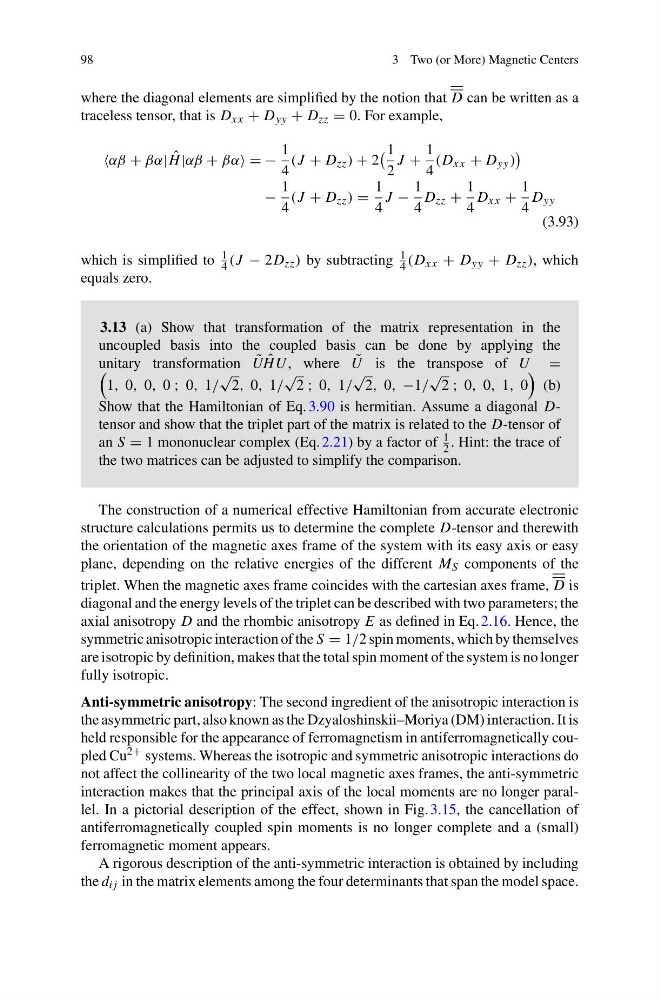
where the diagonal elements are simplified by the notion that D can be written as a
traceless tensor, that is D xx + D yy + D zz = 0. For example,
αβ + βα| ˆ
H |αβ + βα
1
4
(J + D zz ) + 2
1
2
J +
1
4
(D xx + D yy )
−
1
4
(J + D zz ) =
1
4
J −
1
4
D zz +
1
4
D xx +
1
4
D yy
(3.93)
which is simplified to
1
4 (J − 2D zz ) by subtracting
1
4 (D xx + D yy + D zz ), which
equals zero.
3.13 (a) Show that transformation of the matrix representation in the
uncoupled basis into the coupled basis can be done by applying the
unitary transformation ˜
U ˆ
HU, where ˜
U is the transpose of U =
1, 0, 0, 0 ; 0, 1/
√
2, 0, 1/
√
2 ; 0, 1/
√
2, 0, −1/
√
2 ; 0, 0, 1, 0
(b)
Show that the Hamiltonian of Eq. 3.90 is hermitian. Assume a diagonal Dtensor and show that the triplet part of the matrix is related to the D-tensor of
an S = 1 mononuclear complex (Eq. 2.21) by a factor of
1
2 . Hint: the trace of
the two matrices can be adjusted to simplify the comparison.
The construction of a numerical effective Hamiltonian from accurate electronic
structure calculations permits us to determine the complete D-tensor and therewith
the orientation of the magnetic axes frame of the system with its easy axis or easy
plane, depending on the relative energies of the different M S components of the
triplet. When the magnetic axes frame coincides with the cartesian axes frame, D is
diagonal and the energy levels of the triplet can be described with two parameters; the
axial anisotropy D and the rhombic anisotropy E as defined in Eq. 2.16. Hence, the
symmetric anisotropic interaction of the S = 1/2 spin moments, which by themselves
are isotropic by definition, makes that the total spin moment of the system is no longer
fully isotropic.
Anti-symmetric anisotropy: The second ingredient of the anisotropic interaction is
the asymmetric part, also known as the Dzyaloshinskii–Moriya (DM) interaction. It is
held responsible for the appearance of ferromagnetism in antiferromagnetically coupled Cu 2+ systems. Whereas the isotropic and symmetric anisotropic interactions do
not affect the collinearity of the two local magnetic axes frames, the anti-symmetric
interaction makes that the principal axis of the local moments are no longer parallel. In a pictorial description of the effect, shown in Fig. 3.15, the cancellation of
antiferromagnetically coupled spin moments is no longer complete and a (small)
ferromagnetic moment appears.
A rigorous description of the anti-symmetric interaction is obtained by including
the d ij in the matrix elements among the four determinants that span the model space.
3 Two (or More) Magnetic Centers
where the diagonal elements are simplified by the notion that D can be written as a
traceless tensor, that is D xx + D yy + D zz = 0. For example,
αβ + βα| ˆ
H |αβ + βα
1
4
(J + D zz ) + 2
1
2
J +
1
4
(D xx + D yy )
−
1
4
(J + D zz ) =
1
4
J −
1
4
D zz +
1
4
D xx +
1
4
D yy
(3.93)
which is simplified to
1
4 (J − 2D zz ) by subtracting
1
4 (D xx + D yy + D zz ), which
equals zero.
3.13 (a) Show that transformation of the matrix representation in the
uncoupled basis into the coupled basis can be done by applying the
unitary transformation ˜
U ˆ
HU, where ˜
U is the transpose of U =
1, 0, 0, 0 ; 0, 1/
√
2, 0, 1/
√
2 ; 0, 1/
√
2, 0, −1/
√
2 ; 0, 0, 1, 0
(b)
Show that the Hamiltonian of Eq. 3.90 is hermitian. Assume a diagonal Dtensor and show that the triplet part of the matrix is related to the D-tensor of
an S = 1 mononuclear complex (Eq. 2.21) by a factor of
1
2 . Hint: the trace of
the two matrices can be adjusted to simplify the comparison.
The construction of a numerical effective Hamiltonian from accurate electronic
structure calculations permits us to determine the complete D-tensor and therewith
the orientation of the magnetic axes frame of the system with its easy axis or easy
plane, depending on the relative energies of the different M S components of the
triplet. When the magnetic axes frame coincides with the cartesian axes frame, D is
diagonal and the energy levels of the triplet can be described with two parameters; the
axial anisotropy D and the rhombic anisotropy E as defined in Eq. 2.16. Hence, the
symmetric anisotropic interaction of the S = 1/2 spin moments, which by themselves
are isotropic by definition, makes that the total spin moment of the system is no longer
fully isotropic.
Anti-symmetric anisotropy: The second ingredient of the anisotropic interaction is
the asymmetric part, also known as the Dzyaloshinskii–Moriya (DM) interaction. It is
held responsible for the appearance of ferromagnetism in antiferromagnetically coupled Cu 2+ systems. Whereas the isotropic and symmetric anisotropic interactions do
not affect the collinearity of the two local magnetic axes frames, the anti-symmetric
interaction makes that the principal axis of the local moments are no longer parallel. In a pictorial description of the effect, shown in Fig. 3.15, the cancellation of
antiferromagnetically coupled spin moments is no longer complete and a (small)
ferromagnetic moment appears.
A rigorous description of the anti-symmetric interaction is obtained by including
the d ij in the matrix elements among the four determinants that span the model space.