

3.4 Complex Interactions
97
• ˆ
S 1 A ˆ
S 2 |βα|
A xx ˆ
S x ˆ
S x βα =
1
4
A xx αβ
A xy ˆ
S x ˆ
S y βα =−
1
4i
A xy αβ
A xz ˆ
S x ˆ
S z βα =
1
4
A xz αα
A yx ˆ
S y ˆ
S x βα =
1
4i
A yx αβ
A yy ˆ
S y ˆ
S y βα =
1
4
A yy αβ
A yz ˆ
S y ˆ
S z βα =
1
4i
A yz αα
A zx ˆ
S z ˆ
S x βα =−
1
4
A zx ββ
A zy ˆ
S z ˆ
S y βα =
1
4i
A zy ββ
A zz ˆ
S z ˆ
S z βα =−
1
4
A zz βα
(3.91d)
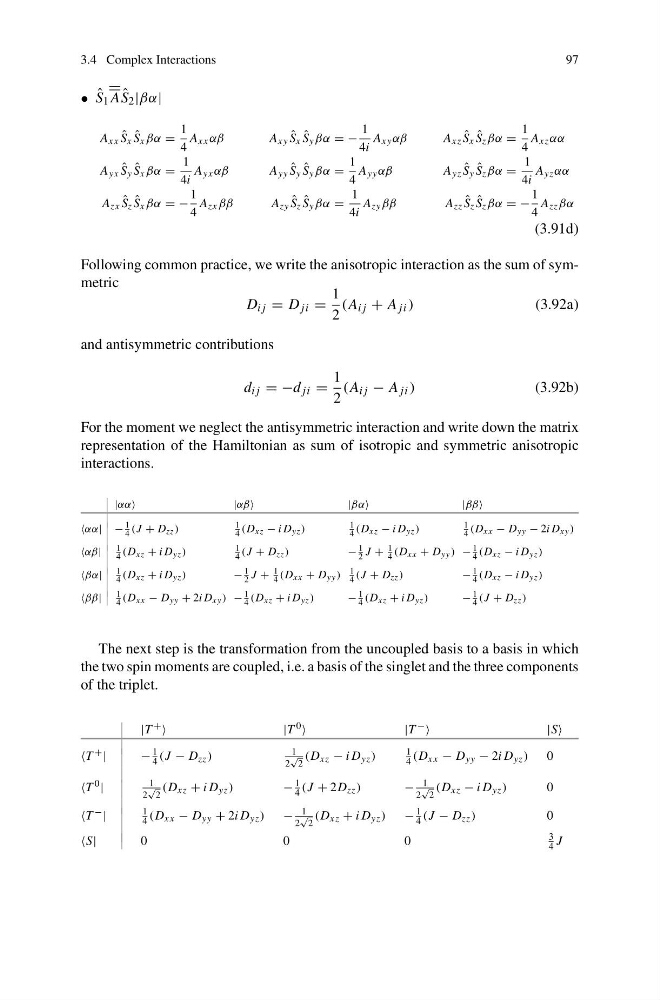
Following common practice, we write the anisotropic interaction as the sum of symmetric
D ij = D ji =
1
2
(A ij + A ji )
(3.92a)
and antisymmetric contributions
d ij =−d ji =
1
2
(A ij − A ji )
(3.92b)
For the moment we neglect the antisymmetric interaction and write down the matrix
representation of the Hamiltonian as sum of isotropic and symmetric anisotropic
interactions.
|αα| αβ| βα| ββ
αα| −
1
4 (J + D zz )
1
4 (D xz − iD yz )
1
4 (D xz − iD yz )
1
4 (D xx − D yy − 2iD xy )
αβ|
1
4 (D xz + iD yz )
1
4 (J + D zz )
−
1
2 J +
1
4 (D xx + D yy ) −
1
4 (D xz − iD yz )
βα|
1
4 (D xz + iD yz )
−
1
2 J +
1
4 (D xx + D yy )
1
4 (J + D zz )
−
1
4 (D xz − iD yz )
ββ|
1
4 (D xx − D yy + 2iD xy ) −
1
4 (D xz + iD yz )
−
1
4 (D xz + iD yz )
−
1
4 (J + D zz )
The next step is the transformation from the uncoupled basis to a basis in which
the two spin moments are coupled, i.e. a basis of the singlet and the three components
of the triplet.
|T + | T 0 | T − | S
T + |
−
1
4 (J − D zz )
1
2
√
2
(D xz − iD yz )
1
4 (D xx − D yy − 2iD yz ) 0
T 0 |
1
2
√
2
(D xz + iD yz )
−
1
4 (J + 2D zz )
−
1
2
√
2
(D xz − iD yz )
0
T − |
1
4 (D xx − D yy + 2iD yz ) −
1
2
√
2
(D xz + iD yz ) −
1
4 (J − D zz )
0
S|
00
0
3
4 J
97
• ˆ
S 1 A ˆ
S 2 |βα|
A xx ˆ
S x ˆ
S x βα =
1
4
A xx αβ
A xy ˆ
S x ˆ
S y βα =−
1
4i
A xy αβ
A xz ˆ
S x ˆ
S z βα =
1
4
A xz αα
A yx ˆ
S y ˆ
S x βα =
1
4i
A yx αβ
A yy ˆ
S y ˆ
S y βα =
1
4
A yy αβ
A yz ˆ
S y ˆ
S z βα =
1
4i
A yz αα
A zx ˆ
S z ˆ
S x βα =−
1
4
A zx ββ
A zy ˆ
S z ˆ
S y βα =
1
4i
A zy ββ
A zz ˆ
S z ˆ
S z βα =−
1
4
A zz βα
(3.91d)
Following common practice, we write the anisotropic interaction as the sum of symmetric
D ij = D ji =
1
2
(A ij + A ji )
(3.92a)
and antisymmetric contributions
d ij =−d ji =
1
2
(A ij − A ji )
(3.92b)
For the moment we neglect the antisymmetric interaction and write down the matrix
representation of the Hamiltonian as sum of isotropic and symmetric anisotropic
interactions.
|αα| αβ| βα| ββ
αα| −
1
4 (J + D zz )
1
4 (D xz − iD yz )
1
4 (D xz − iD yz )
1
4 (D xx − D yy − 2iD xy )
αβ|
1
4 (D xz + iD yz )
1
4 (J + D zz )
−
1
2 J +
1
4 (D xx + D yy ) −
1
4 (D xz − iD yz )
βα|
1
4 (D xz + iD yz )
−
1
2 J +
1
4 (D xx + D yy )
1
4 (J + D zz )
−
1
4 (D xz − iD yz )
ββ|
1
4 (D xx − D yy + 2iD xy ) −
1
4 (D xz + iD yz )
−
1
4 (D xz + iD yz )
−
1
4 (J + D zz )
The next step is the transformation from the uncoupled basis to a basis in which
the two spin moments are coupled, i.e. a basis of the singlet and the three components
of the triplet.
|T + | T 0 | T − | S
T + |
−
1
4 (J − D zz )
1
2
√
2
(D xz − iD yz )
1
4 (D xx − D yy − 2iD yz ) 0
T 0 |
1
2
√
2
(D xz + iD yz )
−
1
4 (J + 2D zz )
−
1
2
√
2
(D xz − iD yz )
0
T − |
1
4 (D xx − D yy + 2iD yz ) −
1
2
√
2
(D xz + iD yz ) −
1
4 (J − D zz )
0
S|
00
0
3
4 J