

94
3 Two (or More) Magnetic Centers
3.10 Couple the spins of the four centers in a sequential fashion in all possible
ways to check the existence of one quintet, three different triplets and two
singlets for a system with four S = 1/2 magnetic moments.
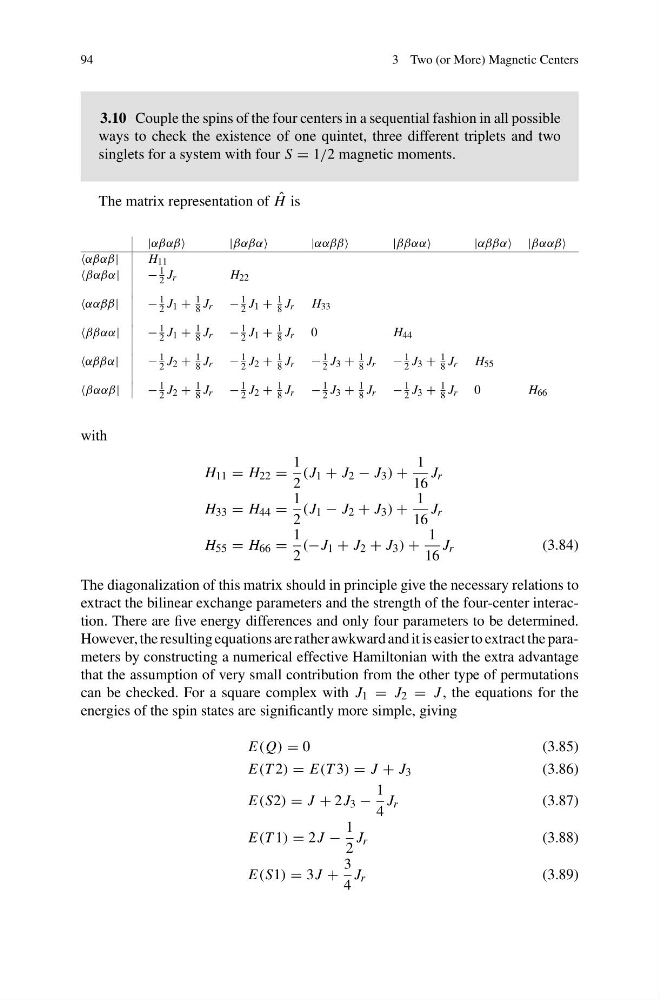
The matrix representation of ˆ
H is
|αβ αβ| βαβα| ααββ| ββαα| αββ α| βααβ
αβ αβ|
H 11
βαβα|
−
1
2 J r
H 22
ααββ|
−
1
2 J 1 +
1
8 J r −
1
2 J 1 +
1
8 J r H 33
ββαα|
−
1
2 J 1 +
1
8 J r −
1
2 J 1 +
1
8 J r 0
H 44
αββ α|
−
1
2 J 2 +
1
8 J r −
1
2 J 2 +
1
8 J r −
1
2 J 3 +
1
8 J r −
1
2 J 3 +
1
8 J r H 55
βααβ|
−
1
2 J 2 +
1
8 J r −
1
2 J 2 +
1
8 J r −
1
2 J 3 +
1
8 J r −
1
2 J 3 +
1
8 J r 0
H 66
with
H 11 = H 22 =
1
2
(J 1 + J 2 − J 3 ) +
1
16
J r
H 33 = H 44 =
1
2
(J 1 − J 2 + J 3 ) +
1
16
J r
H 55 = H 66 =
1
2
(−J 1 + J 2 + J 3 ) +
1
16
J r
(3.84)
The diagonalization of this matrix should in principle give the necessary relations to
extract the bilinear exchange parameters and the strength of the four-center interaction. There are five energy differences and only four parameters to be determined.
However, the resulting equations are rather awkward and it is easier to extract the parameters by constructing a numerical effective Hamiltonian with the extra advantage
that the assumption of very small contribution from the other type of permutations
can be checked. For a square complex with J 1 = J 2 = J , the equations for the
energies of the spin states are significantly more simple, giving
E(Q) = 0
(3.85)
E(T 2) = E(T 3) = J + J 3
(3.86)
E(S2) = J + 2J 3 −
1
4
J r
(3.87)
E(T 1) = 2J −
1
2
J r
(3.88)
E(S1) = 3J +
3
4
J r
(3.89)
3 Two (or More) Magnetic Centers
3.10 Couple the spins of the four centers in a sequential fashion in all possible
ways to check the existence of one quintet, three different triplets and two
singlets for a system with four S = 1/2 magnetic moments.
The matrix representation of ˆ
H is
|αβ αβ| βαβα| ααββ| ββαα| αββ α| βααβ
αβ αβ|
H 11
βαβα|
−
1
2 J r
H 22
ααββ|
−
1
2 J 1 +
1
8 J r −
1
2 J 1 +
1
8 J r H 33
ββαα|
−
1
2 J 1 +
1
8 J r −
1
2 J 1 +
1
8 J r 0
H 44
αββ α|
−
1
2 J 2 +
1
8 J r −
1
2 J 2 +
1
8 J r −
1
2 J 3 +
1
8 J r −
1
2 J 3 +
1
8 J r H 55
βααβ|
−
1
2 J 2 +
1
8 J r −
1
2 J 2 +
1
8 J r −
1
2 J 3 +
1
8 J r −
1
2 J 3 +
1
8 J r 0
H 66
with
H 11 = H 22 =
1
2
(J 1 + J 2 − J 3 ) +
1
16
J r
H 33 = H 44 =
1
2
(J 1 − J 2 + J 3 ) +
1
16
J r
H 55 = H 66 =
1
2
(−J 1 + J 2 + J 3 ) +
1
16
J r
(3.84)
The diagonalization of this matrix should in principle give the necessary relations to
extract the bilinear exchange parameters and the strength of the four-center interaction. There are five energy differences and only four parameters to be determined.
However, the resulting equations are rather awkward and it is easier to extract the parameters by constructing a numerical effective Hamiltonian with the extra advantage
that the assumption of very small contribution from the other type of permutations
can be checked. For a square complex with J 1 = J 2 = J , the equations for the
energies of the spin states are significantly more simple, giving
E(Q) = 0
(3.85)
E(T 2) = E(T 3) = J + J 3
(3.86)
E(S2) = J + 2J 3 −
1
4
J r
(3.87)
E(T 1) = 2J −
1
2
J r
(3.88)
E(S1) = 3J +
3
4
J r
(3.89)