

3.4 Complex Interactions
95
3.11 Extract the magnetic coupling parameters for a four-center Cu 2+ complex with a square geometry. (i) Under the assumption of equal coupling along
the edges of the square, zero coupling along the diagonal and no four-center
interactions; (ii) with a non-negligible ring exchange (J 1 = J 2 ; J r = 0 and
J 3 = 0); (iii) considering the three different interactions. The following total
energies for the spin states were calculated: E(Q) =− 3953.38577312 E h ;
E(T2) = E(T3) =− 3953.39054141 E h ;E (S2) =− 3953.39100763 E h ;
E(T1) =− 3953.39533075 E h ;E(S1) =− 3953.39867933 E h . Are the estimates of J the same in the first case when extracted from different ∆E’s?
3.4.3 Anisotropic Exchange
In Sect. 3.2 we have introduced the general expression (Eq. 3.20) to describe the
interaction between two spin moments on different magnetic centers. So far, only
the isotropic interactions have been considered in this chapter; the total spin moment
(and the single-ion spin) in itself has no preferred orientation in space, only the relative
orientation—parallel or antiparallel—of the local spins has been looked at. This is
of course only part of the story. Due to relativistic effects, in many systems the spin
moment is anisotropic as seen in the previous chapter for mononuclear complexes.
The magnetic anisotropy is in some compounds accompanied by ferroelectricity.
These so-called multiferroic compounds, often perovskite transition metal oxides,
have potential applications as switches, sensors or memory devices. Coming back to
Eq. 3.20, we will separate isotropic and anisotropic interactions before orienting the
molecule in such a way that the magnetic frame coincides with the cartesian axes
frame. Then, the Hamiltonian becomes
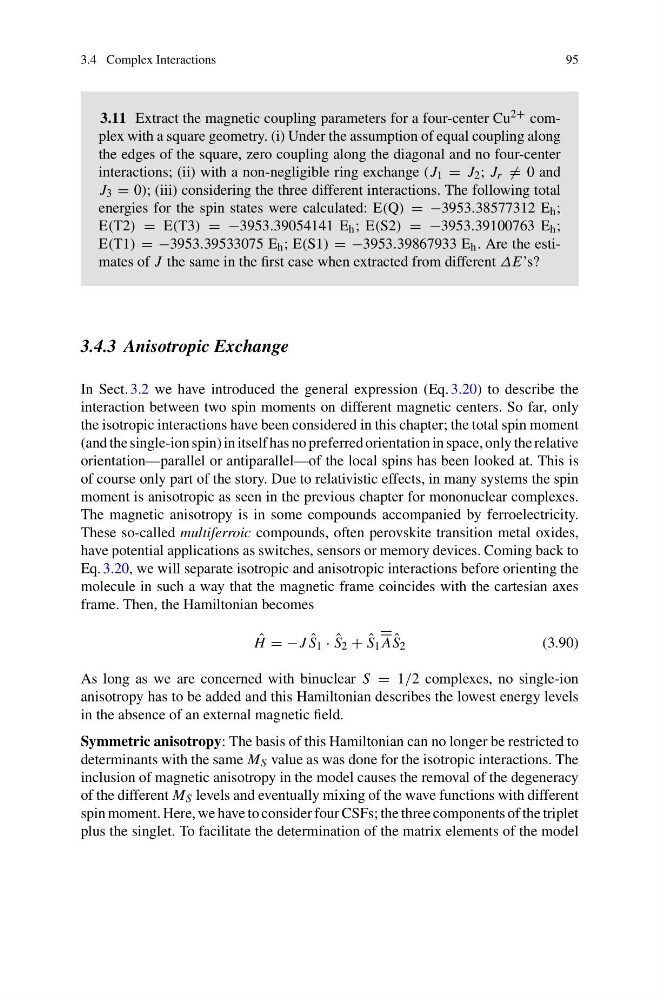
ˆ
H =−J ˆ
S 1 · ˆ
S 2 + ˆ
S 1 A ˆ
S 2
(3.90)
As long as we are concerned with binuclear S = 1/2 complexes, no single-ion
anisotropy has to be added and this Hamiltonian describes the lowest energy levels
in the absence of an external magnetic field.
Symmetric anisotropy: The basis of this Hamiltonian can no longer be restricted to
determinants with the same M S value as was done for the isotropic interactions. The
inclusion of magnetic anisotropy in the model causes the removal of the degeneracy
of the different M S levels and eventually mixing of the wave functions with different
spin moment. Here, we have to consider four CSFs; the three components of the triplet
plus the singlet. To facilitate the determination of the matrix elements of the model
95
3.11 Extract the magnetic coupling parameters for a four-center Cu 2+ complex with a square geometry. (i) Under the assumption of equal coupling along
the edges of the square, zero coupling along the diagonal and no four-center
interactions; (ii) with a non-negligible ring exchange (J 1 = J 2 ; J r = 0 and
J 3 = 0); (iii) considering the three different interactions. The following total
energies for the spin states were calculated: E(Q) =− 3953.38577312 E h ;
E(T2) = E(T3) =− 3953.39054141 E h ;E (S2) =− 3953.39100763 E h ;
E(T1) =− 3953.39533075 E h ;E(S1) =− 3953.39867933 E h . Are the estimates of J the same in the first case when extracted from different ∆E’s?
3.4.3 Anisotropic Exchange
In Sect. 3.2 we have introduced the general expression (Eq. 3.20) to describe the
interaction between two spin moments on different magnetic centers. So far, only
the isotropic interactions have been considered in this chapter; the total spin moment
(and the single-ion spin) in itself has no preferred orientation in space, only the relative
orientation—parallel or antiparallel—of the local spins has been looked at. This is
of course only part of the story. Due to relativistic effects, in many systems the spin
moment is anisotropic as seen in the previous chapter for mononuclear complexes.
The magnetic anisotropy is in some compounds accompanied by ferroelectricity.
These so-called multiferroic compounds, often perovskite transition metal oxides,
have potential applications as switches, sensors or memory devices. Coming back to
Eq. 3.20, we will separate isotropic and anisotropic interactions before orienting the
molecule in such a way that the magnetic frame coincides with the cartesian axes
frame. Then, the Hamiltonian becomes
ˆ
H =−J ˆ
S 1 · ˆ
S 2 + ˆ
S 1 A ˆ
S 2
(3.90)
As long as we are concerned with binuclear S = 1/2 complexes, no single-ion
anisotropy has to be added and this Hamiltonian describes the lowest energy levels
in the absence of an external magnetic field.
Symmetric anisotropy: The basis of this Hamiltonian can no longer be restricted to
determinants with the same M S value as was done for the isotropic interactions. The
inclusion of magnetic anisotropy in the model causes the removal of the degeneracy
of the different M S levels and eventually mixing of the wave functions with different
spin moment. Here, we have to consider four CSFs; the three components of the triplet
plus the singlet. To facilitate the determination of the matrix elements of the model