

3.4 Complex Interactions
93
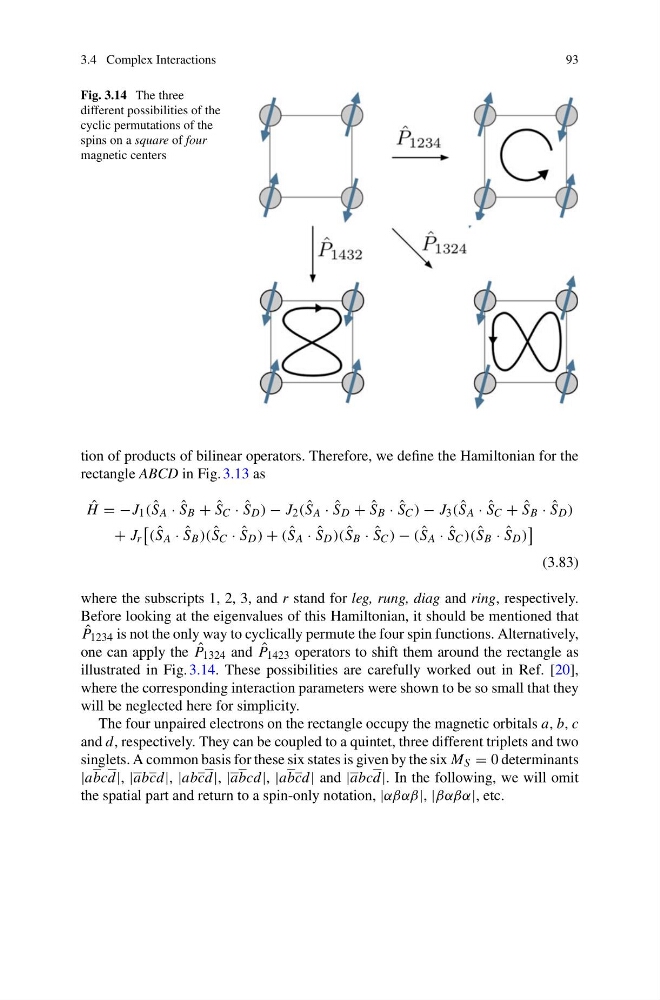
Fig. 3.14 The three
different possibilities of the
cyclic permutations of the
spins on a square of four
magnetic centers
tion of products of bilinear operators. Therefore, we define the Hamiltonian for the
rectangle ABCD in Fig. 3.13 as
ˆ
H =−J 1 ( ˆ
S A · ˆ
S B + ˆ
S C · ˆ
S D ) − J 2 ( ˆ
S A · ˆ
S D + ˆ
S B · ˆ
S C ) − J 3 ( ˆ
S A · ˆ
S C + ˆ
S B · ˆ
S D )
+ J r
( ˆ
S A · ˆ
S B )( ˆ
S C · ˆ
S D ) + ( ˆ
S A · ˆ
S D )( ˆ
S B · ˆ
S C ) − ( ˆ
S A · ˆ
S C )( ˆ
S B · ˆ
S D )
(3.83)
where the subscripts 1, 2, 3, and r stand for leg, rung, diag and ring, respectively.
Before looking at the eigenvalues of this Hamiltonian, it should be mentioned that
ˆ
P 1234 is not the only way to cyclically permute the four spin functions. Alternatively,
one can apply the ˆ
P 1324 and ˆ
P 1423 operators to shift them around the rectangle as
illustrated in Fig. 3.14. These possibilities are carefully worked out in Ref. [20],
where the corresponding interaction parameters were shown to be so small that they
will be neglected here for simplicity.
The four unpaired electrons on the rectangle occupy the magnetic orbitals a, b, c
and d, respectively. They can be coupled to a quintet, three different triplets and two
singlets. A common basis for these six states is given by the six M S = 0 determinants
|abcd|, |abcd|, |abcd|, |abcd|, |abcd| and |abcd|. In the following, we will omit
the spatial part and return to a spin-only notation, |αβαβ |, |βαβα|,etc.
93
Fig. 3.14 The three
different possibilities of the
cyclic permutations of the
spins on a square of four
magnetic centers
tion of products of bilinear operators. Therefore, we define the Hamiltonian for the
rectangle ABCD in Fig. 3.13 as
ˆ
H =−J 1 ( ˆ
S A · ˆ
S B + ˆ
S C · ˆ
S D ) − J 2 ( ˆ
S A · ˆ
S D + ˆ
S B · ˆ
S C ) − J 3 ( ˆ
S A · ˆ
S C + ˆ
S B · ˆ
S D )
+ J r
( ˆ
S A · ˆ
S B )( ˆ
S C · ˆ
S D ) + ( ˆ
S A · ˆ
S D )( ˆ
S B · ˆ
S C ) − ( ˆ
S A · ˆ
S C )( ˆ
S B · ˆ
S D )
(3.83)
where the subscripts 1, 2, 3, and r stand for leg, rung, diag and ring, respectively.
Before looking at the eigenvalues of this Hamiltonian, it should be mentioned that
ˆ
P 1234 is not the only way to cyclically permute the four spin functions. Alternatively,
one can apply the ˆ
P 1324 and ˆ
P 1423 operators to shift them around the rectangle as
illustrated in Fig. 3.14. These possibilities are carefully worked out in Ref. [20],
where the corresponding interaction parameters were shown to be so small that they
will be neglected here for simplicity.
The four unpaired electrons on the rectangle occupy the magnetic orbitals a, b, c
and d, respectively. They can be coupled to a quintet, three different triplets and two
singlets. A common basis for these six states is given by the six M S = 0 determinants
|abcd|, |abcd|, |abcd|, |abcd|, |abcd| and |abcd|. In the following, we will omit
the spatial part and return to a spin-only notation, |αβαβ |, |βαβα|,etc.