

88
3 Two (or More) Magnetic Centers
have set aside the spatial anisotropy in the interaction between two spin moments.
Furthermore we have assumed that the interaction can be described with a simple
vector product of linear operators and that more-than-two particle interactions are
irrelevant. In this section, we will discuss refinements of the standard Hamiltonian
and see how more complex interactions can be incorporated in the description of the
magnetic couplings.
3.4.1 Biquadratic Exchange
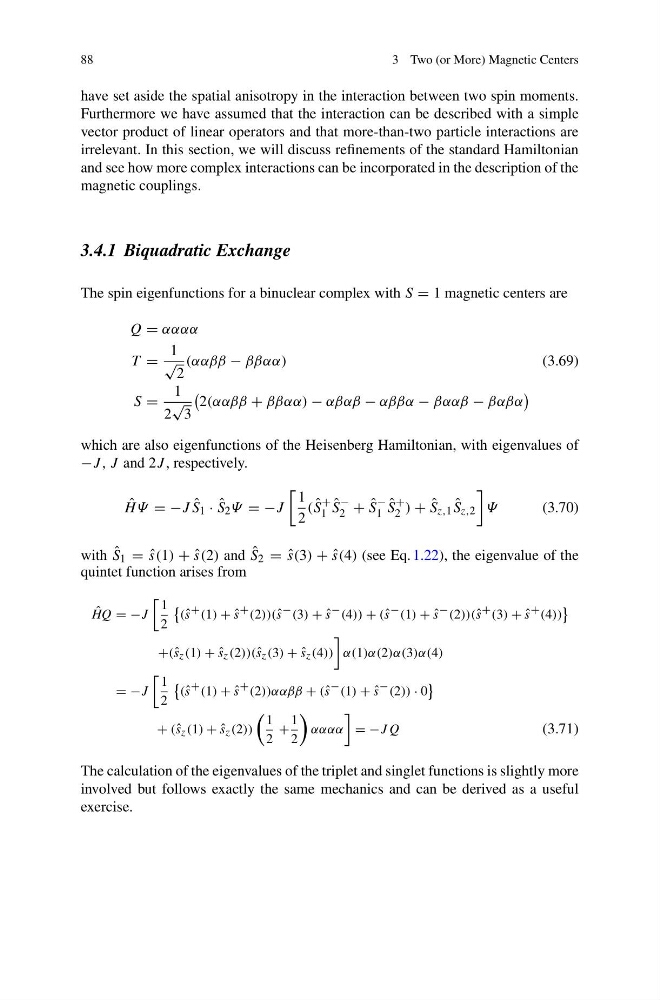
The spin eigenfunctions for a binuclear complex with S = 1 magnetic centers are
Q = αααα
T =
1
√
2
(ααββ − ββαα)
(3.69)
S =
1
2
√
3
2(ααββ + ββαα) − αβαβ − αββα − βααβ − βαβα
which are also eigenfunctions of the Heisenberg Hamiltonian, with eigenvalues of
−J , J and 2J , respectively.
ˆ
H Ψ =−J ˆ
S 1 · ˆ
S 2 Ψ =−J
1
2
( ˆ
S
+
1
ˆ
S
−
2 + ˆ
S
−
1
ˆ
S
+
2 ) + ˆ
S z,1 ˆ
S z,2
Ψ
(3.70)
with ˆ
S 1 =ˆ s(1) +ˆ s(2) and ˆ
S 2 =ˆ s(3) +ˆ s(4) (see Eq. 1.22), the eigenvalue of the
quintet function arises from
ˆ
HQ =−J
1
2
(ˆ s + (1) +ˆ s + (2))(ˆ s − (3) +ˆ s − (4)) + (ˆ s − (1) +ˆ s − (2))(ˆ s + (3) +ˆ s + (4))
+(ˆ s z (1) +ˆ s z (2))(ˆ s z (3) +ˆ s z (4))
α(1)α(2)α(3)α(4)
=−J
1
2
(ˆ s + (1) +ˆ s + (2))ααββ + (ˆ s − (1) +ˆ s − (2)) · 0
+ (ˆ s z (1) +ˆ s z (2))
1
2
+
1
2
αααα
=−JQ
(3.71)
The calculation of the eigenvalues of the triplet and singlet functions is slightly more
involved but follows exactly the same mechanics and can be derived as a useful
exercise.
3 Two (or More) Magnetic Centers
have set aside the spatial anisotropy in the interaction between two spin moments.
Furthermore we have assumed that the interaction can be described with a simple
vector product of linear operators and that more-than-two particle interactions are
irrelevant. In this section, we will discuss refinements of the standard Hamiltonian
and see how more complex interactions can be incorporated in the description of the
magnetic couplings.
3.4.1 Biquadratic Exchange
The spin eigenfunctions for a binuclear complex with S = 1 magnetic centers are
Q = αααα
T =
1
√
2
(ααββ − ββαα)
(3.69)
S =
1
2
√
3
2(ααββ + ββαα) − αβαβ − αββα − βααβ − βαβα
which are also eigenfunctions of the Heisenberg Hamiltonian, with eigenvalues of
−J , J and 2J , respectively.
ˆ
H Ψ =−J ˆ
S 1 · ˆ
S 2 Ψ =−J
1
2
( ˆ
S
+
1
ˆ
S
−
2 + ˆ
S
−
1
ˆ
S
+
2 ) + ˆ
S z,1 ˆ
S z,2
Ψ
(3.70)
with ˆ
S 1 =ˆ s(1) +ˆ s(2) and ˆ
S 2 =ˆ s(3) +ˆ s(4) (see Eq. 1.22), the eigenvalue of the
quintet function arises from
ˆ
HQ =−J
1
2
(ˆ s + (1) +ˆ s + (2))(ˆ s − (3) +ˆ s − (4)) + (ˆ s − (1) +ˆ s − (2))(ˆ s + (3) +ˆ s + (4))
+(ˆ s z (1) +ˆ s z (2))(ˆ s z (3) +ˆ s z (4))
α(1)α(2)α(3)α(4)
=−J
1
2
(ˆ s + (1) +ˆ s + (2))ααββ + (ˆ s − (1) +ˆ s − (2)) · 0
+ (ˆ s z (1) +ˆ s z (2))
1
2
+
1
2
αααα
=−JQ
(3.71)
The calculation of the eigenvalues of the triplet and singlet functions is slightly more
involved but follows exactly the same mechanics and can be derived as a useful
exercise.