

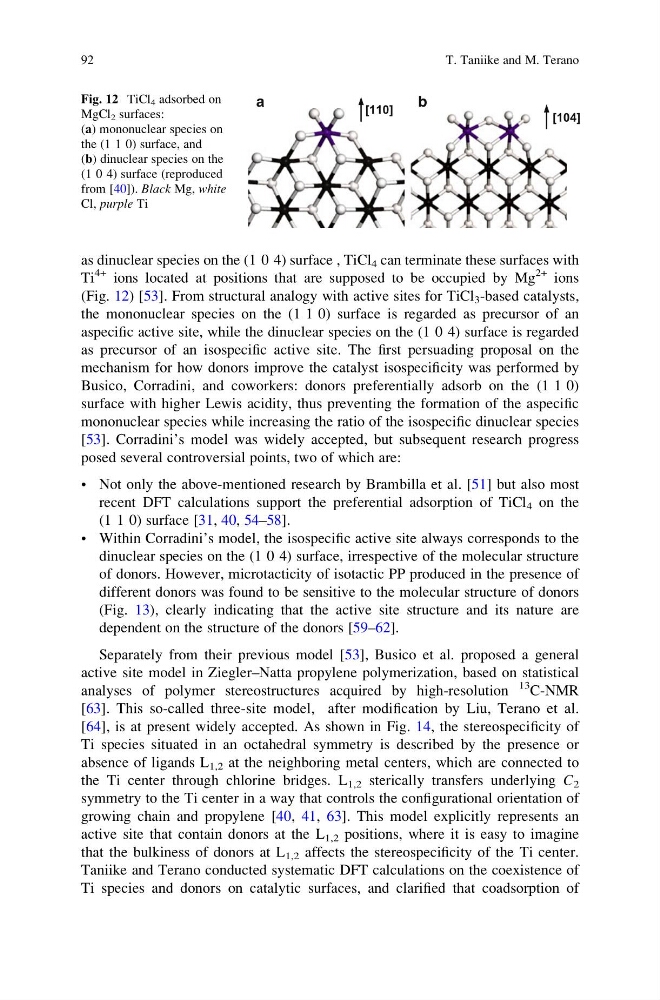
as dinuclear species on the (1 0 4) surface , TiCl 4 can terminate these surfaces with
Ti
4+ ions located at positions that are supposed to be occupied by Mg
2+ ions
(Fig. 12) [53]. From structural analogy with active sites for TiCl 3 -based catalysts,
the mononuclear species on the (1 1 0) surface is regarded as precursor of an
aspecific active site, while the dinuclear species on the (1 0 4) surface is regarded
as precursor of an isospecific active site. The first persuading proposal on the
mechanism for how donors improve the catalyst isospecificity was performed by
Busico, Corradini, and coworkers: donors preferentially adsorb on the (1 1 0)
surface with higher Lewis acidity, thus preventing the formation of the aspecific
mononuclear species while increasing the ratio of the isospecific dinuclear species
[53]. Corradini’s model was widely accepted, but subsequent research progress
posed several controversial points, two of which are:
• Not only the above-mentioned research by Brambilla et al. [51] but also most
recent DFT calculations support the preferential adsorption of TiCl 4 on the
(1 1 0) surface [31, 40, 54–58].
• Within Corradini’s model, the isospecific active site always corresponds to the
dinuclear species on the (1 0 4) surface, irrespective of the molecular structure
of donors. However, microtacticity of isotactic PP produced in the presence of
different donors was found to be sensitive to the molecular structure of donors
(Fig. 13), clearly indicating that the active site structure and its nature are
dependent on the structure of the donors [59–62].
Separately from their previous model [53], Busico et al. proposed a general
active site model in Ziegler–Natta propylene polymerization, based on statistical
analyses of polymer stereostructures acquired by high-resolution
13 C-NMR
[63]. This so-called three-site model, after modification by Liu, Terano et al.
[64], is at present widely accepted. As shown in Fig. 14, the stereospecificity of
Ti species situated in an octahedral symmetry is described by the presence or
absence of ligands L 1,2 at the neighboring metal centers, which are connected to
the Ti center through chlorine bridges. L 1,2 sterically transfers underlying C 2
symmetry to the Ti center in a way that controls the configurational orientation of
growing chain and propylene [40, 41, 63]. This model explicitly represents an
active site that contain donors at the L 1,2 positions, where it is easy to imagine
that the bulkiness of donors at L 1,2 affects the stereospecificity of the Ti center.
Taniike and Terano conducted systematic DFT calculations on the coexistence of
Ti species and donors on catalytic surfaces, and clarified that coadsorption of
a
b
[110]
[104]
Fig. 12 TiCl 4 adsorbed on
MgCl 2 surfaces:
(a) mononuclear species on
the (1 1 0) surface, and
(b) dinuclear species on the
(1 0 4) surface (reproduced
from [40]). Black Mg, white
Cl, purple Ti
92
T. Taniike and M. Terano
Ti
4+ ions located at positions that are supposed to be occupied by Mg
2+ ions
(Fig. 12) [53]. From structural analogy with active sites for TiCl 3 -based catalysts,
the mononuclear species on the (1 1 0) surface is regarded as precursor of an
aspecific active site, while the dinuclear species on the (1 0 4) surface is regarded
as precursor of an isospecific active site. The first persuading proposal on the
mechanism for how donors improve the catalyst isospecificity was performed by
Busico, Corradini, and coworkers: donors preferentially adsorb on the (1 1 0)
surface with higher Lewis acidity, thus preventing the formation of the aspecific
mononuclear species while increasing the ratio of the isospecific dinuclear species
[53]. Corradini’s model was widely accepted, but subsequent research progress
posed several controversial points, two of which are:
• Not only the above-mentioned research by Brambilla et al. [51] but also most
recent DFT calculations support the preferential adsorption of TiCl 4 on the
(1 1 0) surface [31, 40, 54–58].
• Within Corradini’s model, the isospecific active site always corresponds to the
dinuclear species on the (1 0 4) surface, irrespective of the molecular structure
of donors. However, microtacticity of isotactic PP produced in the presence of
different donors was found to be sensitive to the molecular structure of donors
(Fig. 13), clearly indicating that the active site structure and its nature are
dependent on the structure of the donors [59–62].
Separately from their previous model [53], Busico et al. proposed a general
active site model in Ziegler–Natta propylene polymerization, based on statistical
analyses of polymer stereostructures acquired by high-resolution
13 C-NMR
[63]. This so-called three-site model, after modification by Liu, Terano et al.
[64], is at present widely accepted. As shown in Fig. 14, the stereospecificity of
Ti species situated in an octahedral symmetry is described by the presence or
absence of ligands L 1,2 at the neighboring metal centers, which are connected to
the Ti center through chlorine bridges. L 1,2 sterically transfers underlying C 2
symmetry to the Ti center in a way that controls the configurational orientation of
growing chain and propylene [40, 41, 63]. This model explicitly represents an
active site that contain donors at the L 1,2 positions, where it is easy to imagine
that the bulkiness of donors at L 1,2 affects the stereospecificity of the Ti center.
Taniike and Terano conducted systematic DFT calculations on the coexistence of
Ti species and donors on catalytic surfaces, and clarified that coadsorption of
a
b
[110]
[104]
Fig. 12 TiCl 4 adsorbed on
MgCl 2 surfaces:
(a) mononuclear species on
the (1 1 0) surface, and
(b) dinuclear species on the
(1 0 4) surface (reproduced
from [40]). Black Mg, white
Cl, purple Ti
92
T. Taniike and M. Terano