

distribution of PP produced by a 1,3-diether-containing catalyst. The number of
adsorption modes for one donor may be important for the molecular weight
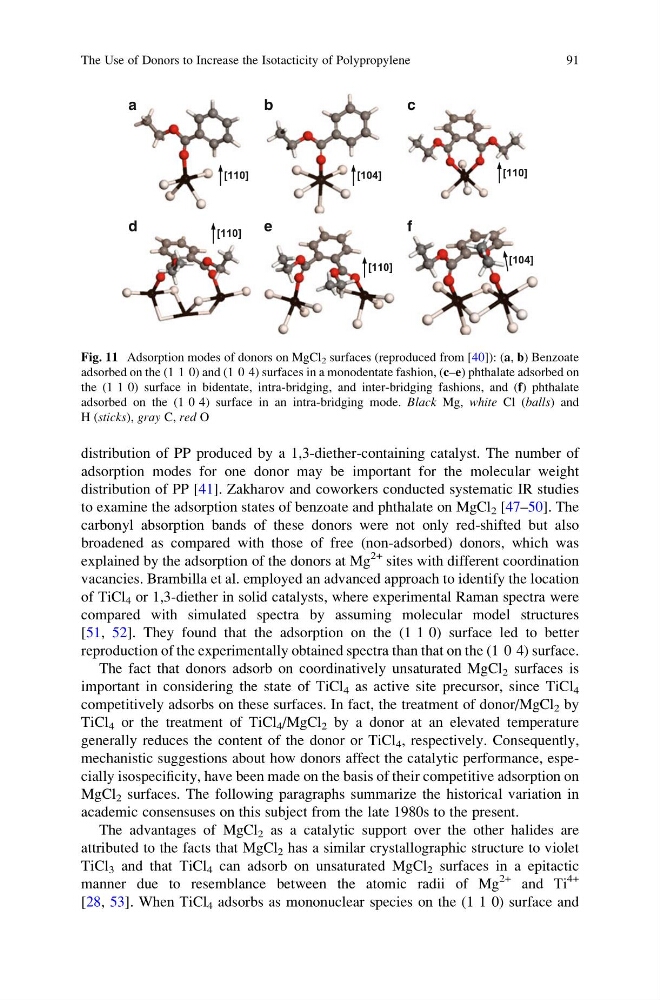
distribution of PP [41]. Zakharov and coworkers conducted systematic IR studies
to examine the adsorption states of benzoate and phthalate on MgCl 2 [47–50]. The
carbonyl absorption bands of these donors were not only red-shifted but also
broadened as compared with those of free (non-adsorbed) donors, which was
explained by the adsorption of the donors at Mg
2+ sites with different coordination
vacancies. Brambilla et al. employed an advanced approach to identify the location
of TiCl 4 or 1,3-diether in solid catalysts, where experimental Raman spectra were
compared with simulated spectra by assuming molecular model structures
[51, 52]. They found that the adsorption on the (1 1 0) surface led to better
reproduction of the experimentally obtained spectra than that on the (1 0 4) surface.
The fact that donors adsorb on coordinatively unsaturated MgCl 2 surfaces is
important in considering the state of TiCl 4 as active site precursor, since TiCl 4
competitively adsorbs on these surfaces. In fact, the treatment of donor/MgCl 2 by
TiCl 4 or the treatment of TiCl 4 /MgCl 2 by a donor at an elevated temperature
generally reduces the content of the donor or TiCl 4 , respectively. Consequently,
mechanistic suggestions about how donors affect the catalytic performance, especially isospecificity, have been made on the basis of their competitive adsorption on
MgCl 2 surfaces. The following paragraphs summarize the historical variation in
academic consensuses on this subject from the late 1980s to the present.
The advantages of MgCl 2 as a catalytic support over the other halides are
attributed to the facts that MgCl 2 has a similar crystallographic structure to violet
TiCl 3 and that TiCl 4 can adsorb on unsaturated MgCl 2 surfaces in a epitactic
manner due to resemblance between the atomic radii of Mg
2+ and Ti
4+
[28, 53]. When TiCl 4 adsorbs as mononuclear species on the (1 1 0) surface and
a
b
[110]
c
d
e
f
[104]
[104]
[110]
[110]
[110]
Fig. 11 Adsorption modes of donors on MgCl 2 surfaces (reproduced from [40]): (a, b) Benzoate
adsorbed on the (1 1 0) and (1 0 4) surfaces in a monodentate fashion, (c–e) phthalate adsorbed on
the (1 1 0) surface in bidentate, intra-bridging, and inter-bridging fashions, and (f) phthalate
adsorbed on the (1 0 4) surface in an intra-bridging mode. Black Mg, white Cl (balls) and
H (sticks), gray C, red O
The Use of Donors to Increase the Isotacticity of Polypropylene
91
adsorption modes for one donor may be important for the molecular weight
distribution of PP [41]. Zakharov and coworkers conducted systematic IR studies
to examine the adsorption states of benzoate and phthalate on MgCl 2 [47–50]. The
carbonyl absorption bands of these donors were not only red-shifted but also
broadened as compared with those of free (non-adsorbed) donors, which was
explained by the adsorption of the donors at Mg
2+ sites with different coordination
vacancies. Brambilla et al. employed an advanced approach to identify the location
of TiCl 4 or 1,3-diether in solid catalysts, where experimental Raman spectra were
compared with simulated spectra by assuming molecular model structures
[51, 52]. They found that the adsorption on the (1 1 0) surface led to better
reproduction of the experimentally obtained spectra than that on the (1 0 4) surface.
The fact that donors adsorb on coordinatively unsaturated MgCl 2 surfaces is
important in considering the state of TiCl 4 as active site precursor, since TiCl 4
competitively adsorbs on these surfaces. In fact, the treatment of donor/MgCl 2 by
TiCl 4 or the treatment of TiCl 4 /MgCl 2 by a donor at an elevated temperature
generally reduces the content of the donor or TiCl 4 , respectively. Consequently,
mechanistic suggestions about how donors affect the catalytic performance, especially isospecificity, have been made on the basis of their competitive adsorption on
MgCl 2 surfaces. The following paragraphs summarize the historical variation in
academic consensuses on this subject from the late 1980s to the present.
The advantages of MgCl 2 as a catalytic support over the other halides are
attributed to the facts that MgCl 2 has a similar crystallographic structure to violet
TiCl 3 and that TiCl 4 can adsorb on unsaturated MgCl 2 surfaces in a epitactic
manner due to resemblance between the atomic radii of Mg
2+ and Ti
4+
[28, 53]. When TiCl 4 adsorbs as mononuclear species on the (1 1 0) surface and
a
b
[110]
c
d
e
f
[104]
[104]
[110]
[110]
[110]
Fig. 11 Adsorption modes of donors on MgCl 2 surfaces (reproduced from [40]): (a, b) Benzoate
adsorbed on the (1 1 0) and (1 0 4) surfaces in a monodentate fashion, (c–e) phthalate adsorbed on
the (1 1 0) surface in bidentate, intra-bridging, and inter-bridging fashions, and (f) phthalate
adsorbed on the (1 0 4) surface in an intra-bridging mode. Black Mg, white Cl (balls) and
H (sticks), gray C, red O
The Use of Donors to Increase the Isotacticity of Polypropylene
91