

high-resolution transmission electron microscope (TEM) that lateral surfaces of
mechanically activated MgCl 2 are dominantly composed of the (1 1 0) and (1 0 4)
planes (Fig. 9) [42]. Andoni et al. reported preferential growth of MgCl 2 crystal
along the (1 1 0) direction in the presence of 1,3-diether, while the growth occurred
along both the (1 1 0) and (1 0 4) directions in the presence of DBP (Fig. 10)
[43]. Recent DFT calculations by Credendino, Cavallo et al. pointed out that the
equilibrium crystallographic morphology of MgCl 2 became completely different in
the presence of a donor, where the (1 1 0) termination prevailed over the (1 0 4)
termination in the presence of ether adsorbates [44].
Since donors bind to and stabilize undercoordinated Mg
2+ ions during the
formation of solid catalysts, their adsorption behaviors on MgCl 2 surfaces have
been extensively studied, mainly based on IR spectroscopy and quantum chemical
calculations. The adsorption structures of representative donors are summarized in
Fig. 11 [40, 41]. In general, monoester-type donors for the third generation adsorb
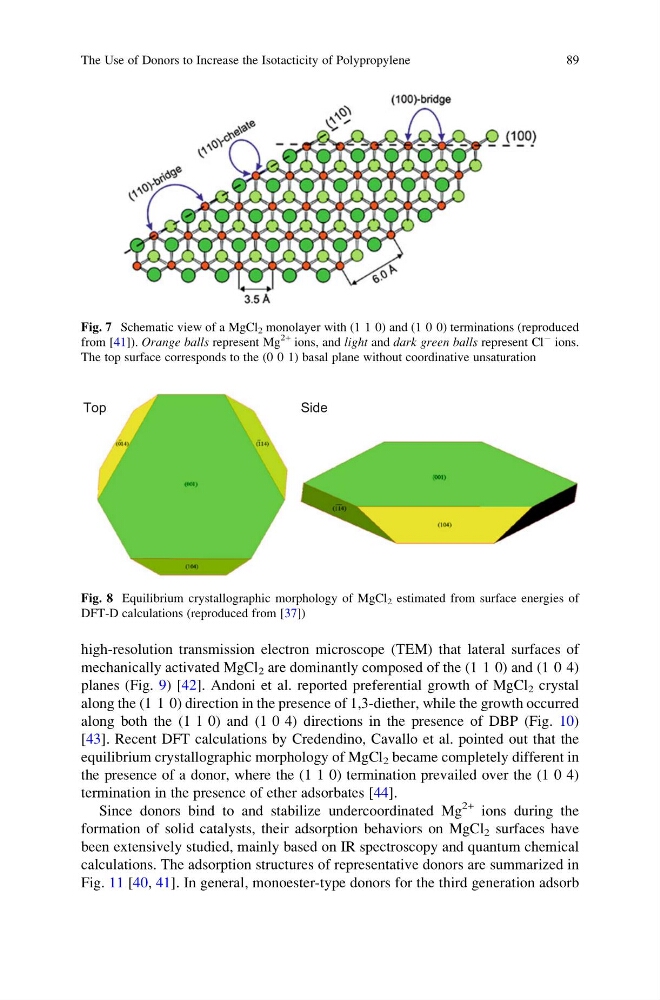
Fig. 7 Schematic view of a MgCl 2 monolayer with (1 1 0) and (1 0 0) terminations (reproduced
from [41]). Orange balls represent Mg
2+ ions, and light and dark green balls represent Cl
À ions.
The top surface corresponds to the (0 0 1) basal plane without coordinative unsaturation
Top
Side
Fig. 8 Equilibrium crystallographic morphology of MgCl 2 estimated from surface energies of
DFT-D calculations (reproduced from [37])
The Use of Donors to Increase the Isotacticity of Polypropylene
89
mechanically activated MgCl 2 are dominantly composed of the (1 1 0) and (1 0 4)
planes (Fig. 9) [42]. Andoni et al. reported preferential growth of MgCl 2 crystal
along the (1 1 0) direction in the presence of 1,3-diether, while the growth occurred
along both the (1 1 0) and (1 0 4) directions in the presence of DBP (Fig. 10)
[43]. Recent DFT calculations by Credendino, Cavallo et al. pointed out that the
equilibrium crystallographic morphology of MgCl 2 became completely different in
the presence of a donor, where the (1 1 0) termination prevailed over the (1 0 4)
termination in the presence of ether adsorbates [44].
Since donors bind to and stabilize undercoordinated Mg
2+ ions during the
formation of solid catalysts, their adsorption behaviors on MgCl 2 surfaces have
been extensively studied, mainly based on IR spectroscopy and quantum chemical
calculations. The adsorption structures of representative donors are summarized in
Fig. 11 [40, 41]. In general, monoester-type donors for the third generation adsorb
Fig. 7 Schematic view of a MgCl 2 monolayer with (1 1 0) and (1 0 0) terminations (reproduced
from [41]). Orange balls represent Mg
2+ ions, and light and dark green balls represent Cl
À ions.
The top surface corresponds to the (0 0 1) basal plane without coordinative unsaturation
Top
Side
Fig. 8 Equilibrium crystallographic morphology of MgCl 2 estimated from surface energies of
DFT-D calculations (reproduced from [37])
The Use of Donors to Increase the Isotacticity of Polypropylene
89