

The most stable surface of MgCl 2 is the (0 0 1) basal plane, which is obtained by
cleaving the MgCl 2 tri-layer stacking. The (0 0 1) plane is coordinatively saturated
[37] and therefore inactive to the adsorption of TiCl 4 and donors [38, 39], i.e., it is
catalytically irrelevant. Catalytically relevant surfaces are low-index planes that
expose unsaturated Mg
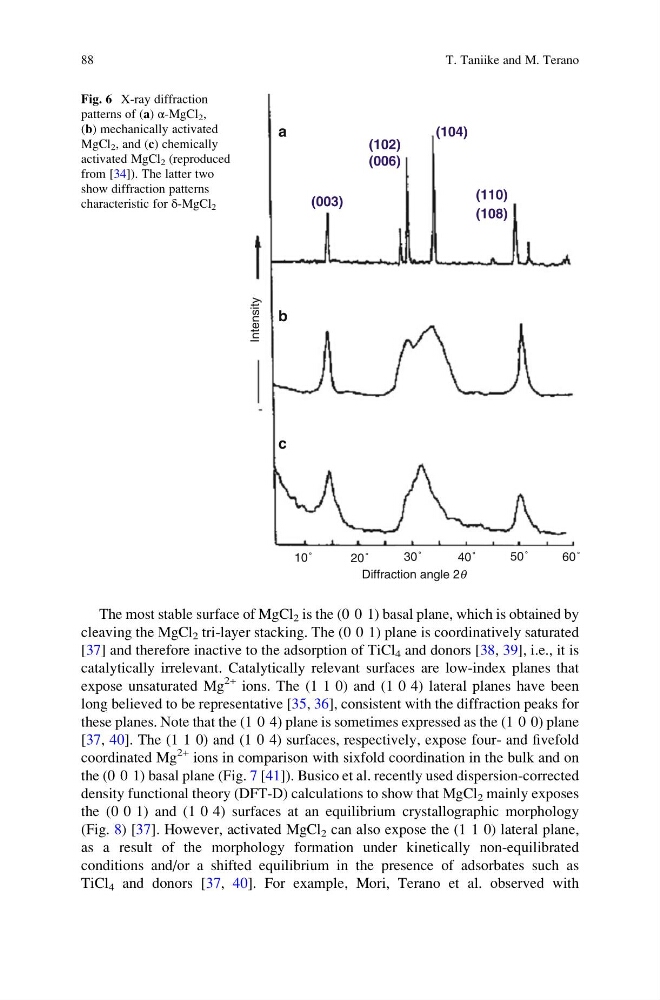
2+ ions. The (1 1 0) and (1 0 4) lateral planes have been
long believed to be representative [35, 36], consistent with the diffraction peaks for
these planes. Note that the (1 0 4) plane is sometimes expressed as the (1 0 0) plane
[37, 40]. The (1 1 0) and (1 0 4) surfaces, respectively, expose four- and fivefold
coordinated Mg
2+ ions in comparison with sixfold coordination in the bulk and on
the (0 0 1) basal plane (Fig. 7 [41]). Busico et al. recently used dispersion-corrected
density functional theory (DFT-D) calculations to show that MgCl 2 mainly exposes
the (0 0 1) and (1 0 4) surfaces at an equilibrium crystallographic morphology
(Fig. 8) [37]. However, activated MgCl 2 can also expose the (1 1 0) lateral plane,
as a result of the morphology formation under kinetically non-equilibrated
conditions and/or a shifted equilibrium in the presence of adsorbates such as
TiCl 4 and donors [37, 40]. For example, Mori, Terano et al. observed with
(003)
(102)
(006)
(104)
(110)
(108)
10˚
20˚
30˚
40˚
50˚
60˚
Intensity
Diffraction angle 2q
a
b
c
Fig. 6 X-ray diffraction
patterns of (a) α-MgCl 2 ,
(b) mechanically activated
MgCl 2 , and (c) chemically
activated MgCl 2 (reproduced
from [34]). The latter two
show diffraction patterns
characteristic for δ-MgCl 2
88
T. Taniike and M. Terano
cleaving the MgCl 2 tri-layer stacking. The (0 0 1) plane is coordinatively saturated
[37] and therefore inactive to the adsorption of TiCl 4 and donors [38, 39], i.e., it is
catalytically irrelevant. Catalytically relevant surfaces are low-index planes that
expose unsaturated Mg
2+ ions. The (1 1 0) and (1 0 4) lateral planes have been
long believed to be representative [35, 36], consistent with the diffraction peaks for
these planes. Note that the (1 0 4) plane is sometimes expressed as the (1 0 0) plane
[37, 40]. The (1 1 0) and (1 0 4) surfaces, respectively, expose four- and fivefold
coordinated Mg
2+ ions in comparison with sixfold coordination in the bulk and on
the (0 0 1) basal plane (Fig. 7 [41]). Busico et al. recently used dispersion-corrected
density functional theory (DFT-D) calculations to show that MgCl 2 mainly exposes
the (0 0 1) and (1 0 4) surfaces at an equilibrium crystallographic morphology
(Fig. 8) [37]. However, activated MgCl 2 can also expose the (1 1 0) lateral plane,
as a result of the morphology formation under kinetically non-equilibrated
conditions and/or a shifted equilibrium in the presence of adsorbates such as
TiCl 4 and donors [37, 40]. For example, Mori, Terano et al. observed with
(003)
(102)
(006)
(104)
(110)
(108)
10˚
20˚
30˚
40˚
50˚
60˚
Intensity
Diffraction angle 2q
a
b
c
Fig. 6 X-ray diffraction
patterns of (a) α-MgCl 2 ,
(b) mechanically activated
MgCl 2 , and (c) chemically
activated MgCl 2 (reproduced
from [34]). The latter two
show diffraction patterns
characteristic for δ-MgCl 2
88
T. Taniike and M. Terano