

the molecular weight distribution of PP, an odor problem, and so on. However,
heteroatom-containing donors are doubtless promising in order to facilitate unique
properties.
Though the fifth generation catalysts achieved almost two times higher activity
than the fourth generation catalysts, their application is limited to some special
grades. This is mainly because of the lower isospecificity as well as the narrower
molecular weight range, which is disadvantageous in terms of balanced solid
stiffness and melt flowability of the resultant PP. Consequently, the decade after
the late 1990s was devoted to the finding of new donor systems that facilitated not
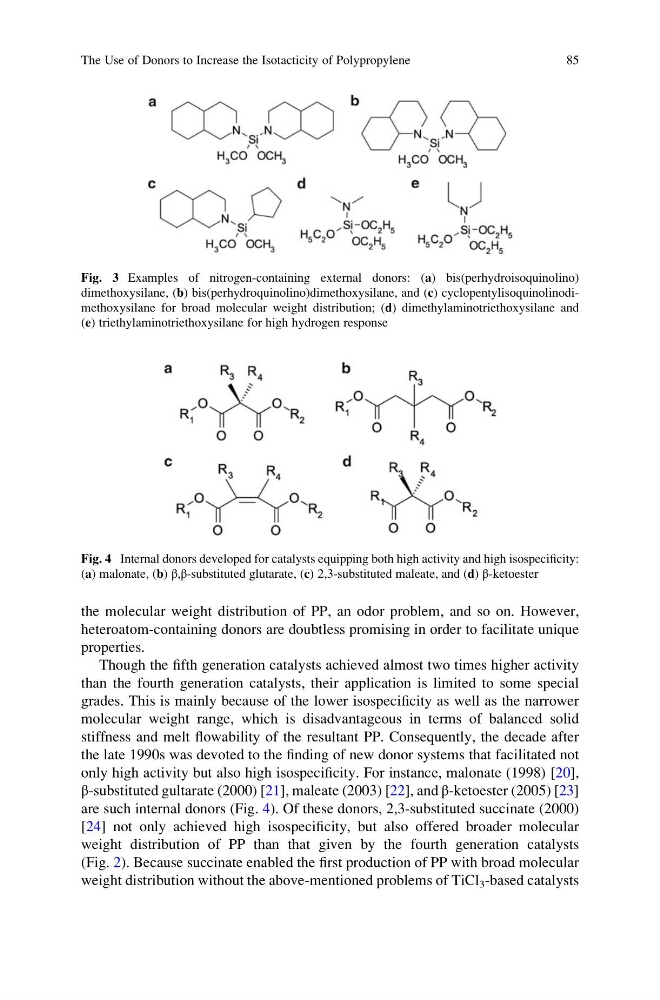
only high activity but also high isospecificity. For instance, malonate (1998) [20],
β-substituted gultarate (2000) [21], maleate (2003) [22], and β-ketoester (2005) [23]
are such internal donors (Fig. 4). Of these donors, 2,3-substituted succinate (2000)
[24] not only achieved high isospecificity, but also offered broader molecular
weight distribution of PP than that given by the fourth generation catalysts
(Fig. 2). Because succinate enabled the first production of PP with broad molecular
weight distribution without the above-mentioned problems of TiCl 3 -based catalysts
Fig. 4 Internal donors developed for catalysts equipping both high activity and high isospecificity:
(a) malonate, (b) β,β-substituted glutarate, (c) 2,3-substituted maleate, and (d) β-ketoester
Fig. 3 Examples of nitrogen-containing external donors: (a) bis(perhydroisoquinolino)
dimethoxysilane, (b) bis(perhydroquinolino)dimethoxysilane, and (c) cyclopentylisoquinolinodimethoxysilane for broad molecular weight distribution; (d) dimethylaminotriethoxysilane and
(e) triethylaminotriethoxysilane for high hydrogen response
The Use of Donors to Increase the Isotacticity of Polypropylene
85
heteroatom-containing donors are doubtless promising in order to facilitate unique
properties.
Though the fifth generation catalysts achieved almost two times higher activity
than the fourth generation catalysts, their application is limited to some special
grades. This is mainly because of the lower isospecificity as well as the narrower
molecular weight range, which is disadvantageous in terms of balanced solid
stiffness and melt flowability of the resultant PP. Consequently, the decade after
the late 1990s was devoted to the finding of new donor systems that facilitated not
only high activity but also high isospecificity. For instance, malonate (1998) [20],
β-substituted gultarate (2000) [21], maleate (2003) [22], and β-ketoester (2005) [23]
are such internal donors (Fig. 4). Of these donors, 2,3-substituted succinate (2000)
[24] not only achieved high isospecificity, but also offered broader molecular
weight distribution of PP than that given by the fourth generation catalysts
(Fig. 2). Because succinate enabled the first production of PP with broad molecular
weight distribution without the above-mentioned problems of TiCl 3 -based catalysts
Fig. 4 Internal donors developed for catalysts equipping both high activity and high isospecificity:
(a) malonate, (b) β,β-substituted glutarate, (c) 2,3-substituted maleate, and (d) β-ketoester
Fig. 3 Examples of nitrogen-containing external donors: (a) bis(perhydroisoquinolino)
dimethoxysilane, (b) bis(perhydroquinolino)dimethoxysilane, and (c) cyclopentylisoquinolinodimethoxysilane for broad molecular weight distribution; (d) dimethylaminotriethoxysilane and
(e) triethylaminotriethoxysilane for high hydrogen response
The Use of Donors to Increase the Isotacticity of Polypropylene
85