

comprises TiCl 4 /MgCl 2 /phthalate and AlEt 3 /alkoxysilane, and has been widely
employed for the industrial production of polypropylene (PP) since its discovery.
From the late 1980s to 1990s, a series of 1,3-diether compounds were proposed
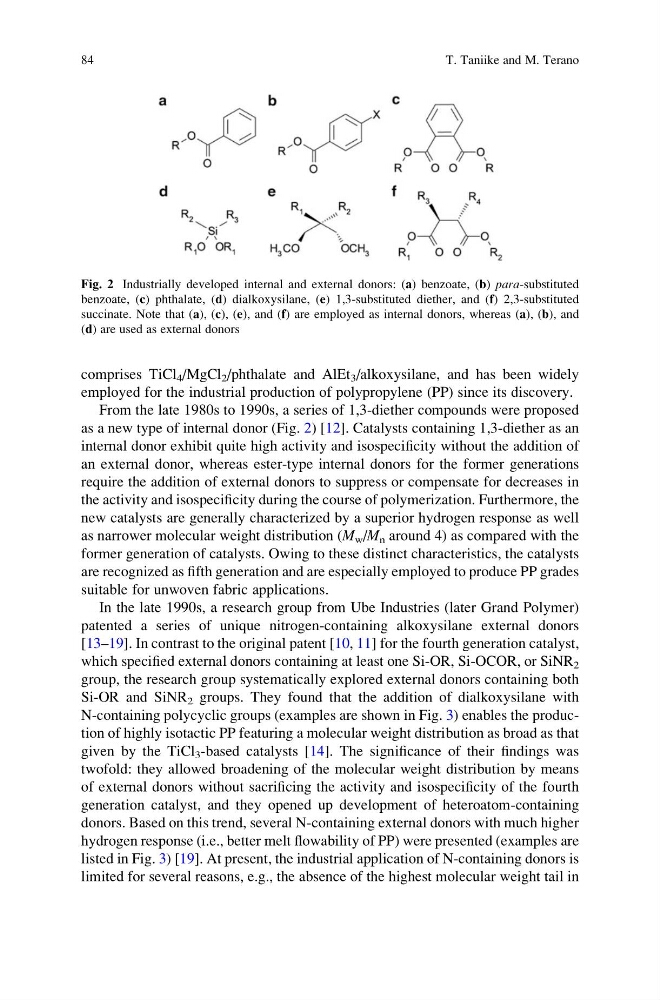
as a new type of internal donor (Fig. 2) [12]. Catalysts containing 1,3-diether as an
internal donor exhibit quite high activity and isospecificity without the addition of
an external donor, whereas ester-type internal donors for the former generations
require the addition of external donors to suppress or compensate for decreases in
the activity and isospecificity during the course of polymerization. Furthermore, the
new catalysts are generally characterized by a superior hydrogen response as well
as narrower molecular weight distribution (M w /M n around 4) as compared with the
former generation of catalysts. Owing to these distinct characteristics, the catalysts
are recognized as fifth generation and are especially employed to produce PP grades
suitable for unwoven fabric applications.
In the late 1990s, a research group from Ube Industries (later Grand Polymer)
patented a series of unique nitrogen-containing alkoxysilane external donors
[13–19]. In contrast to the original patent [10, 11] for the fourth generation catalyst,
which specified external donors containing at least one Si-OR, Si-OCOR, or SiNR 2
group, the research group systematically explored external donors containing both
Si-OR and SiNR 2 groups. They found that the addition of dialkoxysilane with
N-containing polycyclic groups (examples are shown in Fig. 3) enables the production of highly isotactic PP featuring a molecular weight distribution as broad as that
given by the TiCl 3 -based catalysts [14]. The significance of their findings was
twofold: they allowed broadening of the molecular weight distribution by means
of external donors without sacrificing the activity and isospecificity of the fourth
generation catalyst, and they opened up development of heteroatom-containing
donors. Based on this trend, several N-containing external donors with much higher
hydrogen response (i.e., better melt flowability of PP) were presented (examples are
listed in Fig. 3) [19]. At present, the industrial application of N-containing donors is
limited for several reasons, e.g., the absence of the highest molecular weight tail in
Fig. 2 Industrially developed internal and external donors: (a) benzoate, (b) para-substituted
benzoate, (c) phthalate, (d) dialkoxysilane, (e) 1,3-substituted diether, and (f) 2,3-substituted
succinate. Note that (a), (c), (e), and (f) are employed as internal donors, whereas (a), (b), and
(d) are used as external donors
84
T. Taniike and M. Terano
employed for the industrial production of polypropylene (PP) since its discovery.
From the late 1980s to 1990s, a series of 1,3-diether compounds were proposed
as a new type of internal donor (Fig. 2) [12]. Catalysts containing 1,3-diether as an
internal donor exhibit quite high activity and isospecificity without the addition of
an external donor, whereas ester-type internal donors for the former generations
require the addition of external donors to suppress or compensate for decreases in
the activity and isospecificity during the course of polymerization. Furthermore, the
new catalysts are generally characterized by a superior hydrogen response as well
as narrower molecular weight distribution (M w /M n around 4) as compared with the
former generation of catalysts. Owing to these distinct characteristics, the catalysts
are recognized as fifth generation and are especially employed to produce PP grades
suitable for unwoven fabric applications.
In the late 1990s, a research group from Ube Industries (later Grand Polymer)
patented a series of unique nitrogen-containing alkoxysilane external donors
[13–19]. In contrast to the original patent [10, 11] for the fourth generation catalyst,
which specified external donors containing at least one Si-OR, Si-OCOR, or SiNR 2
group, the research group systematically explored external donors containing both
Si-OR and SiNR 2 groups. They found that the addition of dialkoxysilane with
N-containing polycyclic groups (examples are shown in Fig. 3) enables the production of highly isotactic PP featuring a molecular weight distribution as broad as that
given by the TiCl 3 -based catalysts [14]. The significance of their findings was
twofold: they allowed broadening of the molecular weight distribution by means
of external donors without sacrificing the activity and isospecificity of the fourth
generation catalyst, and they opened up development of heteroatom-containing
donors. Based on this trend, several N-containing external donors with much higher
hydrogen response (i.e., better melt flowability of PP) were presented (examples are
listed in Fig. 3) [19]. At present, the industrial application of N-containing donors is
limited for several reasons, e.g., the absence of the highest molecular weight tail in
Fig. 2 Industrially developed internal and external donors: (a) benzoate, (b) para-substituted
benzoate, (c) phthalate, (d) dialkoxysilane, (e) 1,3-substituted diether, and (f) 2,3-substituted
succinate. Note that (a), (c), (e), and (f) are employed as internal donors, whereas (a), (b), and
(d) are used as external donors
84
T. Taniike and M. Terano