

electron-donating ability. Usually, donors are classified into two types according to
their roles: internal donors contained in the solid component (TiCl 4 /MgCl 2 ) and
external donors, which are added together with alkylaluminum in order to prevent
the deterioration of the catalyst isospecificity during the course of polymerization.
It should be noted that the idea to add Lewis bases already existed for TiCl 3 -based
catalysts, where the addition of some Lewis bases during polymerization improved
the isotactic index (I.I.) by, at maximum, up to 10%. However, donors for MgCl 2 -
supported catalysts are totally different in terms of the dramatic improvements in
the isospecificity; it is not exaggerating to say that donors “endow” isospecificity to
MgCl 2 -supported catalysts. The third generation catalyst typically combines
ethylbenzoate (EB) as an internal donor with EB or para-substituted benzoate as
an external donor (Fig. 2). The third generation catalysts achieved propylene
polymerization activity of 100 times higher than the second generation (Table 1),
and high isospecificity (I.I. of 92–94%). However, the remaining 6–8% of poorly
isotactic fraction triggered further research, mainly focused on improvements in
catalyst preparation procedures as well as on finding a more efficient combination
of internal and external donors. The extraction process for poorly isotactic fraction
was finally eliminated in 1977 by use of a catalyst employing a new donor
combination. i.e., phthalic diester as an internal donor and alkoxysilane as an
external donor (Fig. 2) [10, 11]. This catalyst, termed a fourth generation catalyst,
Table 1 Propylene polymerization performance of Ziegler–Natta catalysts of different
generations
a
Generation
Pro-catalyst
External donor
Activity
(g-PP/mmol-Ti h atm)
I.I.
b
(%)
First
TiCl 3
–
ca. 4
90
Second
Solvay-type TiCl 3
–
ca. 30
95
Third
TiCl 4 /MgCl 2 /benzoate
Benzoate
ca. 1,000
92–94
Fourth
TiCl 4 /MgCl 2 /phthalate
Alkoxysilane
ca. 1,000–3,000
>98
Fifth
TiCl 4 /MgCl 2 /1,3-diether
Alkoxysilane
ca. 3,000–5,000
>98
a
Reproduced from [1]
b
Insoluble fraction in boiling heptane
0
10,000
20,000
30,000
40,000
50,000
60,000
70,000
80,000
2 0 0 3
2 0 0 4
2 0 0 5
2 0 0 6
2 0 0 7
2 0 0 8
2 0 0 9
2 0 1 0
2 0 1 1
2 0 1 2
2 0 1 3
2 0 1 4
2 0 1 5
2 0 1 6
Year
Annual production (x 1000 ton)
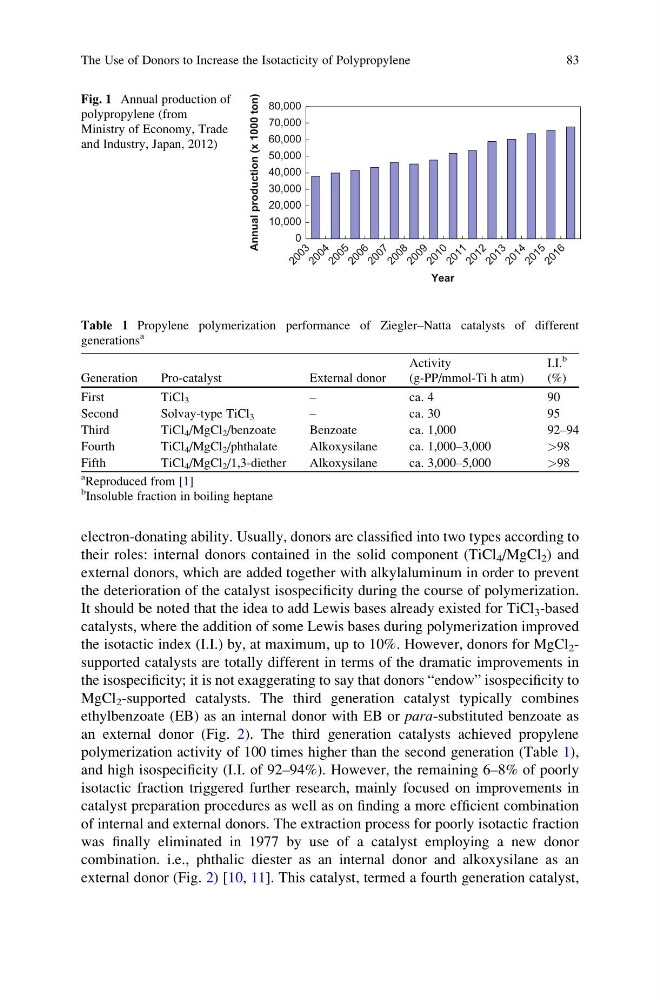
Fig. 1 Annual production of
polypropylene (from
Ministry of Economy, Trade
and Industry, Japan, 2012)
The Use of Donors to Increase the Isotacticity of Polypropylene
83
their roles: internal donors contained in the solid component (TiCl 4 /MgCl 2 ) and
external donors, which are added together with alkylaluminum in order to prevent
the deterioration of the catalyst isospecificity during the course of polymerization.
It should be noted that the idea to add Lewis bases already existed for TiCl 3 -based
catalysts, where the addition of some Lewis bases during polymerization improved
the isotactic index (I.I.) by, at maximum, up to 10%. However, donors for MgCl 2 -
supported catalysts are totally different in terms of the dramatic improvements in
the isospecificity; it is not exaggerating to say that donors “endow” isospecificity to
MgCl 2 -supported catalysts. The third generation catalyst typically combines
ethylbenzoate (EB) as an internal donor with EB or para-substituted benzoate as
an external donor (Fig. 2). The third generation catalysts achieved propylene
polymerization activity of 100 times higher than the second generation (Table 1),
and high isospecificity (I.I. of 92–94%). However, the remaining 6–8% of poorly
isotactic fraction triggered further research, mainly focused on improvements in
catalyst preparation procedures as well as on finding a more efficient combination
of internal and external donors. The extraction process for poorly isotactic fraction
was finally eliminated in 1977 by use of a catalyst employing a new donor
combination. i.e., phthalic diester as an internal donor and alkoxysilane as an
external donor (Fig. 2) [10, 11]. This catalyst, termed a fourth generation catalyst,
Table 1 Propylene polymerization performance of Ziegler–Natta catalysts of different
generations
a
Generation
Pro-catalyst
External donor
Activity
(g-PP/mmol-Ti h atm)
I.I.
b
(%)
First
TiCl 3
–
ca. 4
90
Second
Solvay-type TiCl 3
–
ca. 30
95
Third
TiCl 4 /MgCl 2 /benzoate
Benzoate
ca. 1,000
92–94
Fourth
TiCl 4 /MgCl 2 /phthalate
Alkoxysilane
ca. 1,000–3,000
>98
Fifth
TiCl 4 /MgCl 2 /1,3-diether
Alkoxysilane
ca. 3,000–5,000
>98
a
Reproduced from [1]
b
Insoluble fraction in boiling heptane
0
10,000
20,000
30,000
40,000
50,000
60,000
70,000
80,000
2 0 0 3
2 0 0 4
2 0 0 5
2 0 0 6
2 0 0 7
2 0 0 8
2 0 0 9
2 0 1 0
2 0 1 1
2 0 1 2
2 0 1 3
2 0 1 4
2 0 1 5
2 0 1 6
Year
Annual production (x 1000 ton)
Fig. 1 Annual production of
polypropylene (from
Ministry of Economy, Trade
and Industry, Japan, 2012)
The Use of Donors to Increase the Isotacticity of Polypropylene
83