

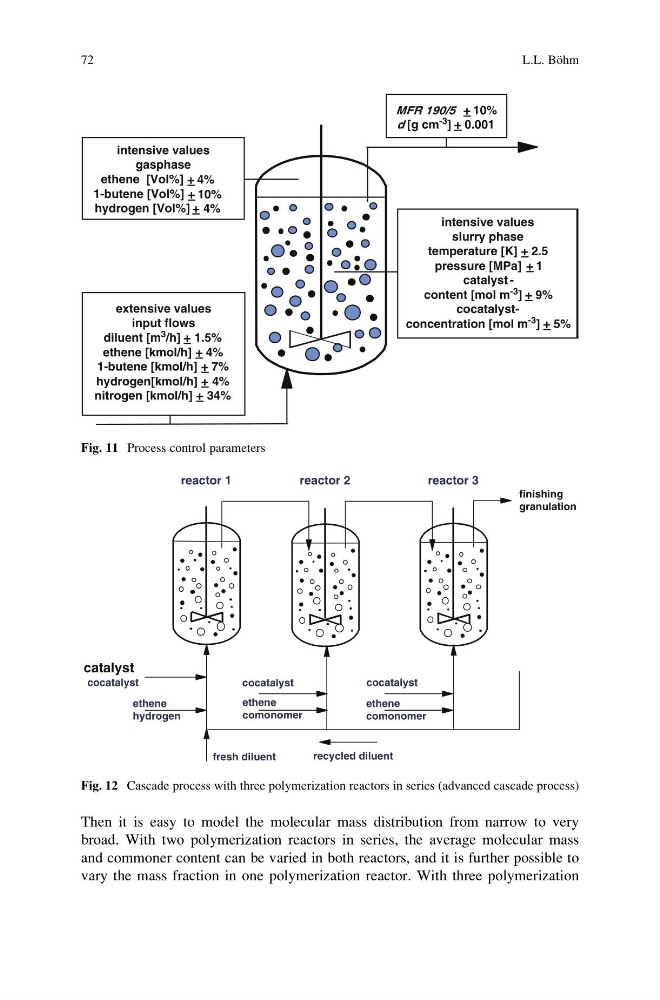
Then it is easy to model the molecular mass distribution from narrow to very
broad. With two polymerization reactors in series, the average molecular mass
and commoner content can be varied in both reactors, and it is further possible to
vary the mass fraction in one polymerization reactor. With three polymerization
reactor 1
reactor 2
reactor 3
recycled diluent
catalyst
cocatalyst
fresh diluent
ethene
hydrogen
cocatalyst
ethene
comonomer
cocatalyst
ethene
comonomer
finishing
granulation
Fig. 12 Cascade process with three polymerization reactors in series (advanced cascade process)
intensive values
gasphase
ethene [Vol%] + 4%
1-butene [Vol%] + 10%
hydrogen [Vol%] + 4%
MFR 190/5 + 10%
d [g cm
-3 ] + 0.001
intensive values
slurry phase
temperature [K] + 2.5
pressure [MPa] + 1
catalyst -
content [mol m -3 ] + 9%
cocatalystconcentration [mol m
-3 ] + 5%
extensive values
input flows
diluent [m
3 /h] + 1.5%
ethene [kmol/h] + 4%
1-butene [kmol/h] + 7%
hydrogen[kmol/h] + 4%
nitrogen [kmol/h] + 34%
Fig. 11 Process control parameters
72
L.L. Bo ¨hm
broad. With two polymerization reactors in series, the average molecular mass
and commoner content can be varied in both reactors, and it is further possible to
vary the mass fraction in one polymerization reactor. With three polymerization
reactor 1
reactor 2
reactor 3
recycled diluent
catalyst
cocatalyst
fresh diluent
ethene
hydrogen
cocatalyst
ethene
comonomer
cocatalyst
ethene
comonomer
finishing
granulation
Fig. 12 Cascade process with three polymerization reactors in series (advanced cascade process)
intensive values
gasphase
ethene [Vol%] + 4%
1-butene [Vol%] + 10%
hydrogen [Vol%] + 4%
MFR 190/5 + 10%
d [g cm
-3 ] + 0.001
intensive values
slurry phase
temperature [K] + 2.5
pressure [MPa] + 1
catalyst -
content [mol m -3 ] + 9%
cocatalystconcentration [mol m
-3 ] + 5%
extensive values
input flows
diluent [m
3 /h] + 1.5%
ethene [kmol/h] + 4%
1-butene [kmol/h] + 7%
hydrogen[kmol/h] + 4%
nitrogen [kmol/h] + 34%
Fig. 11 Process control parameters
72
L.L. Bo ¨hm