

mass distribution and the comonomer distribution in the final product can be varied
in an easy way. The process design of this cascaded process is shown in Fig. 12.
In this cascade process, the first polymerization reactor is operated under a high
hydrogen content to generate the low molecular mass fraction. This fraction contains
no or only a minor amount of comonomer. The high hydrogen content offers a
further advantage because hydrogen reduces the activity of the catalyst [26].
This helps to avoid overheating of the polymer particles with the fresh catalyst
introduced into this polymerization reactor. From this polymerization reactor,
the growing polymer particles pass into the second polymerization reactor to
generate a medium molecular mass fraction with a small amount of comonomer.
Then, the growing polymer particles enter the third reactor to form the very
high molecular mass fraction with a high amount of comonomer. This process
allows the molecular mass distribution to be shaped from narrow to broad, and
the comonomer distribution from homogeneous to heterogeneous. Operating one
reactor, only the average molecular mass and comonomer content can be varied.
The molecular mass distribution is given by the catalyst. For the cascaded process,
the molecular mass distribution as given by the catalyst should not be too broad.
160
180
200
220
240
c 1.g 1.g V g
in
in
.
200
400
600
800
1000
1200
0
0
2
4
6
8
0.940
0.942
0.944
0.946
0.950
[ kmol h
kmol h -1 ]
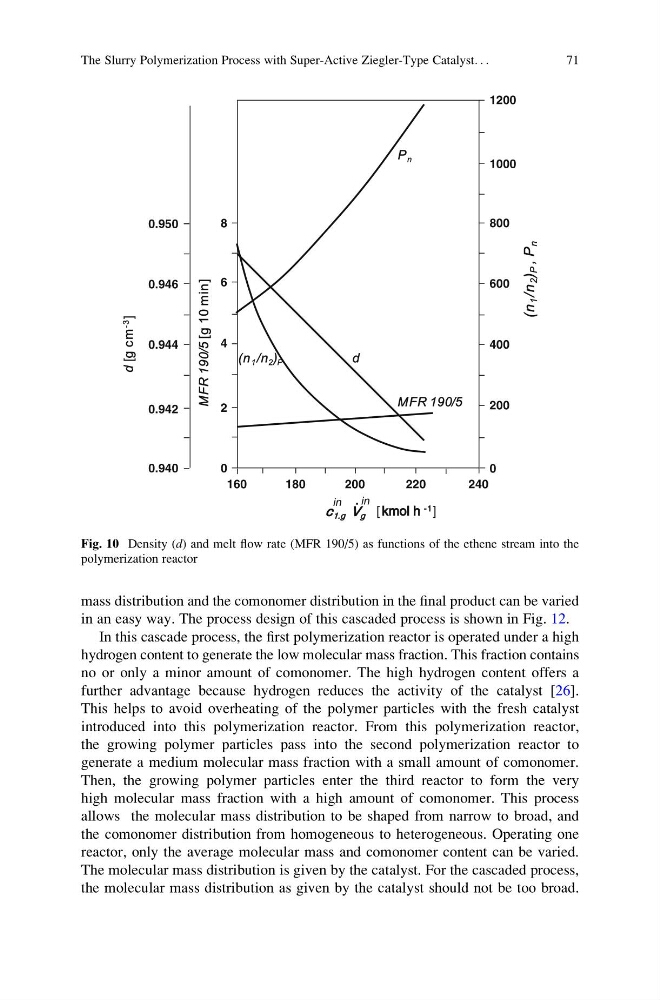
Fig. 10 Density (d) and melt flow rate (MFR 190/5) as functions of the ethene stream into the
polymerization reactor
The Slurry Polymerization Process with Super-Active Ziegler-Type Catalyst. . .
71
in an easy way. The process design of this cascaded process is shown in Fig. 12.
In this cascade process, the first polymerization reactor is operated under a high
hydrogen content to generate the low molecular mass fraction. This fraction contains
no or only a minor amount of comonomer. The high hydrogen content offers a
further advantage because hydrogen reduces the activity of the catalyst [26].
This helps to avoid overheating of the polymer particles with the fresh catalyst
introduced into this polymerization reactor. From this polymerization reactor,
the growing polymer particles pass into the second polymerization reactor to
generate a medium molecular mass fraction with a small amount of comonomer.
Then, the growing polymer particles enter the third reactor to form the very
high molecular mass fraction with a high amount of comonomer. This process
allows the molecular mass distribution to be shaped from narrow to broad, and
the comonomer distribution from homogeneous to heterogeneous. Operating one
reactor, only the average molecular mass and comonomer content can be varied.
The molecular mass distribution is given by the catalyst. For the cascaded process,
the molecular mass distribution as given by the catalyst should not be too broad.
160
180
200
220
240
c 1.g 1.g V g
in
in
.
200
400
600
800
1000
1200
0
0
2
4
6
8
0.940
0.942
0.944
0.946
0.950
[ kmol h
kmol h -1 ]
Fig. 10 Density (d) and melt flow rate (MFR 190/5) as functions of the ethene stream into the
polymerization reactor
The Slurry Polymerization Process with Super-Active Ziegler-Type Catalyst. . .
71