

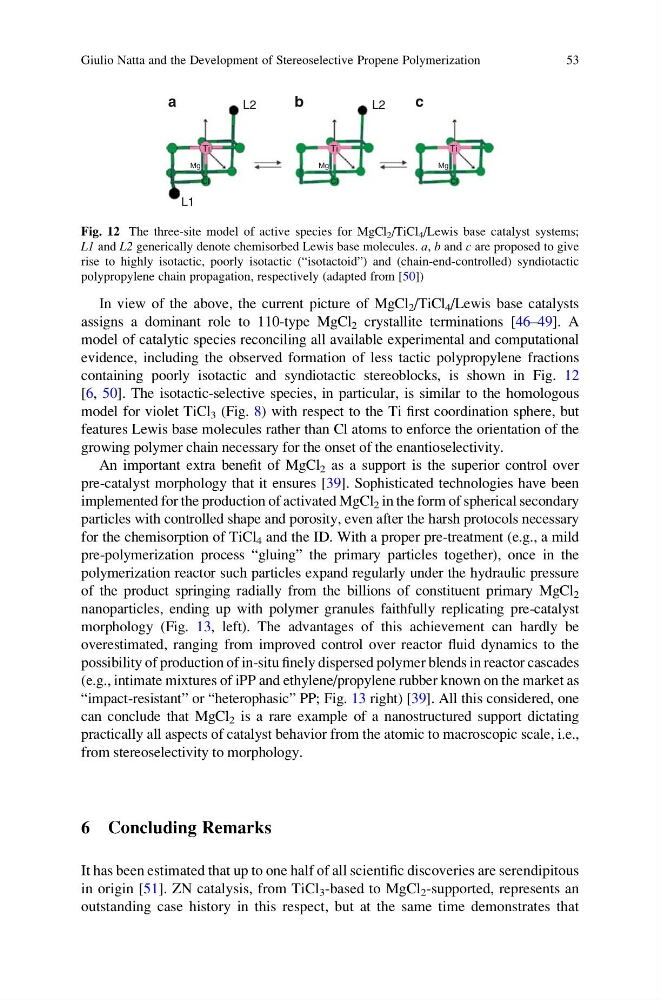
In view of the above, the current picture of MgCl 2 /TiCl 4 /Lewis base catalysts
assigns a dominant role to 110-type MgCl 2 crystallite terminations [46–49]. A
model of catalytic species reconciling all available experimental and computational
evidence, including the observed formation of less tactic polypropylene fractions
containing poorly isotactic and syndiotactic stereoblocks, is shown in Fig. 12
[6, 50]. The isotactic-selective species, in particular, is similar to the homologous
model for violet TiCl 3 (Fig. 8) with respect to the Ti first coordination sphere, but
features Lewis base molecules rather than Cl atoms to enforce the orientation of the
growing polymer chain necessary for the onset of the enantioselectivity.
An important extra benefit of MgCl 2 as a support is the superior control over
pre-catalyst morphology that it ensures [39]. Sophisticated technologies have been
implemented for the production of activated MgCl 2 in the form of spherical secondary
particles with controlled shape and porosity, even after the harsh protocols necessary
for the chemisorption of TiCl 4 and the ID. With a proper pre-treatment (e.g., a mild
pre-polymerization process “gluing” the primary particles together), once in the
polymerization reactor such particles expand regularly under the hydraulic pressure
of the product springing radially from the billions of constituent primary MgCl 2
nanoparticles, ending up with polymer granules faithfully replicating pre-catalyst
morphology (Fig. 13, left). The advantages of this achievement can hardly be
overestimated, ranging from improved control over reactor fluid dynamics to the
possibility of production of in-situ finely dispersed polymer blends in reactor cascades
(e.g., intimate mixtures of iPP and ethylene/propylene rubber known on the market as
“impact-resistant” or “heterophasic” PP; Fig. 13 right) [39]. All this considered, one
can conclude that MgCl 2 is a rare example of a nanostructured support dictating
practically all aspects of catalyst behavior from the atomic to macroscopic scale, i.e.,
from stereoselectivity to morphology.
6 Concluding Remarks
It has been estimated that up to one half of all scientific discoveries are serendipitous
in origin [51]. ZN catalysis, from TiCl 3 -based to MgCl 2 -supported, represents an
outstanding case history in this respect, but at the same time demonstrates that
L1
Ti
Ti
Ti
Mg
Mg
Mg
CI
CI
CI
L2
L2
a
b
c
Fig. 12 The three-site model of active species for MgCl 2 /TiCl 4 /Lewis base catalyst systems;
L1 and L2 generically denote chemisorbed Lewis base molecules. a, b and c are proposed to give
rise to highly isotactic, poorly isotactic (“isotactoid”) and (chain-end-controlled) syndiotactic
polypropylene chain propagation, respectively (adapted from [50])
Giulio Natta and the Development of Stereoselective Propene Polymerization
53
assigns a dominant role to 110-type MgCl 2 crystallite terminations [46–49]. A
model of catalytic species reconciling all available experimental and computational
evidence, including the observed formation of less tactic polypropylene fractions
containing poorly isotactic and syndiotactic stereoblocks, is shown in Fig. 12
[6, 50]. The isotactic-selective species, in particular, is similar to the homologous
model for violet TiCl 3 (Fig. 8) with respect to the Ti first coordination sphere, but
features Lewis base molecules rather than Cl atoms to enforce the orientation of the
growing polymer chain necessary for the onset of the enantioselectivity.
An important extra benefit of MgCl 2 as a support is the superior control over
pre-catalyst morphology that it ensures [39]. Sophisticated technologies have been
implemented for the production of activated MgCl 2 in the form of spherical secondary
particles with controlled shape and porosity, even after the harsh protocols necessary
for the chemisorption of TiCl 4 and the ID. With a proper pre-treatment (e.g., a mild
pre-polymerization process “gluing” the primary particles together), once in the
polymerization reactor such particles expand regularly under the hydraulic pressure
of the product springing radially from the billions of constituent primary MgCl 2
nanoparticles, ending up with polymer granules faithfully replicating pre-catalyst
morphology (Fig. 13, left). The advantages of this achievement can hardly be
overestimated, ranging from improved control over reactor fluid dynamics to the
possibility of production of in-situ finely dispersed polymer blends in reactor cascades
(e.g., intimate mixtures of iPP and ethylene/propylene rubber known on the market as
“impact-resistant” or “heterophasic” PP; Fig. 13 right) [39]. All this considered, one
can conclude that MgCl 2 is a rare example of a nanostructured support dictating
practically all aspects of catalyst behavior from the atomic to macroscopic scale, i.e.,
from stereoselectivity to morphology.
6 Concluding Remarks
It has been estimated that up to one half of all scientific discoveries are serendipitous
in origin [51]. ZN catalysis, from TiCl 3 -based to MgCl 2 -supported, represents an
outstanding case history in this respect, but at the same time demonstrates that
L1
Ti
Ti
Ti
Mg
Mg
Mg
CI
CI
CI
L2
L2
a
b
c
Fig. 12 The three-site model of active species for MgCl 2 /TiCl 4 /Lewis base catalyst systems;
L1 and L2 generically denote chemisorbed Lewis base molecules. a, b and c are proposed to give
rise to highly isotactic, poorly isotactic (“isotactoid”) and (chain-end-controlled) syndiotactic
polypropylene chain propagation, respectively (adapted from [50])
Giulio Natta and the Development of Stereoselective Propene Polymerization
53