

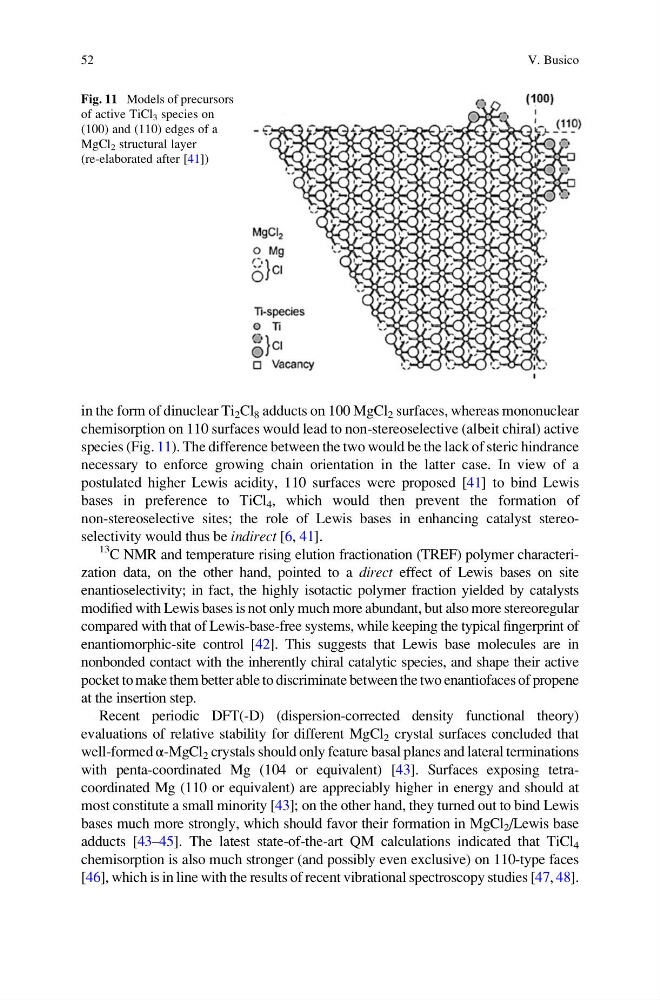
in the form of dinuclear Ti 2 Cl 8 adducts on 100 MgCl 2 surfaces, whereas mononuclear
chemisorption on 110 surfaces would lead to non-stereoselective (albeit chiral) active
species (Fig. 11). The difference between the two would be the lack of steric hindrance
necessary to enforce growing chain orientation in the latter case. In view of a
postulated higher Lewis acidity, 110 surfaces were proposed [41] to bind Lewis
bases in preference to TiCl 4 , which would then prevent the formation of
non-stereoselective sites; the role of Lewis bases in enhancing catalyst stereoselectivity would thus be indirect [6, 41].
13
C NMR and temperature rising elution fractionation (TREF) polymer characterization data, on the other hand, pointed to a direct effect of Lewis bases on site
enantioselectivity; in fact, the highly isotactic polymer fraction yielded by catalysts
modified with Lewis bases is not only much more abundant, but also more stereoregular
compared with that of Lewis-base-free systems, while keeping the typical fingerprint of
enantiomorphic-site control [42]. This suggests that Lewis base molecules are in
nonbonded contact with the inherently chiral catalytic species, and shape their active
pocket to make them better able to discriminate between the two enantiofaces of propene
at the insertion step.
Recent periodic DFT(-D) (dispersion-corrected density functional theory)
evaluations of relative stability for different MgCl 2 crystal surfaces concluded that
well-formed α-MgCl 2 crystals should only feature basal planes and lateral terminations
with penta-coordinated Mg (104 or equivalent) [43]. Surfaces exposing tetracoordinated Mg (110 or equivalent) are appreciably higher in energy and should at
most constitute a small minority [43]; on the other hand, they turned out to bind Lewis
bases much more strongly, which should favor their formation in MgCl 2 /Lewis base
adducts [43–45]. The latest state-of-the-art QM calculations indicated that TiCl 4
chemisorption is also much stronger (and possibly even exclusive) on 110-type faces
[46], which is in line with the results of recent vibrational spectroscopy studies [47, 48].
Fig. 11 Models of precursors
of active TiCl 3 species on
(100) and (110) edges of a
MgCl 2 structural layer
(re-elaborated after [41])
52
V. Busico
chemisorption on 110 surfaces would lead to non-stereoselective (albeit chiral) active
species (Fig. 11). The difference between the two would be the lack of steric hindrance
necessary to enforce growing chain orientation in the latter case. In view of a
postulated higher Lewis acidity, 110 surfaces were proposed [41] to bind Lewis
bases in preference to TiCl 4 , which would then prevent the formation of
non-stereoselective sites; the role of Lewis bases in enhancing catalyst stereoselectivity would thus be indirect [6, 41].
13
C NMR and temperature rising elution fractionation (TREF) polymer characterization data, on the other hand, pointed to a direct effect of Lewis bases on site
enantioselectivity; in fact, the highly isotactic polymer fraction yielded by catalysts
modified with Lewis bases is not only much more abundant, but also more stereoregular
compared with that of Lewis-base-free systems, while keeping the typical fingerprint of
enantiomorphic-site control [42]. This suggests that Lewis base molecules are in
nonbonded contact with the inherently chiral catalytic species, and shape their active
pocket to make them better able to discriminate between the two enantiofaces of propene
at the insertion step.
Recent periodic DFT(-D) (dispersion-corrected density functional theory)
evaluations of relative stability for different MgCl 2 crystal surfaces concluded that
well-formed α-MgCl 2 crystals should only feature basal planes and lateral terminations
with penta-coordinated Mg (104 or equivalent) [43]. Surfaces exposing tetracoordinated Mg (110 or equivalent) are appreciably higher in energy and should at
most constitute a small minority [43]; on the other hand, they turned out to bind Lewis
bases much more strongly, which should favor their formation in MgCl 2 /Lewis base
adducts [43–45]. The latest state-of-the-art QM calculations indicated that TiCl 4
chemisorption is also much stronger (and possibly even exclusive) on 110-type faces
[46], which is in line with the results of recent vibrational spectroscopy studies [47, 48].
Fig. 11 Models of precursors
of active TiCl 3 species on
(100) and (110) edges of a
MgCl 2 structural layer
(re-elaborated after [41])
52
V. Busico