

calcined silica or alumina were impregnated with TiCl 4 and reacted with Al-alkyls for
Ti alkylation/reduction, the results were very poor (at most, moderate activity in the
polymerization of ethene; low or no activity and no stereoselecivity in that of propene)
[11]. The breakthrough came, once again, serendipitously: highly active catalysts for
ethene polymerization were obtained when TiCl 4 was supported on MgO, and it did
not take too long to realize that (1) TiCl 4 chlorinates MgO to give MgCl 2 /TiCl 4
adducts, and (2) MgCl 2 has a layered structure very similar to that of violet TiCl 3
(i.e., stacked Cl–Mg–Cl sandwiches with all octahedral cavities in between the two Cl
planes occupied by Mg) [11].
Using authentic MgCl 2 as the support led to even better catalysts for polyethylene,
whereas the performance for polypropylene was ambivalent: high productivity
(>150 kg of polymer per gram of Ti) but poor stereoselectivity (less than 40%
highly isotactic polymer) [11]. However, the addition of proper Lewis bases to the
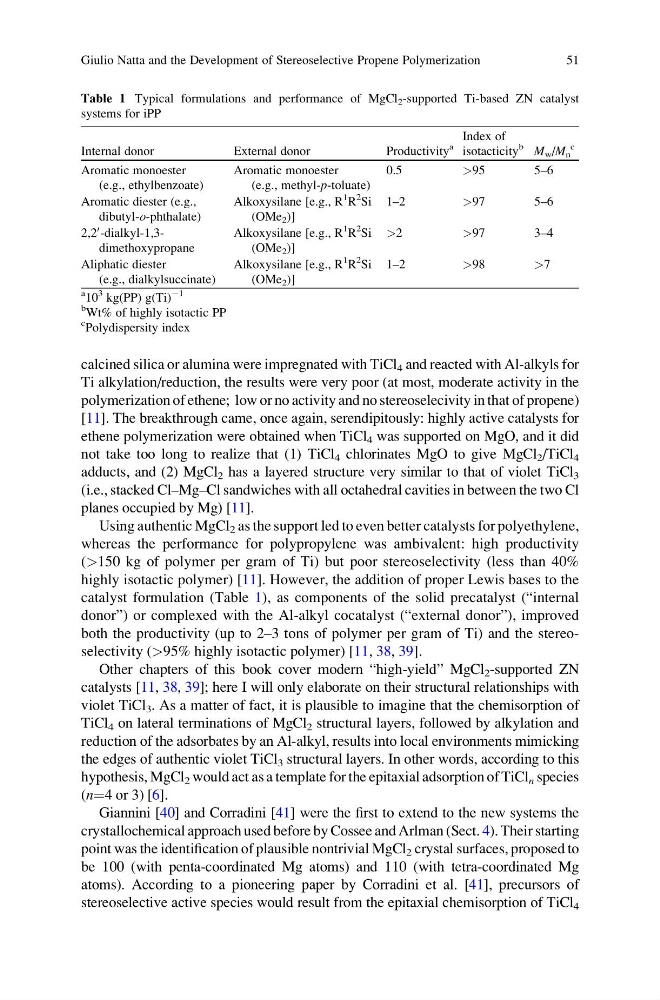
catalyst formulation (Table 1), as components of the solid precatalyst (“internal
donor”) or complexed with the Al-alkyl cocatalyst (“external donor”), improved
both the productivity (up to 2–3 tons of polymer per gram of Ti) and the stereoselectivity (>95% highly isotactic polymer) [11, 38, 39].
Other chapters of this book cover modern “high-yield” MgCl 2 -supported ZN
catalysts [11, 38, 39]; here I will only elaborate on their structural relationships with
violet TiCl 3 . As a matter of fact, it is plausible to imagine that the chemisorption of
TiCl 4 on lateral terminations of MgCl 2 structural layers, followed by alkylation and
reduction of the adsorbates by an Al-alkyl, results into local environments mimicking
the edges of authentic violet TiCl 3 structural layers. In other words, according to this
hypothesis, MgCl 2 would act as a template for the epitaxial adsorption of TiCl n species
(n¼4 or 3) [6].
Giannini [40] and Corradini [41] were the first to extend to the new systems the
crystallochemical approach used before by Cossee and Arlman (Sect. 4). Their starting
point was the identification of plausible nontrivial MgCl 2 crystal surfaces, proposed to
be 100 (with penta-coordinated Mg atoms) and 110 (with tetra-coordinated Mg
atoms). According to a pioneering paper by Corradini et al. [41], precursors of
stereoselective active species would result from the epitaxial chemisorption of TiCl 4
Table 1 Typical formulations and performance of MgCl 2 -supported Ti-based ZN catalyst
systems for iPP
Internal donor
External donor
Productivity
a
Index of
isotacticity
b M w /M n
c
Aromatic monoester
(e.g., ethylbenzoate)
Aromatic monoester
(e.g., methyl-p-toluate)
0.5
>95
5–6
Aromatic diester (e.g.,
dibutyl-o-phthalate)
Alkoxysilane [e.g., R
1 R
2
Si
(OMe 2 )]
1–2
>97
5–6
2,2
0 -dialkyl-1,3dimethoxypropane
Alkoxysilane [e.g., R
1 R
2
Si
(OMe 2 )]
>2
>97
3–4
Aliphatic diester
(e.g., dialkylsuccinate)
Alkoxysilane [e.g., R
1 R
2
Si
(OMe 2 )]
1–2
>98
>7
a
10
3 kg(PP) g(Ti)
À1
b
Wt% of highly isotactic PP
c
Polydispersity index
Giulio Natta and the Development of Stereoselective Propene Polymerization
51
Ti alkylation/reduction, the results were very poor (at most, moderate activity in the
polymerization of ethene; low or no activity and no stereoselecivity in that of propene)
[11]. The breakthrough came, once again, serendipitously: highly active catalysts for
ethene polymerization were obtained when TiCl 4 was supported on MgO, and it did
not take too long to realize that (1) TiCl 4 chlorinates MgO to give MgCl 2 /TiCl 4
adducts, and (2) MgCl 2 has a layered structure very similar to that of violet TiCl 3
(i.e., stacked Cl–Mg–Cl sandwiches with all octahedral cavities in between the two Cl
planes occupied by Mg) [11].
Using authentic MgCl 2 as the support led to even better catalysts for polyethylene,
whereas the performance for polypropylene was ambivalent: high productivity
(>150 kg of polymer per gram of Ti) but poor stereoselectivity (less than 40%
highly isotactic polymer) [11]. However, the addition of proper Lewis bases to the
catalyst formulation (Table 1), as components of the solid precatalyst (“internal
donor”) or complexed with the Al-alkyl cocatalyst (“external donor”), improved
both the productivity (up to 2–3 tons of polymer per gram of Ti) and the stereoselectivity (>95% highly isotactic polymer) [11, 38, 39].
Other chapters of this book cover modern “high-yield” MgCl 2 -supported ZN
catalysts [11, 38, 39]; here I will only elaborate on their structural relationships with
violet TiCl 3 . As a matter of fact, it is plausible to imagine that the chemisorption of
TiCl 4 on lateral terminations of MgCl 2 structural layers, followed by alkylation and
reduction of the adsorbates by an Al-alkyl, results into local environments mimicking
the edges of authentic violet TiCl 3 structural layers. In other words, according to this
hypothesis, MgCl 2 would act as a template for the epitaxial adsorption of TiCl n species
(n¼4 or 3) [6].
Giannini [40] and Corradini [41] were the first to extend to the new systems the
crystallochemical approach used before by Cossee and Arlman (Sect. 4). Their starting
point was the identification of plausible nontrivial MgCl 2 crystal surfaces, proposed to
be 100 (with penta-coordinated Mg atoms) and 110 (with tetra-coordinated Mg
atoms). According to a pioneering paper by Corradini et al. [41], precursors of
stereoselective active species would result from the epitaxial chemisorption of TiCl 4
Table 1 Typical formulations and performance of MgCl 2 -supported Ti-based ZN catalyst
systems for iPP
Internal donor
External donor
Productivity
a
Index of
isotacticity
b M w /M n
c
Aromatic monoester
(e.g., ethylbenzoate)
Aromatic monoester
(e.g., methyl-p-toluate)
0.5
>95
5–6
Aromatic diester (e.g.,
dibutyl-o-phthalate)
Alkoxysilane [e.g., R
1 R
2
Si
(OMe 2 )]
1–2
>97
5–6
2,2
0 -dialkyl-1,3dimethoxypropane
Alkoxysilane [e.g., R
1 R
2
Si
(OMe 2 )]
>2
>97
3–4
Aliphatic diester
(e.g., dialkylsuccinate)
Alkoxysilane [e.g., R
1 R
2
Si
(OMe 2 )]
1–2
>98
>7
a
10
3 kg(PP) g(Ti)
À1
b
Wt% of highly isotactic PP
c
Polydispersity index
Giulio Natta and the Development of Stereoselective Propene Polymerization
51