

5 From “Self-Supported” TiCl 3 -Based to MgCl 2 -
Supported TiCl 4 -Based ZN Catalysts
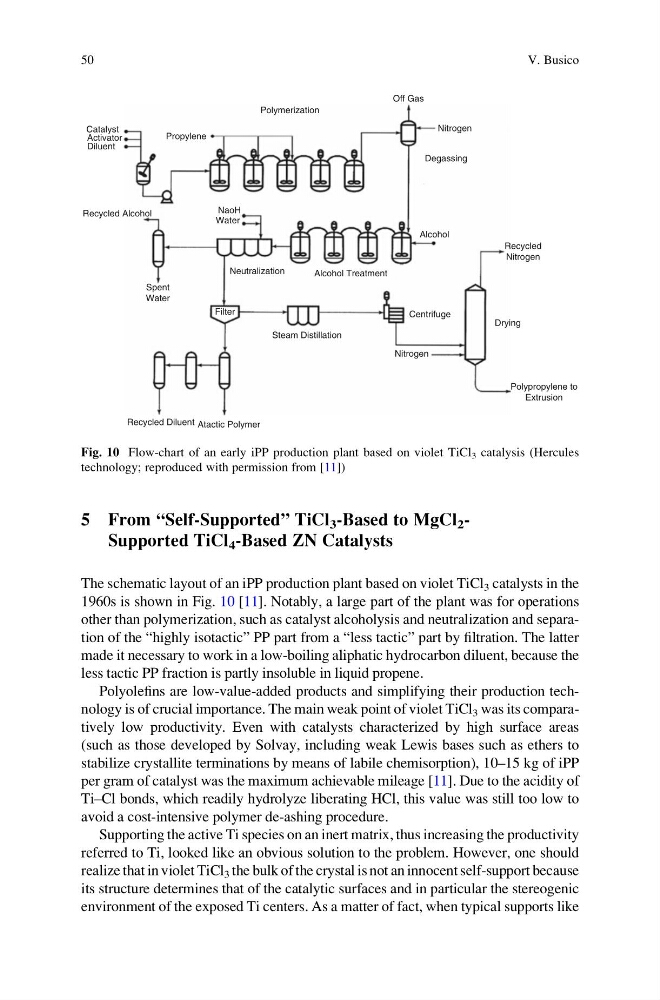
The schematic layout of an iPP production plant based on violet TiCl 3 catalysts in the
1960s is shown in Fig. 10 [11]. Notably, a large part of the plant was for operations
other than polymerization, such as catalyst alcoholysis and neutralization and separation of the “highly isotactic” PP part from a “less tactic” part by filtration. The latter
made it necessary to work in a low-boiling aliphatic hydrocarbon diluent, because the
less tactic PP fraction is partly insoluble in liquid propene.
Polyolefins are low-value-added products and simplifying their production technology is of crucial importance. The main weak point of violet TiCl 3 was its comparatively low productivity. Even with catalysts characterized by high surface areas
(such as those developed by Solvay, including weak Lewis bases such as ethers to
stabilize crystallite terminations by means of labile chemisorption), 10–15 kg of iPP
per gram of catalyst was the maximum achievable mileage [11]. Due to the acidity of
Ti–Cl bonds, which readily hydrolyze liberating HCl, this value was still too low to
avoid a cost-intensive polymer de-ashing procedure.
Supporting the active Ti species on an inert matrix, thus increasing the productivity
referred to Ti, looked like an obvious solution to the problem. However, one should
realize that in violet TiCl 3 the bulk of the crystal is not an innocent self-support because
its structure determines that of the catalytic surfaces and in particular the stereogenic
environment of the exposed Ti centers. As a matter of fact, when typical supports like
Recycled Diluent Atactic Polymer
Spent
Water
Filter
Water
NaoH
Recycled Alcohol
Diluent
Activator
Catalyst
Propylene
Polymerization
Off Gas
Nitrogen
Degassing
Polypropylene to
Extrusion
Recycled
Nitrogen
Alcohol
Drying
Centrifuge
Nitrogen
Neutralization
Alcohol Treatment
Steam Distillation
Fig. 10 Flow-chart of an early iPP production plant based on violet TiCl 3 catalysis (Hercules
technology; reproduced with permission from [11])
50
V. Busico
Supported TiCl 4 -Based ZN Catalysts
The schematic layout of an iPP production plant based on violet TiCl 3 catalysts in the
1960s is shown in Fig. 10 [11]. Notably, a large part of the plant was for operations
other than polymerization, such as catalyst alcoholysis and neutralization and separation of the “highly isotactic” PP part from a “less tactic” part by filtration. The latter
made it necessary to work in a low-boiling aliphatic hydrocarbon diluent, because the
less tactic PP fraction is partly insoluble in liquid propene.
Polyolefins are low-value-added products and simplifying their production technology is of crucial importance. The main weak point of violet TiCl 3 was its comparatively low productivity. Even with catalysts characterized by high surface areas
(such as those developed by Solvay, including weak Lewis bases such as ethers to
stabilize crystallite terminations by means of labile chemisorption), 10–15 kg of iPP
per gram of catalyst was the maximum achievable mileage [11]. Due to the acidity of
Ti–Cl bonds, which readily hydrolyze liberating HCl, this value was still too low to
avoid a cost-intensive polymer de-ashing procedure.
Supporting the active Ti species on an inert matrix, thus increasing the productivity
referred to Ti, looked like an obvious solution to the problem. However, one should
realize that in violet TiCl 3 the bulk of the crystal is not an innocent self-support because
its structure determines that of the catalytic surfaces and in particular the stereogenic
environment of the exposed Ti centers. As a matter of fact, when typical supports like
Recycled Diluent Atactic Polymer
Spent
Water
Filter
Water
NaoH
Recycled Alcohol
Diluent
Activator
Catalyst
Propylene
Polymerization
Off Gas
Nitrogen
Degassing
Polypropylene to
Extrusion
Recycled
Nitrogen
Alcohol
Drying
Centrifuge
Nitrogen
Neutralization
Alcohol Treatment
Steam Distillation
Fig. 10 Flow-chart of an early iPP production plant based on violet TiCl 3 catalysis (Hercules
technology; reproduced with permission from [11])
50
V. Busico