

available QM study is a PhD dissertation from my own research group [27] that
investigated with periodic DFT-D methods – inter alia – the relative stability of
possible crystal terminations for different TiCl 3 polymorphs. In brief, the conclusion
was that, apart from trivial 001 planes, plausible surfaces indeed have the structures
postulated in Figs. 5, 6, and 8. For α-TiCl 3 , 100-type terminations (Fig. 8a) would be
slightly lower in energy than 110-type (Fig. 8b); the calculated values of surface
energy after full relaxation were 0.14 and 0.15 J m
À2 , respectively. In the same work
[27], it was also found that the chemisorption of AlEt 2 Cl on 110-type terminations at
θ ¼ 0.5 (where θ is the degree of surface coverage), which is the highest allowed by
steric interference between neighboring adsorbates, is exergonic and makes the
residual exposed Ti centers rather similar to those on 100-type terminations, as far
as the local coordination environment is concerned. A weaker chemisorption of
AlEt 3 compared with AlEt 2 Cl might be the reason for the lower stereoselectivity of
violet-TiCl 3 /AlEt 3 catalyst systems than for violet-TiCl 3 /AlEt 2 Cl ones. It should be
noted, however, that no QM studies of catalytic reactivity for these surfaces have
been published so far.
Also pending is an explanation for the partial stereoselectivity of catalyst
systems based on β-TiCl 3 .
13 C NMR analysis of the highly isotactic PP fraction
demonstrates that the stereocontrol must be traced to inherently chiral active sites
[19], but in this case the Ti centers in the bulk of the crystal are not stereogenic
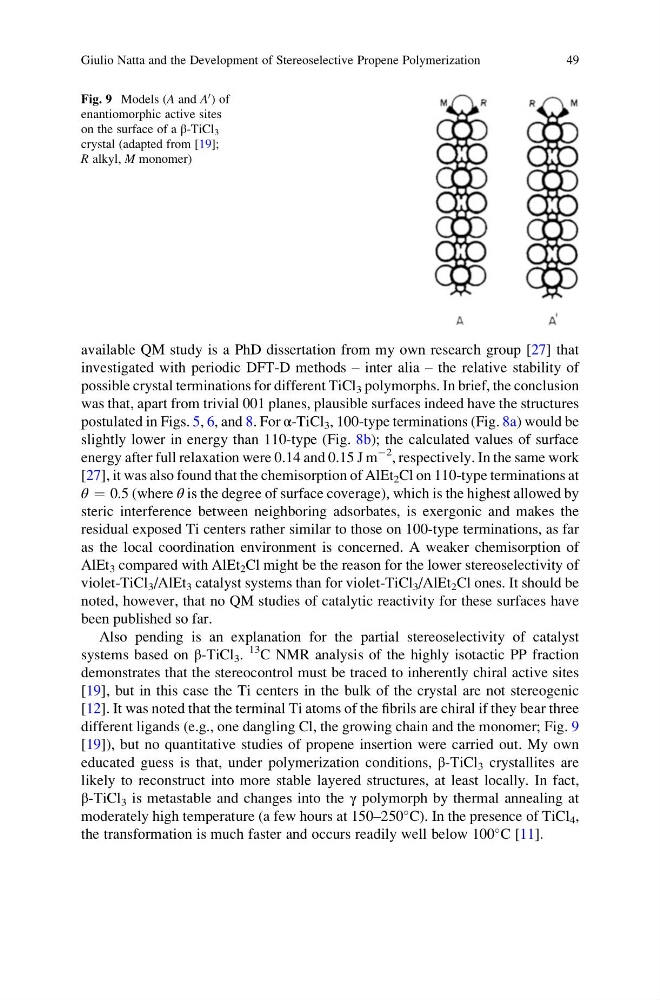
[12]. It was noted that the terminal Ti atoms of the fibrils are chiral if they bear three
different ligands (e.g., one dangling Cl, the growing chain and the monomer; Fig. 9
[19]), but no quantitative studies of propene insertion were carried out. My own
educated guess is that, under polymerization conditions, β-TiCl 3 crystallites are
likely to reconstruct into more stable layered structures, at least locally. In fact,
β-TiCl 3 is metastable and changes into the γ polymorph by thermal annealing at
moderately high temperature (a few hours at 150–250
C). In the presence of TiCl 4 ,
the transformation is much faster and occurs readily well below 100
C [11].
Fig. 9 Models (A and A
0 ) of
enantiomorphic active sites
on the surface of a β-TiCl 3
crystal (adapted from [19];
R alkyl, M monomer)
Giulio Natta and the Development of Stereoselective Propene Polymerization
49
investigated with periodic DFT-D methods – inter alia – the relative stability of
possible crystal terminations for different TiCl 3 polymorphs. In brief, the conclusion
was that, apart from trivial 001 planes, plausible surfaces indeed have the structures
postulated in Figs. 5, 6, and 8. For α-TiCl 3 , 100-type terminations (Fig. 8a) would be
slightly lower in energy than 110-type (Fig. 8b); the calculated values of surface
energy after full relaxation were 0.14 and 0.15 J m
À2 , respectively. In the same work
[27], it was also found that the chemisorption of AlEt 2 Cl on 110-type terminations at
θ ¼ 0.5 (where θ is the degree of surface coverage), which is the highest allowed by
steric interference between neighboring adsorbates, is exergonic and makes the
residual exposed Ti centers rather similar to those on 100-type terminations, as far
as the local coordination environment is concerned. A weaker chemisorption of
AlEt 3 compared with AlEt 2 Cl might be the reason for the lower stereoselectivity of
violet-TiCl 3 /AlEt 3 catalyst systems than for violet-TiCl 3 /AlEt 2 Cl ones. It should be
noted, however, that no QM studies of catalytic reactivity for these surfaces have
been published so far.
Also pending is an explanation for the partial stereoselectivity of catalyst
systems based on β-TiCl 3 .
13 C NMR analysis of the highly isotactic PP fraction
demonstrates that the stereocontrol must be traced to inherently chiral active sites
[19], but in this case the Ti centers in the bulk of the crystal are not stereogenic
[12]. It was noted that the terminal Ti atoms of the fibrils are chiral if they bear three
different ligands (e.g., one dangling Cl, the growing chain and the monomer; Fig. 9
[19]), but no quantitative studies of propene insertion were carried out. My own
educated guess is that, under polymerization conditions, β-TiCl 3 crystallites are
likely to reconstruct into more stable layered structures, at least locally. In fact,
β-TiCl 3 is metastable and changes into the γ polymorph by thermal annealing at
moderately high temperature (a few hours at 150–250
C). In the presence of TiCl 4 ,
the transformation is much faster and occurs readily well below 100
C [11].
Fig. 9 Models (A and A
0 ) of
enantiomorphic active sites
on the surface of a β-TiCl 3
crystal (adapted from [19];
R alkyl, M monomer)
Giulio Natta and the Development of Stereoselective Propene Polymerization
49