

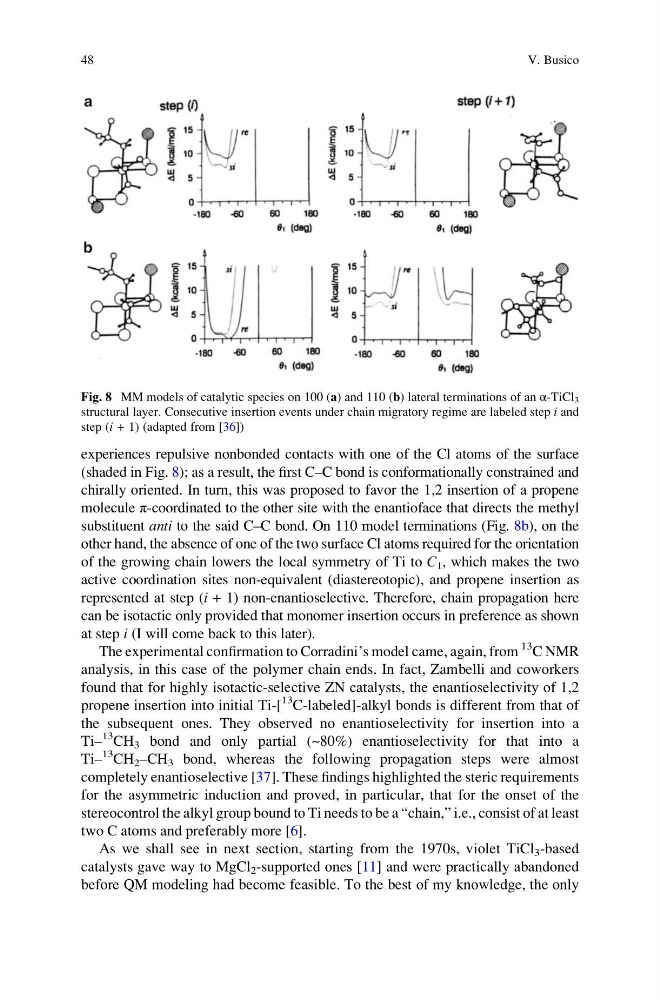
experiences repulsive nonbonded contacts with one of the Cl atoms of the surface
(shaded in Fig. 8); as a result, the first C–C bond is conformationally constrained and
chirally oriented. In turn, this was proposed to favor the 1,2 insertion of a propene
molecule π-coordinated to the other site with the enantioface that directs the methyl
substituent anti to the said C–C bond. On 110 model terminations (Fig. 8b), on the
other hand, the absence of one of the two surface Cl atoms required for the orientation
of the growing chain lowers the local symmetry of Ti to C 1 , which makes the two
active coordination sites non-equivalent (diastereotopic), and propene insertion as
represented at step (i + 1) non-enantioselective. Therefore, chain propagation here
can be isotactic only provided that monomer insertion occurs in preference as shown
at step i (I will come back to this later).
The experimental confirmation to Corradini’s model came, again, from
13 C NMR
analysis, in this case of the polymer chain ends. In fact, Zambelli and coworkers
found that for highly isotactic-selective ZN catalysts, the enantioselectivity of 1,2
propene insertion into initial Ti-[
13 C-labeled]-alkyl bonds is different from that of
the subsequent ones. They observed no enantioselectivity for insertion into a
Ti–
13 CH 3 bond and only partial (~80%) enantioselectivity for that into a
Ti–
13 CH 2 –CH 3 bond, whereas the following propagation steps were almost
completely enantioselective [37]. These findings highlighted the steric requirements
for the asymmetric induction and proved, in particular, that for the onset of the
stereocontrol the alkyl group bound to Ti needs to be a “chain,” i.e., consist of at least
two C atoms and preferably more [6].
As we shall see in next section, starting from the 1970s, violet TiCl 3 -based
catalysts gave way to MgCl 2 -supported ones [11] and were practically abandoned
before QM modeling had become feasible. To the best of my knowledge, the only
Fig. 8 MM models of catalytic species on 100 (a) and 110 (b) lateral terminations of an α-TiCl 3
structural layer. Consecutive insertion events under chain migratory regime are labeled step i and
step (i + 1) (adapted from [36])
48
V. Busico
(shaded in Fig. 8); as a result, the first C–C bond is conformationally constrained and
chirally oriented. In turn, this was proposed to favor the 1,2 insertion of a propene
molecule π-coordinated to the other site with the enantioface that directs the methyl
substituent anti to the said C–C bond. On 110 model terminations (Fig. 8b), on the
other hand, the absence of one of the two surface Cl atoms required for the orientation
of the growing chain lowers the local symmetry of Ti to C 1 , which makes the two
active coordination sites non-equivalent (diastereotopic), and propene insertion as
represented at step (i + 1) non-enantioselective. Therefore, chain propagation here
can be isotactic only provided that monomer insertion occurs in preference as shown
at step i (I will come back to this later).
The experimental confirmation to Corradini’s model came, again, from
13 C NMR
analysis, in this case of the polymer chain ends. In fact, Zambelli and coworkers
found that for highly isotactic-selective ZN catalysts, the enantioselectivity of 1,2
propene insertion into initial Ti-[
13 C-labeled]-alkyl bonds is different from that of
the subsequent ones. They observed no enantioselectivity for insertion into a
Ti–
13 CH 3 bond and only partial (~80%) enantioselectivity for that into a
Ti–
13 CH 2 –CH 3 bond, whereas the following propagation steps were almost
completely enantioselective [37]. These findings highlighted the steric requirements
for the asymmetric induction and proved, in particular, that for the onset of the
stereocontrol the alkyl group bound to Ti needs to be a “chain,” i.e., consist of at least
two C atoms and preferably more [6].
As we shall see in next section, starting from the 1970s, violet TiCl 3 -based
catalysts gave way to MgCl 2 -supported ones [11] and were practically abandoned
before QM modeling had become feasible. To the best of my knowledge, the only
Fig. 8 MM models of catalytic species on 100 (a) and 110 (b) lateral terminations of an α-TiCl 3
structural layer. Consecutive insertion events under chain migratory regime are labeled step i and
step (i + 1) (adapted from [36])
48
V. Busico