

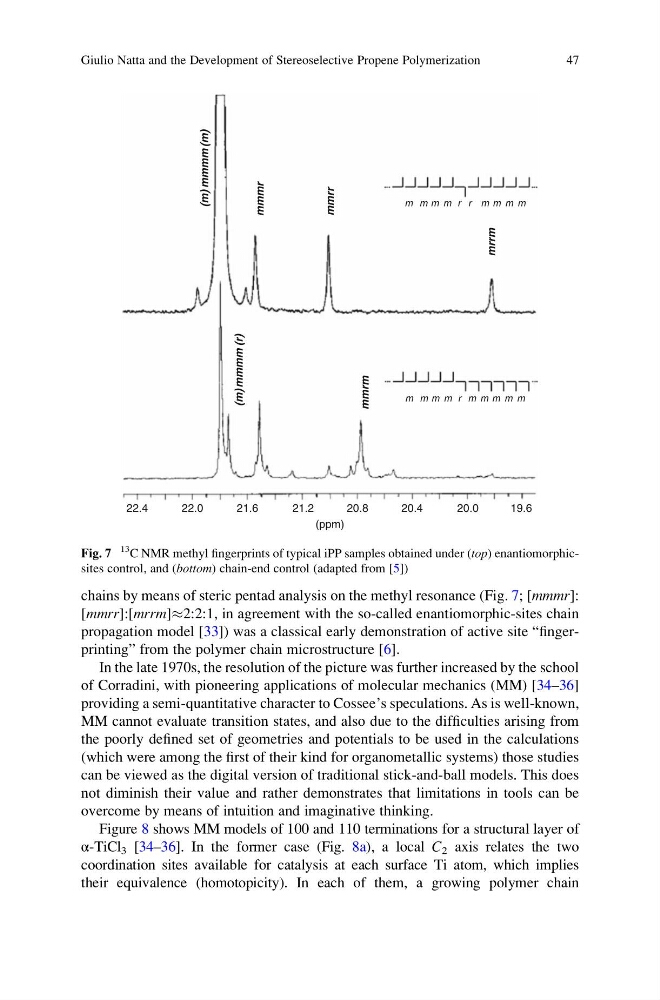
chains by means of steric pentad analysis on the methyl resonance (Fig. 7; [mmmr]:
[mmrr]:[mrrm]%2:2:1, in agreement with the so-called enantiomorphic-sites chain
propagation model [33]) was a classical early demonstration of active site “fingerprinting” from the polymer chain microstructure [6].
In the late 1970s, the resolution of the picture was further increased by the school
of Corradini, with pioneering applications of molecular mechanics (MM) [34–36]
providing a semi-quantitative character to Cossee’s speculations. As is well-known,
MM cannot evaluate transition states, and also due to the difficulties arising from
the poorly defined set of geometries and potentials to be used in the calculations
(which were among the first of their kind for organometallic systems) those studies
can be viewed as the digital version of traditional stick-and-ball models. This does
not diminish their value and rather demonstrates that limitations in tools can be
overcome by means of intuition and imaginative thinking.
Figure 8 shows MM models of 100 and 110 terminations for a structural layer of
α-TiCl 3 [34–36]. In the former case (Fig. 8a), a local C 2 axis relates the two
coordination sites available for catalysis at each surface Ti atom, which implies
their equivalence (homotopicity). In each of them, a growing polymer chain
m m
r
r
m
m
m m
m
m
m
m
m
m
m
r
m
m
m
m
mmrr
mrrm
mmmr
(m) mmmm (r)
(m) mmmm (m)
mmrm
(ppm)
19.6
20.0
20.4
20.8
21.2
21.6
22.0
22.4
Fig. 7
13
C NMR methyl fingerprints of typical iPP samples obtained under (top) enantiomorphicsites control, and (bottom) chain-end control (adapted from [5])
Giulio Natta and the Development of Stereoselective Propene Polymerization
47
[mmrr]:[mrrm]%2:2:1, in agreement with the so-called enantiomorphic-sites chain
propagation model [33]) was a classical early demonstration of active site “fingerprinting” from the polymer chain microstructure [6].
In the late 1970s, the resolution of the picture was further increased by the school
of Corradini, with pioneering applications of molecular mechanics (MM) [34–36]
providing a semi-quantitative character to Cossee’s speculations. As is well-known,
MM cannot evaluate transition states, and also due to the difficulties arising from
the poorly defined set of geometries and potentials to be used in the calculations
(which were among the first of their kind for organometallic systems) those studies
can be viewed as the digital version of traditional stick-and-ball models. This does
not diminish their value and rather demonstrates that limitations in tools can be
overcome by means of intuition and imaginative thinking.
Figure 8 shows MM models of 100 and 110 terminations for a structural layer of
α-TiCl 3 [34–36]. In the former case (Fig. 8a), a local C 2 axis relates the two
coordination sites available for catalysis at each surface Ti atom, which implies
their equivalence (homotopicity). In each of them, a growing polymer chain
m m
r
r
m
m
m m
m
m
m
m
m
m
m
r
m
m
m
m
mmrr
mrrm
mmmr
(m) mmmm (r)
(m) mmmm (m)
mmrm
(ppm)
19.6
20.0
20.4
20.8
21.2
21.6
22.0
22.4
Fig. 7
13
C NMR methyl fingerprints of typical iPP samples obtained under (top) enantiomorphicsites control, and (bottom) chain-end control (adapted from [5])
Giulio Natta and the Development of Stereoselective Propene Polymerization
47