

propene would then chemisorb at the remaining empty site of the octahedron and insert
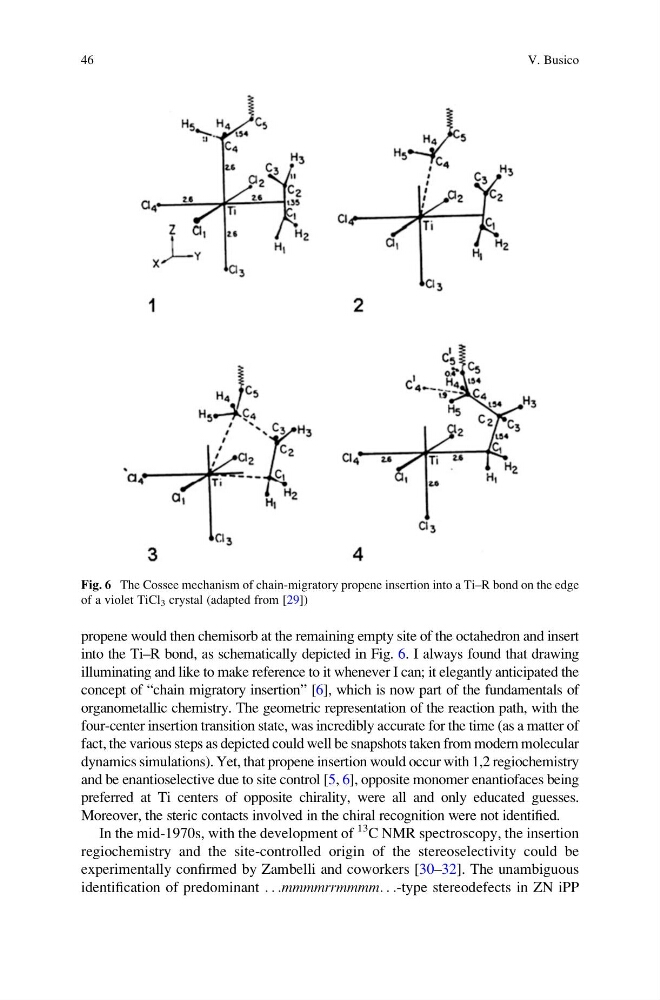
into the Ti–R bond, as schematically depicted in Fig. 6. I always found that drawing
illuminating and like to make reference to it whenever I can; it elegantly anticipated the
concept of “chain migratory insertion” [6], which is now part of the fundamentals of
organometallic chemistry. The geometric representation of the reaction path, with the
four-center insertion transition state, was incredibly accurate for the time (as a matter of
fact, the various steps as depicted could well be snapshots taken from modern molecular
dynamics simulations). Yet, that propene insertion would occur with 1,2 regiochemistry
and be enantioselective due to site control [5, 6], opposite monomer enantiofaces being
preferred at Ti centers of opposite chirality, were all and only educated guesses.
Moreover, the steric contacts involved in the chiral recognition were not identified.
In the mid-1970s, with the development of
13 C NMR spectroscopy, the insertion
regiochemistry and the site-controlled origin of the stereoselectivity could be
experimentally confirmed by Zambelli and coworkers [30–32]. The unambiguous
identification of predominant . . .mmmmrrmmmm. . .-type stereodefects in ZN iPP
Fig. 6 The Cossee mechanism of chain-migratory propene insertion into a Ti–R bond on the edge
of a violet TiCl 3 crystal (adapted from [29])
46
V. Busico
into the Ti–R bond, as schematically depicted in Fig. 6. I always found that drawing
illuminating and like to make reference to it whenever I can; it elegantly anticipated the
concept of “chain migratory insertion” [6], which is now part of the fundamentals of
organometallic chemistry. The geometric representation of the reaction path, with the
four-center insertion transition state, was incredibly accurate for the time (as a matter of
fact, the various steps as depicted could well be snapshots taken from modern molecular
dynamics simulations). Yet, that propene insertion would occur with 1,2 regiochemistry
and be enantioselective due to site control [5, 6], opposite monomer enantiofaces being
preferred at Ti centers of opposite chirality, were all and only educated guesses.
Moreover, the steric contacts involved in the chiral recognition were not identified.
In the mid-1970s, with the development of
13 C NMR spectroscopy, the insertion
regiochemistry and the site-controlled origin of the stereoselectivity could be
experimentally confirmed by Zambelli and coworkers [30–32]. The unambiguous
identification of predominant . . .mmmmrrmmmm. . .-type stereodefects in ZN iPP
Fig. 6 The Cossee mechanism of chain-migratory propene insertion into a Ti–R bond on the edge
of a violet TiCl 3 crystal (adapted from [29])
46
V. Busico