

by the fact that it took one year for the first paper by Natta et al. to find a scientific
journal that would dare to publish something seemingly too revolutionary to be true;
on the other hand, the communication to the J. Am. Chem. Soc., which appeared in
March 1955 [26], was immediately saluted by unbiased polymer scientists (and in
particular by Paul J. Flory) as a groundbreaking announcement.
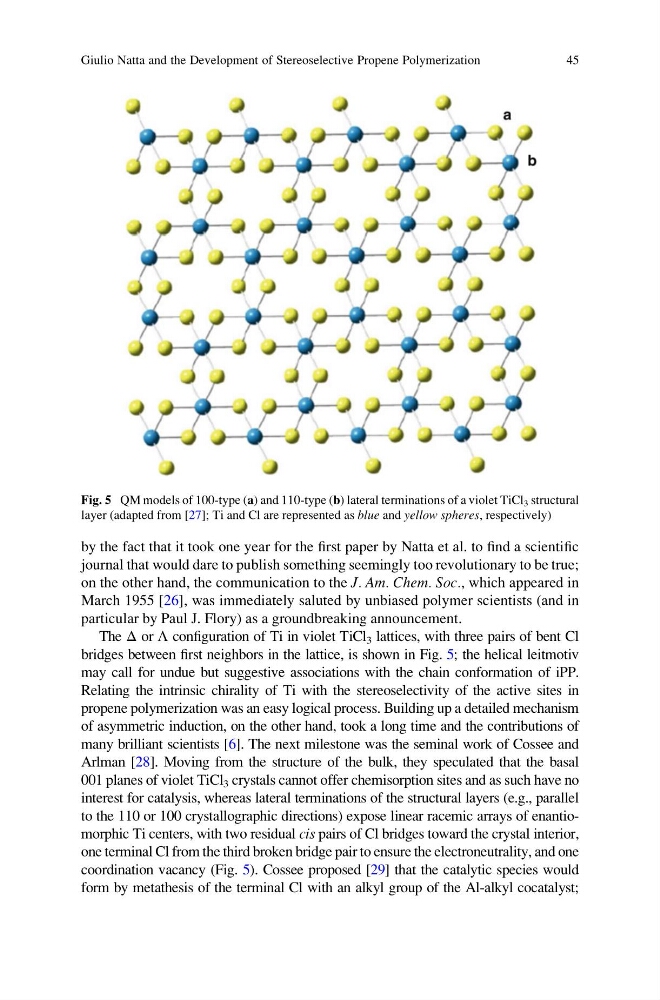
The Δ or Λ configuration of Ti in violet TiCl 3 lattices, with three pairs of bent Cl
bridges between first neighbors in the lattice, is shown in Fig. 5; the helical leitmotiv
may call for undue but suggestive associations with the chain conformation of iPP.
Relating the intrinsic chirality of Ti with the stereoselectivity of the active sites in
propene polymerization was an easy logical process. Building up a detailed mechanism
of asymmetric induction, on the other hand, took a long time and the contributions of
many brilliant scientists [6]. The next milestone was the seminal work of Cossee and
Arlman [28]. Moving from the structure of the bulk, they speculated that the basal
001 planes of violet TiCl 3 crystals cannot offer chemisorption sites and as such have no
interest for catalysis, whereas lateral terminations of the structural layers (e.g., parallel
to the 110 or 100 crystallographic directions) expose linear racemic arrays of enantiomorphic Ti centers, with two residual cis pairs of Cl bridges toward the crystal interior,
one terminal Cl from the third broken bridge pair to ensure the electroneutrality, and one
coordination vacancy (Fig. 5). Cossee proposed [29] that the catalytic species would
form by metathesis of the terminal Cl with an alkyl group of the Al-alkyl cocatalyst;
Fig. 5 QM models of 100-type (a) and 110-type (b) lateral terminations of a violet TiCl 3 structural
layer (adapted from [27]; Ti and Cl are represented as blue and yellow spheres, respectively)
Giulio Natta and the Development of Stereoselective Propene Polymerization
45
journal that would dare to publish something seemingly too revolutionary to be true;
on the other hand, the communication to the J. Am. Chem. Soc., which appeared in
March 1955 [26], was immediately saluted by unbiased polymer scientists (and in
particular by Paul J. Flory) as a groundbreaking announcement.
The Δ or Λ configuration of Ti in violet TiCl 3 lattices, with three pairs of bent Cl
bridges between first neighbors in the lattice, is shown in Fig. 5; the helical leitmotiv
may call for undue but suggestive associations with the chain conformation of iPP.
Relating the intrinsic chirality of Ti with the stereoselectivity of the active sites in
propene polymerization was an easy logical process. Building up a detailed mechanism
of asymmetric induction, on the other hand, took a long time and the contributions of
many brilliant scientists [6]. The next milestone was the seminal work of Cossee and
Arlman [28]. Moving from the structure of the bulk, they speculated that the basal
001 planes of violet TiCl 3 crystals cannot offer chemisorption sites and as such have no
interest for catalysis, whereas lateral terminations of the structural layers (e.g., parallel
to the 110 or 100 crystallographic directions) expose linear racemic arrays of enantiomorphic Ti centers, with two residual cis pairs of Cl bridges toward the crystal interior,
one terminal Cl from the third broken bridge pair to ensure the electroneutrality, and one
coordination vacancy (Fig. 5). Cossee proposed [29] that the catalytic species would
form by metathesis of the terminal Cl with an alkyl group of the Al-alkyl cocatalyst;
Fig. 5 QM models of 100-type (a) and 110-type (b) lateral terminations of a violet TiCl 3 structural
layer (adapted from [27]; Ti and Cl are represented as blue and yellow spheres, respectively)
Giulio Natta and the Development of Stereoselective Propene Polymerization
45