

the conclusions of Natta, Allegra, and Corradini based on powder X-ray diffraction data
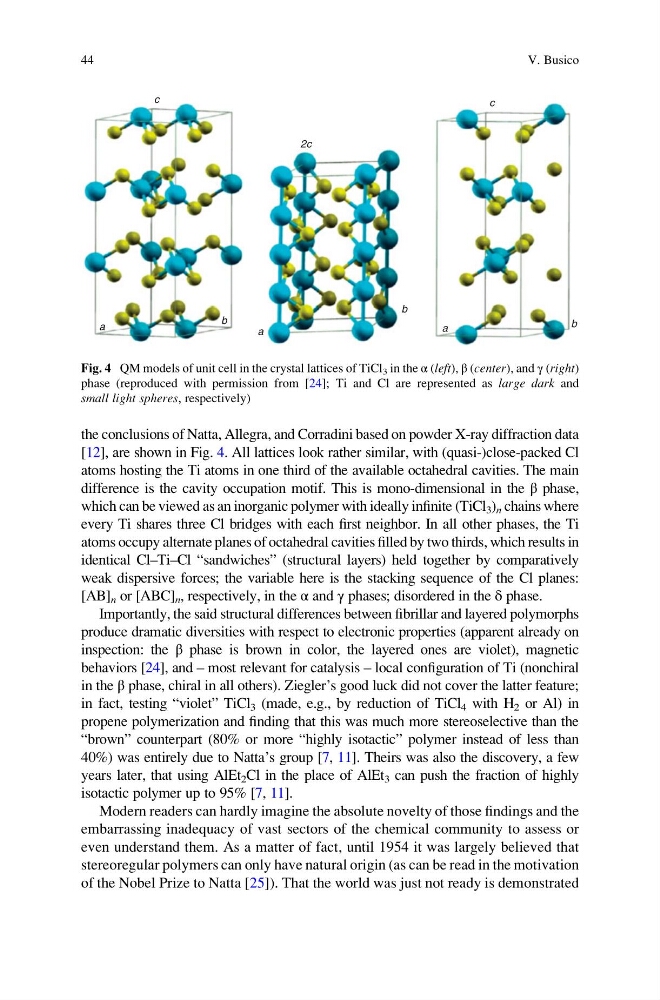
[12], are shown in Fig. 4. All lattices look rather similar, with (quasi-)close-packed Cl
atoms hosting the Ti atoms in one third of the available octahedral cavities. The main
difference is the cavity occupation motif. This is mono-dimensional in the β phase,
which can be viewed as an inorganic polymer with ideally infinite (TiCl 3 ) n chains where
every Ti shares three Cl bridges with each first neighbor. In all other phases, the Ti
atoms occupy alternate planes of octahedral cavities filled by two thirds, which results in
identical Cl–Ti–Cl “sandwiches” (structural layers) held together by comparatively
weak dispersive forces; the variable here is the stacking sequence of the Cl planes:
[AB] n or [ABC] n , respectively, in the α and γ phases; disordered in the δ phase.
Importantly, the said structural differences between fibrillar and layered polymorphs
produce dramatic diversities with respect to electronic properties (apparent already on
inspection: the β phase is brown in color, the layered ones are violet), magnetic
behaviors [24], and – most relevant for catalysis – local configuration of Ti (nonchiral
in the β phase, chiral in all others). Ziegler’s good luck did not cover the latter feature;
in fact, testing “violet” TiCl 3 (made, e.g., by reduction of TiCl 4 with H 2 or Al) in
propene polymerization and finding that this was much more stereoselective than the
“brown” counterpart (80% or more “highly isotactic” polymer instead of less than
40%) was entirely due to Natta’s group [7, 11]. Theirs was also the discovery, a few
years later, that using AlEt 2 Cl in the place of AlEt 3 can push the fraction of highly
isotactic polymer up to 95% [7, 11].
Modern readers can hardly imagine the absolute novelty of those findings and the
embarrassing inadequacy of vast sectors of the chemical community to assess or
even understand them. As a matter of fact, until 1954 it was largely believed that
stereoregular polymers can only have natural origin (as can be read in the motivation
of the Nobel Prize to Natta [25]). That the world was just not ready is demonstrated
c
b
a
a
a
b
b
2c
c
Fig. 4 QM models of unit cell in the crystal lattices of TiCl 3 in the α (left), β (center), and γ (right)
phase (reproduced with permission from [24]; Ti and Cl are represented as large dark and
small light spheres, respectively)
44
V. Busico
[12], are shown in Fig. 4. All lattices look rather similar, with (quasi-)close-packed Cl
atoms hosting the Ti atoms in one third of the available octahedral cavities. The main
difference is the cavity occupation motif. This is mono-dimensional in the β phase,
which can be viewed as an inorganic polymer with ideally infinite (TiCl 3 ) n chains where
every Ti shares three Cl bridges with each first neighbor. In all other phases, the Ti
atoms occupy alternate planes of octahedral cavities filled by two thirds, which results in
identical Cl–Ti–Cl “sandwiches” (structural layers) held together by comparatively
weak dispersive forces; the variable here is the stacking sequence of the Cl planes:
[AB] n or [ABC] n , respectively, in the α and γ phases; disordered in the δ phase.
Importantly, the said structural differences between fibrillar and layered polymorphs
produce dramatic diversities with respect to electronic properties (apparent already on
inspection: the β phase is brown in color, the layered ones are violet), magnetic
behaviors [24], and – most relevant for catalysis – local configuration of Ti (nonchiral
in the β phase, chiral in all others). Ziegler’s good luck did not cover the latter feature;
in fact, testing “violet” TiCl 3 (made, e.g., by reduction of TiCl 4 with H 2 or Al) in
propene polymerization and finding that this was much more stereoselective than the
“brown” counterpart (80% or more “highly isotactic” polymer instead of less than
40%) was entirely due to Natta’s group [7, 11]. Theirs was also the discovery, a few
years later, that using AlEt 2 Cl in the place of AlEt 3 can push the fraction of highly
isotactic polymer up to 95% [7, 11].
Modern readers can hardly imagine the absolute novelty of those findings and the
embarrassing inadequacy of vast sectors of the chemical community to assess or
even understand them. As a matter of fact, until 1954 it was largely believed that
stereoregular polymers can only have natural origin (as can be read in the motivation
of the Nobel Prize to Natta [25]). That the world was just not ready is demonstrated
c
b
a
a
a
b
b
2c
c
Fig. 4 QM models of unit cell in the crystal lattices of TiCl 3 in the α (left), β (center), and γ (right)
phase (reproduced with permission from [24]; Ti and Cl are represented as large dark and
small light spheres, respectively)
44
V. Busico