

called for chain stereoregularity, and therefore a stereoselective active species
[7, 11]. Moreover, the ultimate melting point of the material when observed at the
hot stage microscope exceeded 165
C, i.e., well above that of polyethylene!
The team in Milan had to face two major scientific problems: assign the structure
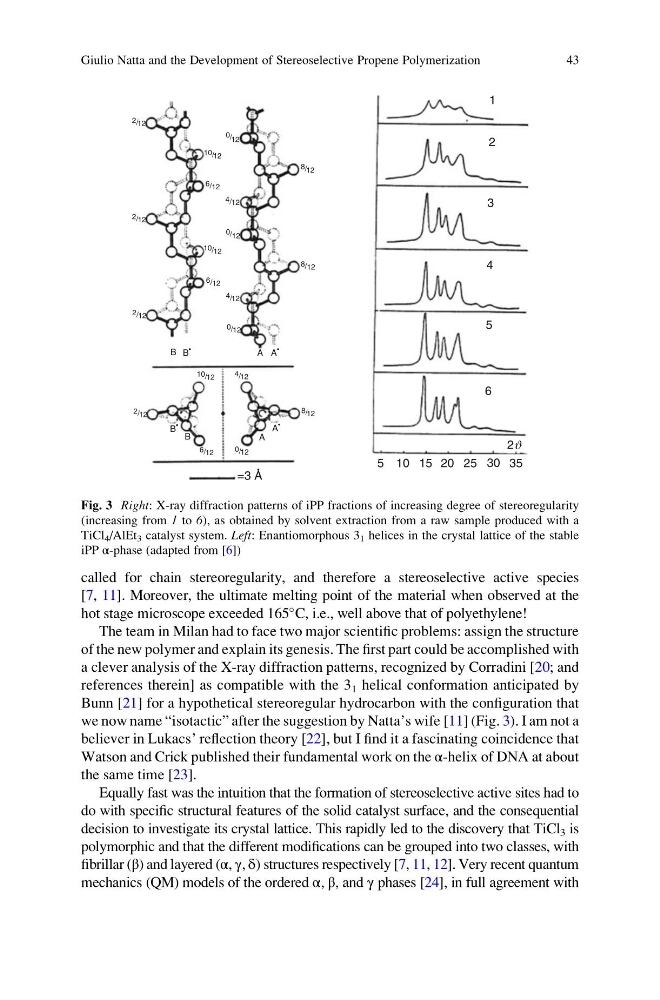
of the new polymer and explain its genesis. The first part could be accomplished with
a clever analysis of the X-ray diffraction patterns, recognized by Corradini [20; and
references therein] as compatible with the 3 1 helical conformation anticipated by
Bunn [21] for a hypothetical stereoregular hydrocarbon with the configuration that
we now name “isotactic” after the suggestion by Natta’s wife [11] (Fig. 3). I am not a
believer in Lukacs’ reflection theory [22], but I find it a fascinating coincidence that
Watson and Crick published their fundamental work on the α-helix of DNA at about
the same time [23].
Equally fast was the intuition that the formation of stereoselective active sites had to
do with specific structural features of the solid catalyst surface, and the consequential
decision to investigate its crystal lattice. This rapidly led to the discovery that TiCl 3 is
polymorphic and that the different modifications can be grouped into two classes, with
fibrillar (β) and layered (α, γ, δ) structures respectively [7, 11, 12]. Very recent quantum
mechanics (QM) models of the ordered α, β, and γ phases [24], in full agreement with
2J
6
20
30 35
25
15
10
5
=3 A
A
•
B
•
B
•
A
•
B
B
A
A
/
5
4
3
2
1
2 12
/
10 12
/
0 12
/
6 12
/
4 12
/
0 12
/
2 12
/
10 12
/
6 12
/
4 12
/
0 12
/
2 12
/
8 12
/
8 12
/
0 12
/
6 12
/
2 12
/
10 12
/
4 12
/
8 12
•
Fig. 3 Right: X-ray diffraction patterns of iPP fractions of increasing degree of stereoregularity
(increasing from 1 to 6), as obtained by solvent extraction from a raw sample produced with a
TiCl 4 /AlEt 3 catalyst system. Left: Enantiomorphous 3 1 helices in the crystal lattice of the stable
iPP α-phase (adapted from [6])
Giulio Natta and the Development of Stereoselective Propene Polymerization
43
[7, 11]. Moreover, the ultimate melting point of the material when observed at the
hot stage microscope exceeded 165
C, i.e., well above that of polyethylene!
The team in Milan had to face two major scientific problems: assign the structure
of the new polymer and explain its genesis. The first part could be accomplished with
a clever analysis of the X-ray diffraction patterns, recognized by Corradini [20; and
references therein] as compatible with the 3 1 helical conformation anticipated by
Bunn [21] for a hypothetical stereoregular hydrocarbon with the configuration that
we now name “isotactic” after the suggestion by Natta’s wife [11] (Fig. 3). I am not a
believer in Lukacs’ reflection theory [22], but I find it a fascinating coincidence that
Watson and Crick published their fundamental work on the α-helix of DNA at about
the same time [23].
Equally fast was the intuition that the formation of stereoselective active sites had to
do with specific structural features of the solid catalyst surface, and the consequential
decision to investigate its crystal lattice. This rapidly led to the discovery that TiCl 3 is
polymorphic and that the different modifications can be grouped into two classes, with
fibrillar (β) and layered (α, γ, δ) structures respectively [7, 11, 12]. Very recent quantum
mechanics (QM) models of the ordered α, β, and γ phases [24], in full agreement with
2J
6
20
30 35
25
15
10
5
=3 A
A
•
B
•
B
•
A
•
B
B
A
A
/
5
4
3
2
1
2 12
/
10 12
/
0 12
/
6 12
/
4 12
/
0 12
/
2 12
/
10 12
/
6 12
/
4 12
/
0 12
/
2 12
/
8 12
/
8 12
/
0 12
/
6 12
/
2 12
/
10 12
/
4 12
/
8 12
•
Fig. 3 Right: X-ray diffraction patterns of iPP fractions of increasing degree of stereoregularity
(increasing from 1 to 6), as obtained by solvent extraction from a raw sample produced with a
TiCl 4 /AlEt 3 catalyst system. Left: Enantiomorphous 3 1 helices in the crystal lattice of the stable
iPP α-phase (adapted from [6])
Giulio Natta and the Development of Stereoselective Propene Polymerization
43