

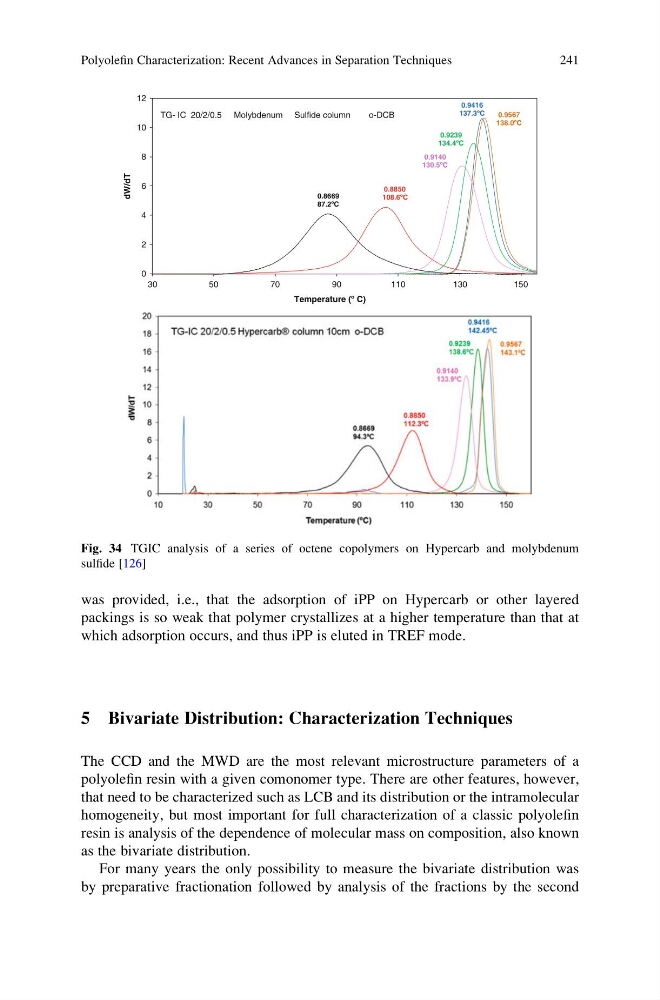
was provided, i.e., that the adsorption of iPP on Hypercarb or other layered
packings is so weak that polymer crystallizes at a higher temperature than that at
which adsorption occurs, and thus iPP is eluted in TREF mode.
5 Bivariate Distribution: Characterization Techniques
The CCD and the MWD are the most relevant microstructure parameters of a
polyolefin resin with a given comonomer type. There are other features, however,
that need to be characterized such as LCB and its distribution or the intramolecular
homogeneity, but most important for full characterization of a classic polyolefin
resin is analysis of the dependence of molecular mass on composition, also known
as the bivariate distribution.
For many years the only possibility to measure the bivariate distribution was
by preparative fractionation followed by analysis of the fractions by the second
Temperature (º C)
0
2
4
6
8
10
12
30
50
70
90
110
130
150
dW/dT
TG- IC 20/2/0.5 Molybdenum Sulfide column
o-DCB
0.9567
138.0ºC
0.9140
130.5ºC
0.8850
108.6ºC
0.9416
137.3ºC
0.8669
87.2ºC
0.9239
134.4ºC
Fig. 34 TGIC analysis of a series of octene copolymers on Hypercarb and molybdenum
sulfide [126]
Polyolefin Characterization: Recent Advances in Separation Techniques
241
packings is so weak that polymer crystallizes at a higher temperature than that at
which adsorption occurs, and thus iPP is eluted in TREF mode.
5 Bivariate Distribution: Characterization Techniques
The CCD and the MWD are the most relevant microstructure parameters of a
polyolefin resin with a given comonomer type. There are other features, however,
that need to be characterized such as LCB and its distribution or the intramolecular
homogeneity, but most important for full characterization of a classic polyolefin
resin is analysis of the dependence of molecular mass on composition, also known
as the bivariate distribution.
For many years the only possibility to measure the bivariate distribution was
by preparative fractionation followed by analysis of the fractions by the second
Temperature (º C)
0
2
4
6
8
10
12
30
50
70
90
110
130
150
dW/dT
TG- IC 20/2/0.5 Molybdenum Sulfide column
o-DCB
0.9567
138.0ºC
0.9140
130.5ºC
0.8850
108.6ºC
0.9416
137.3ºC
0.8669
87.2ºC
0.9239
134.4ºC
Fig. 34 TGIC analysis of a series of octene copolymers on Hypercarb and molybdenum
sulfide [126]
Polyolefin Characterization: Recent Advances in Separation Techniques
241