

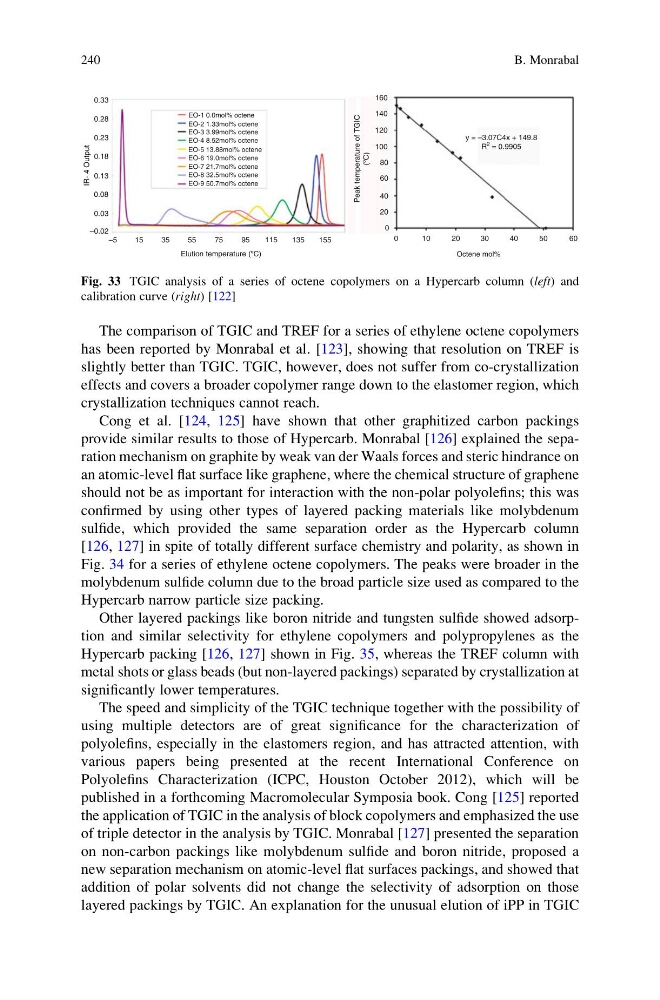
The comparison of TGIC and TREF for a series of ethylene octene copolymers
has been reported by Monrabal et al. [123], showing that resolution on TREF is
slightly better than TGIC. TGIC, however, does not suffer from co-crystallization
effects and covers a broader copolymer range down to the elastomer region, which
crystallization techniques cannot reach.
Cong et al. [124, 125] have shown that other graphitized carbon packings
provide similar results to those of Hypercarb. Monrabal [126] explained the separation mechanism on graphite by weak van der Waals forces and steric hindrance on
an atomic-level flat surface like graphene, where the chemical structure of graphene
should not be as important for interaction with the non-polar polyolefins; this was
confirmed by using other types of layered packing materials like molybdenum
sulfide, which provided the same separation order as the Hypercarb column
[126, 127] in spite of totally different surface chemistry and polarity, as shown in
Fig. 34 for a series of ethylene octene copolymers. The peaks were broader in the
molybdenum sulfide column due to the broad particle size used as compared to the
Hypercarb narrow particle size packing.
Other layered packings like boron nitride and tungsten sulfide showed adsorption and similar selectivity for ethylene copolymers and polypropylenes as the
Hypercarb packing [126, 127] shown in Fig. 35, whereas the TREF column with
metal shots or glass beads (but non-layered packings) separated by crystallization at
significantly lower temperatures.
The speed and simplicity of the TGIC technique together with the possibility of
using multiple detectors are of great significance for the characterization of
polyolefins, especially in the elastomers region, and has attracted attention, with
various papers being presented at the recent International Conference on
Polyolefins Characterization (ICPC, Houston October 2012), which will be
published in a forthcoming Macromolecular Symposia book. Cong [125] reported
the application of TGIC in the analysis of block copolymers and emphasized the use
of triple detector in the analysis by TGIC. Monrabal [127] presented the separation
on non-carbon packings like molybdenum sulfide and boron nitride, proposed a
new separation mechanism on atomic-level flat surfaces packings, and showed that
addition of polar solvents did not change the selectivity of adsorption on those
layered packings by TGIC. An explanation for the unusual elution of iPP in TGIC
40
50
160
Peak temperature of TGIC
(ºC)
0
EO-1 0.0mol% octene
EO-9 50.7mol% octene
75
55
0.08
0.13
0.18
IR- 4 Output
0.33
0.28
0.23
0.03
–0.02
–5
15
35
95
115
135
155
Elution temperature (ºC)
EO-8 32.5mol% octene
EO-7 21.7mol% octene
EO-6 19.0mol% octene
EO-5 13.88mol% octene
EO-4 8.52mol% octene
EO-3 3.99mol% octene
EO-2 1.33mol% octene
y = –3.07C4x + 149.8
R 2 = 0.9905
20
40
60
80
100
120
140
Octene mol%
60
30
20
10
0
Fig. 33 TGIC analysis of a series of octene copolymers on a Hypercarb column (left) and
calibration curve (right) [122]
240
B. Monrabal
has been reported by Monrabal et al. [123], showing that resolution on TREF is
slightly better than TGIC. TGIC, however, does not suffer from co-crystallization
effects and covers a broader copolymer range down to the elastomer region, which
crystallization techniques cannot reach.
Cong et al. [124, 125] have shown that other graphitized carbon packings
provide similar results to those of Hypercarb. Monrabal [126] explained the separation mechanism on graphite by weak van der Waals forces and steric hindrance on
an atomic-level flat surface like graphene, where the chemical structure of graphene
should not be as important for interaction with the non-polar polyolefins; this was
confirmed by using other types of layered packing materials like molybdenum
sulfide, which provided the same separation order as the Hypercarb column
[126, 127] in spite of totally different surface chemistry and polarity, as shown in
Fig. 34 for a series of ethylene octene copolymers. The peaks were broader in the
molybdenum sulfide column due to the broad particle size used as compared to the
Hypercarb narrow particle size packing.
Other layered packings like boron nitride and tungsten sulfide showed adsorption and similar selectivity for ethylene copolymers and polypropylenes as the
Hypercarb packing [126, 127] shown in Fig. 35, whereas the TREF column with
metal shots or glass beads (but non-layered packings) separated by crystallization at
significantly lower temperatures.
The speed and simplicity of the TGIC technique together with the possibility of
using multiple detectors are of great significance for the characterization of
polyolefins, especially in the elastomers region, and has attracted attention, with
various papers being presented at the recent International Conference on
Polyolefins Characterization (ICPC, Houston October 2012), which will be
published in a forthcoming Macromolecular Symposia book. Cong [125] reported
the application of TGIC in the analysis of block copolymers and emphasized the use
of triple detector in the analysis by TGIC. Monrabal [127] presented the separation
on non-carbon packings like molybdenum sulfide and boron nitride, proposed a
new separation mechanism on atomic-level flat surfaces packings, and showed that
addition of polar solvents did not change the selectivity of adsorption on those
layered packings by TGIC. An explanation for the unusual elution of iPP in TGIC
40
50
160
Peak temperature of TGIC
(ºC)
0
EO-1 0.0mol% octene
EO-9 50.7mol% octene
75
55
0.08
0.13
0.18
IR- 4 Output
0.33
0.28
0.23
0.03
–0.02
–5
15
35
95
115
135
155
Elution temperature (ºC)
EO-8 32.5mol% octene
EO-7 21.7mol% octene
EO-6 19.0mol% octene
EO-5 13.88mol% octene
EO-4 8.52mol% octene
EO-3 3.99mol% octene
EO-2 1.33mol% octene
y = –3.07C4x + 149.8
R 2 = 0.9905
20
40
60
80
100
120
140
Octene mol%
60
30
20
10
0
Fig. 33 TGIC analysis of a series of octene copolymers on a Hypercarb column (left) and
calibration curve (right) [122]
240
B. Monrabal