

dimension technique. In that case there are two possible analytical routes to perform
the cross-fractionation:
1. To first fractionate the polymer on the basis of molecular mass followed
by composition analysis (TREF)
2. To first fractionate the polymer on the basis of composition (TREF) followed
by molar mass analysis (GPC)
Aust et al. [128] have used the molar mass fractionation first on a medium
density polyethylene, and Faldi and Soares [129] the composition fractionation
first on an LLDPE resin. One should choose the fractionation technique that
results in the most discriminated fractions [80] in the first step. The most general
approach is to use preparative TREF fractionation because the CCD is usually
more discriminating than the MMD in complex polyolefins.
A major achievement in automation was done by Nakano and Goto [130],
who combined a TREF with a GPC as early as 1981 and presented the full
information of the bivariate distribution in three dimensional (3D) plots (contour
maps or bird’s-eye views) as shown in Fig. 36.
More recently, Li Pi Shan et al. [131] built a home-made TREF-GPC crossfractionation apparatus, which was later modified by Gillespie et al. [132] to perform
GPC-TREF as well. However, in subsequent years the TREF-GPC combination has
been the preferred mode of operation.
A commercial TREF-GPC bench-top apparatus was developed by Polymer
Char in collaboration with Mitsubishi Petrochemical in 2005. A description of
the technique is given by Ortı ´n et al. [133] and a schematic diagram is shown
in Fig. 37.
0
20
40
60
80
100
120
140
160
0
2
4
6
8
10
12
14
16
Peak Tª (ºC)
Octene mol %
TGIC and TREF corrected Tº
TGIC 20/2/0.5 TREF 0,5/1/0,5
o-DCB
Graphites
TREF
MoS2
BN BN
WS WS2
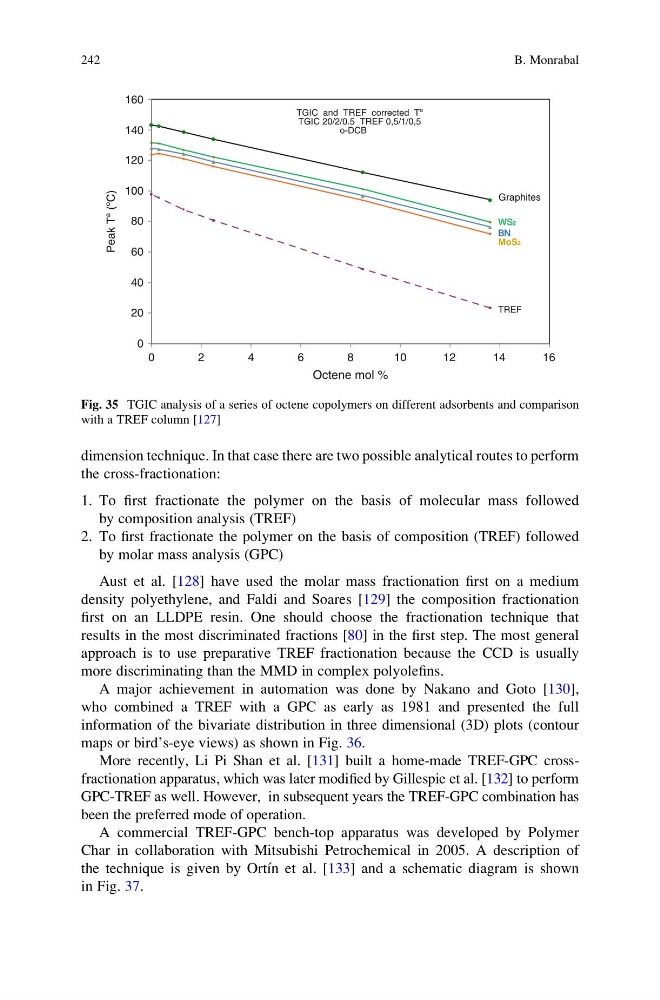
Fig. 35 TGIC analysis of a series of octene copolymers on different adsorbents and comparison
with a TREF column [127]
242
B. Monrabal
the cross-fractionation:
1. To first fractionate the polymer on the basis of molecular mass followed
by composition analysis (TREF)
2. To first fractionate the polymer on the basis of composition (TREF) followed
by molar mass analysis (GPC)
Aust et al. [128] have used the molar mass fractionation first on a medium
density polyethylene, and Faldi and Soares [129] the composition fractionation
first on an LLDPE resin. One should choose the fractionation technique that
results in the most discriminated fractions [80] in the first step. The most general
approach is to use preparative TREF fractionation because the CCD is usually
more discriminating than the MMD in complex polyolefins.
A major achievement in automation was done by Nakano and Goto [130],
who combined a TREF with a GPC as early as 1981 and presented the full
information of the bivariate distribution in three dimensional (3D) plots (contour
maps or bird’s-eye views) as shown in Fig. 36.
More recently, Li Pi Shan et al. [131] built a home-made TREF-GPC crossfractionation apparatus, which was later modified by Gillespie et al. [132] to perform
GPC-TREF as well. However, in subsequent years the TREF-GPC combination has
been the preferred mode of operation.
A commercial TREF-GPC bench-top apparatus was developed by Polymer
Char in collaboration with Mitsubishi Petrochemical in 2005. A description of
the technique is given by Ortı ´n et al. [133] and a schematic diagram is shown
in Fig. 37.
0
20
40
60
80
100
120
140
160
0
2
4
6
8
10
12
14
16
Peak Tª (ºC)
Octene mol %
TGIC and TREF corrected Tº
TGIC 20/2/0.5 TREF 0,5/1/0,5
o-DCB
Graphites
TREF
MoS2
BN BN
WS WS2
Fig. 35 TGIC analysis of a series of octene copolymers on different adsorbents and comparison
with a TREF column [127]
242
B. Monrabal