

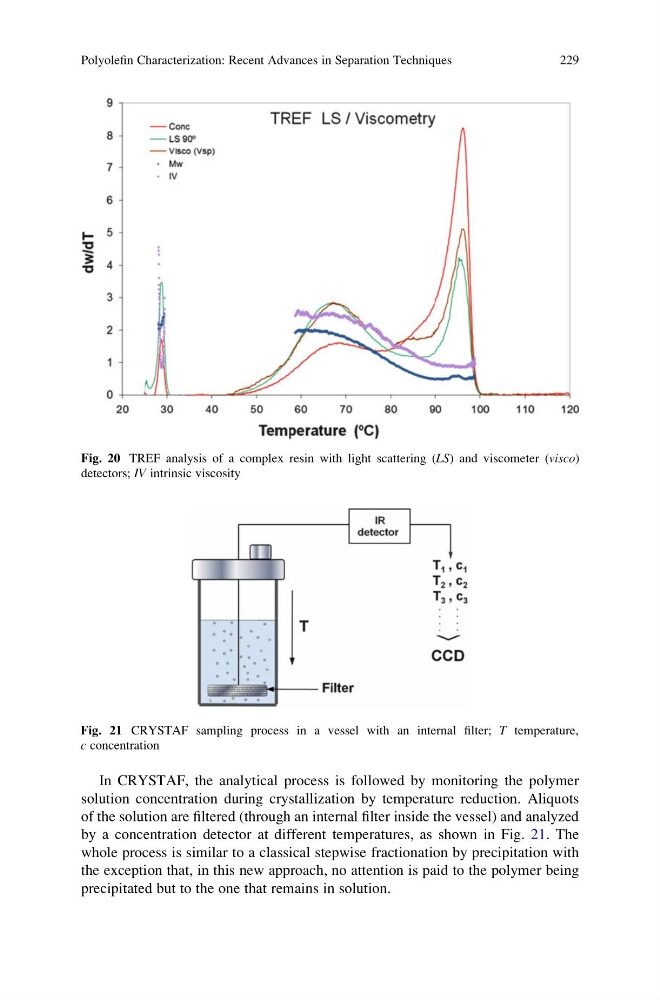
In CRYSTAF, the analytical process is followed by monitoring the polymer
solution concentration during crystallization by temperature reduction. Aliquots
of the solution are filtered (through an internal filter inside the vessel) and analyzed
by a concentration detector at different temperatures, as shown in Fig. 21. The
whole process is similar to a classical stepwise fractionation by precipitation with
the exception that, in this new approach, no attention is paid to the polymer being
precipitated but to the one that remains in solution.
Fig. 20 TREF analysis of a complex resin with light scattering (LS) and viscometer (visco)
detectors; IV intrinsic viscosity
Fig. 21 CRYSTAF sampling process in a vessel with an internal filter; T temperature,
c concentration
Polyolefin Characterization: Recent Advances in Separation Techniques
229
solution concentration during crystallization by temperature reduction. Aliquots
of the solution are filtered (through an internal filter inside the vessel) and analyzed
by a concentration detector at different temperatures, as shown in Fig. 21. The
whole process is similar to a classical stepwise fractionation by precipitation with
the exception that, in this new approach, no attention is paid to the polymer being
precipitated but to the one that remains in solution.
Fig. 20 TREF analysis of a complex resin with light scattering (LS) and viscometer (visco)
detectors; IV intrinsic viscosity
Fig. 21 CRYSTAF sampling process in a vessel with an internal filter; T temperature,
c concentration
Polyolefin Characterization: Recent Advances in Separation Techniques
229