

The incorporation of a composition sensor is important when analyzing PP
copolymers because both tacticity and branching play a role in the separation by
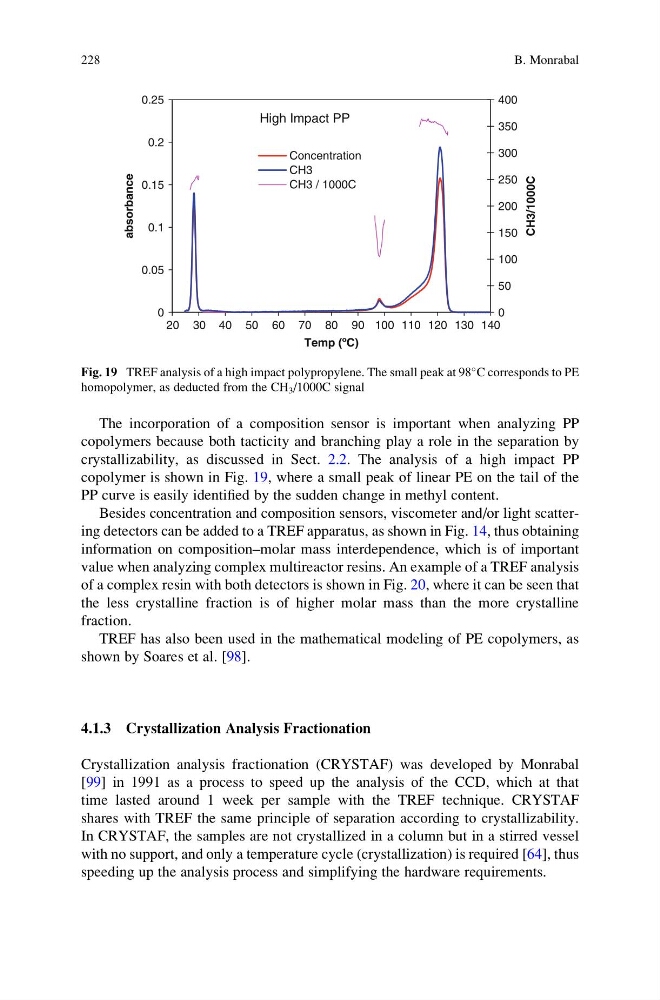
crystallizability, as discussed in Sect. 2.2. The analysis of a high impact PP
copolymer is shown in Fig. 19, where a small peak of linear PE on the tail of the
PP curve is easily identified by the sudden change in methyl content.
Besides concentration and composition sensors, viscometer and/or light scattering detectors can be added to a TREF apparatus, as shown in Fig. 14, thus obtaining
information on composition–molar mass interdependence, which is of important
value when analyzing complex multireactor resins. An example of a TREF analysis
of a complex resin with both detectors is shown in Fig. 20, where it can be seen that
the less crystalline fraction is of higher molar mass than the more crystalline
fraction.
TREF has also been used in the mathematical modeling of PE copolymers, as
shown by Soares et al. [98].
4.1.3 Crystallization Analysis Fractionation
Crystallization analysis fractionation (CRYSTAF) was developed by Monrabal
[99] in 1991 as a process to speed up the analysis of the CCD, which at that
time lasted around 1 week per sample with the TREF technique. CRYSTAF
shares with TREF the same principle of separation according to crystallizability.
In CRYSTAF, the samples are not crystallized in a column but in a stirred vessel
with no support, and only a temperature cycle (crystallization) is required [64], thus
speeding up the analysis process and simplifying the hardware requirements.
0
50
100
150
200
250
300
350
400
0
0.05
0.1
0.15
0.2
0.25
20 30 40 50 60 70 80 90 100 110 120 130 140
CH3/1000C
absorbance
Temp (ºC)
High Impact PP
Concentration
CH3
CH3 / 1000C
Fig. 19 TREF analysis of a high impact polypropylene. The small peak at 98
C corresponds to PE
homopolymer, as deducted from the CH 3 /1000C signal
228
B. Monrabal
copolymers because both tacticity and branching play a role in the separation by
crystallizability, as discussed in Sect. 2.2. The analysis of a high impact PP
copolymer is shown in Fig. 19, where a small peak of linear PE on the tail of the
PP curve is easily identified by the sudden change in methyl content.
Besides concentration and composition sensors, viscometer and/or light scattering detectors can be added to a TREF apparatus, as shown in Fig. 14, thus obtaining
information on composition–molar mass interdependence, which is of important
value when analyzing complex multireactor resins. An example of a TREF analysis
of a complex resin with both detectors is shown in Fig. 20, where it can be seen that
the less crystalline fraction is of higher molar mass than the more crystalline
fraction.
TREF has also been used in the mathematical modeling of PE copolymers, as
shown by Soares et al. [98].
4.1.3 Crystallization Analysis Fractionation
Crystallization analysis fractionation (CRYSTAF) was developed by Monrabal
[99] in 1991 as a process to speed up the analysis of the CCD, which at that
time lasted around 1 week per sample with the TREF technique. CRYSTAF
shares with TREF the same principle of separation according to crystallizability.
In CRYSTAF, the samples are not crystallized in a column but in a stirred vessel
with no support, and only a temperature cycle (crystallization) is required [64], thus
speeding up the analysis process and simplifying the hardware requirements.
0
50
100
150
200
250
300
350
400
0
0.05
0.1
0.15
0.2
0.25
20 30 40 50 60 70 80 90 100 110 120 130 140
CH3/1000C
absorbance
Temp (ºC)
High Impact PP
Concentration
CH3
CH3 / 1000C
Fig. 19 TREF analysis of a high impact polypropylene. The small peak at 98
C corresponds to PE
homopolymer, as deducted from the CH 3 /1000C signal
228
B. Monrabal