

To reduce co-crystallization in polypropylene, Iiba et al. [91] proposed a
temperature cycling scheme during crystallization, which they implemented in a
home-made TREF using a narrow bore TREF column.
TREF analysis is still reported quite often on the basis of dissolution
temperature scale, but as discussed in the introduction of Sect. 4.1 there is a linear
relation between dissolution temperature and comonomer incorporation, which has
been confirmed experimentally [62]. The calibration of temperature to comonomer
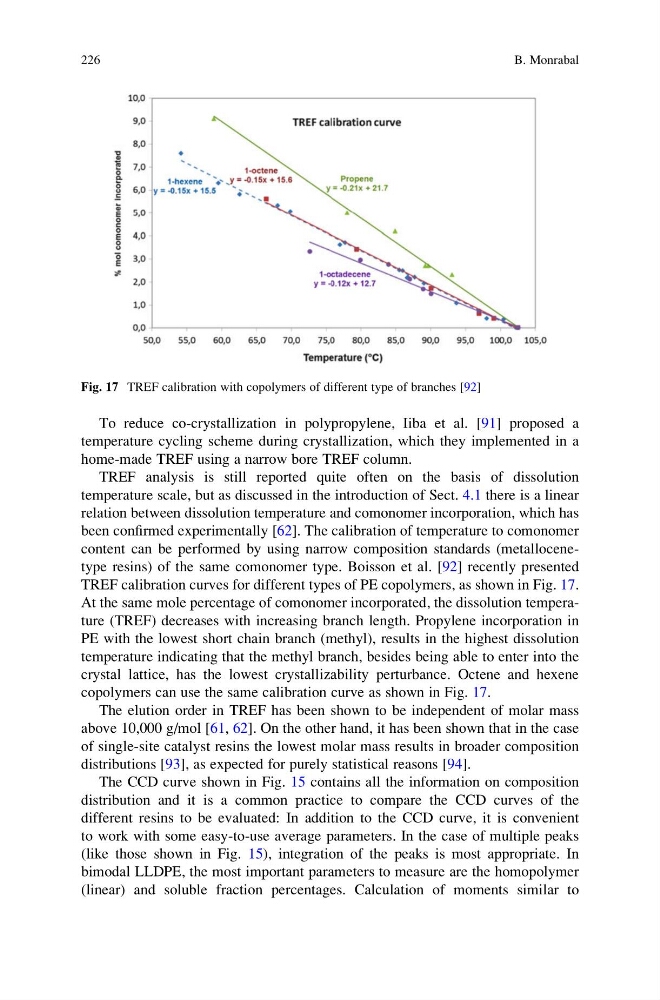
content can be performed by using narrow composition standards (metallocenetype resins) of the same comonomer type. Boisson et al. [92] recently presented
TREF calibration curves for different types of PE copolymers, as shown in Fig. 17.
At the same mole percentage of comonomer incorporated, the dissolution temperature (TREF) decreases with increasing branch length. Propylene incorporation in
PE with the lowest short chain branch (methyl), results in the highest dissolution
temperature indicating that the methyl branch, besides being able to enter into the
crystal lattice, has the lowest crystallizability perturbance. Octene and hexene
copolymers can use the same calibration curve as shown in Fig. 17.
The elution order in TREF has been shown to be independent of molar mass
above 10,000 g/mol [61, 62]. On the other hand, it has been shown that in the case
of single-site catalyst resins the lowest molar mass results in broader composition
distributions [93], as expected for purely statistical reasons [94].
The CCD curve shown in Fig. 15 contains all the information on composition
distribution and it is a common practice to compare the CCD curves of the
different resins to be evaluated: In addition to the CCD curve, it is convenient
to work with some easy-to-use average parameters. In the case of multiple peaks
(like those shown in Fig. 15), integration of the peaks is most appropriate. In
bimodal LLDPE, the most important parameters to measure are the homopolymer
(linear) and soluble fraction percentages. Calculation of moments similar to
Fig. 17 TREF calibration with copolymers of different type of branches [92]
226
B. Monrabal
temperature cycling scheme during crystallization, which they implemented in a
home-made TREF using a narrow bore TREF column.
TREF analysis is still reported quite often on the basis of dissolution
temperature scale, but as discussed in the introduction of Sect. 4.1 there is a linear
relation between dissolution temperature and comonomer incorporation, which has
been confirmed experimentally [62]. The calibration of temperature to comonomer
content can be performed by using narrow composition standards (metallocenetype resins) of the same comonomer type. Boisson et al. [92] recently presented
TREF calibration curves for different types of PE copolymers, as shown in Fig. 17.
At the same mole percentage of comonomer incorporated, the dissolution temperature (TREF) decreases with increasing branch length. Propylene incorporation in
PE with the lowest short chain branch (methyl), results in the highest dissolution
temperature indicating that the methyl branch, besides being able to enter into the
crystal lattice, has the lowest crystallizability perturbance. Octene and hexene
copolymers can use the same calibration curve as shown in Fig. 17.
The elution order in TREF has been shown to be independent of molar mass
above 10,000 g/mol [61, 62]. On the other hand, it has been shown that in the case
of single-site catalyst resins the lowest molar mass results in broader composition
distributions [93], as expected for purely statistical reasons [94].
The CCD curve shown in Fig. 15 contains all the information on composition
distribution and it is a common practice to compare the CCD curves of the
different resins to be evaluated: In addition to the CCD curve, it is convenient
to work with some easy-to-use average parameters. In the case of multiple peaks
(like those shown in Fig. 15), integration of the peaks is most appropriate. In
bimodal LLDPE, the most important parameters to measure are the homopolymer
(linear) and soluble fraction percentages. Calculation of moments similar to
Fig. 17 TREF calibration with copolymers of different type of branches [92]
226
B. Monrabal