

c ¼ k Á HR=F:
(3)
For the same amount of sample injection, keeping the HR/F ratio constant
will maintain the same detector response.
The crystallization process is the most important step in the TREF analysis; it is
in this process where fractions are segregated according to their crystallizability
and it is preferably used at the lowest cooling rate to minimize co-crystallization
effects. The lowest crystallization rate (CR) will also result in most stable crystal
aggregates and will prevent unwanted re-organization during the following melting
process. Typically CR of 0.1–0.5
C/min are used.
The temperature rising elution step, which gives the name to the technique,
can be performed at higher rates than the crystallization step and, typically, heating
rates (HR) of 0.5–5
C/min are used. Most important is to relate the heating to
the flow rate used, as discussed above with (3). A slow HR with a high flow
rate would elute polymer fractions in a large solvent volume and therefore with a
reduced signal-to-noise ratio whereas a low flow rate and fast HR would result
in a too-concentrated solution going through the column, which may result in
plugging (besides loss in resolution, as discussed later in this section). Typically,
flow rates of 0.5–2 mL/min are used depending on the HR being used, and are
optimized for column dimensions and sample size.
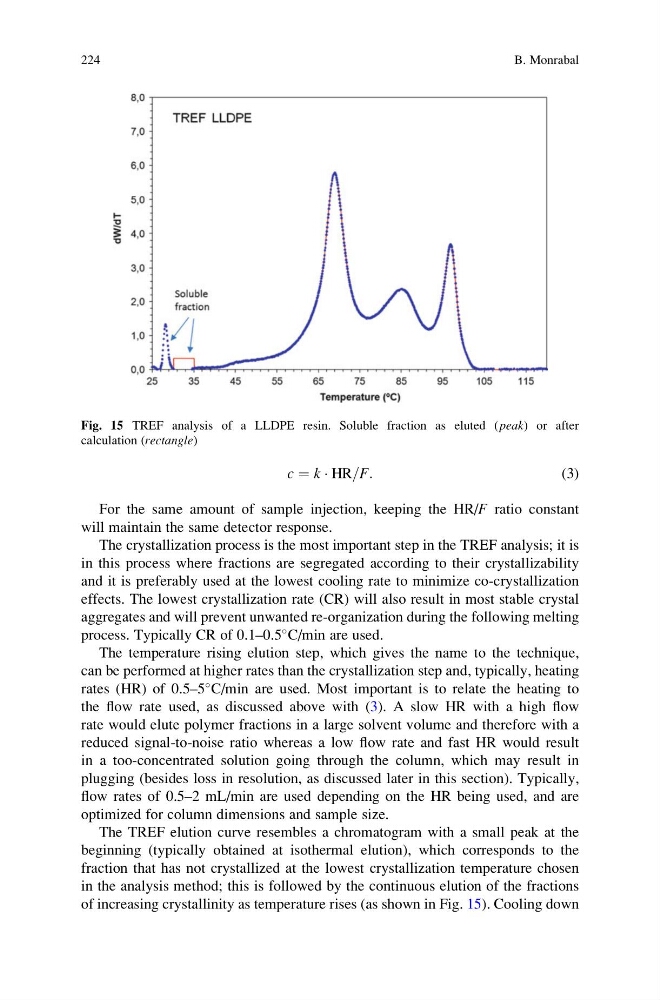
The TREF elution curve resembles a chromatogram with a small peak at the
beginning (typically obtained at isothermal elution), which corresponds to the
fraction that has not crystallized at the lowest crystallization temperature chosen
in the analysis method; this is followed by the continuous elution of the fractions
of increasing crystallinity as temperature rises (as shown in Fig. 15). Cooling down
Fig. 15 TREF analysis of a LLDPE resin. Soluble fraction as eluted (peak) or after
calculation (rectangle)
224
B. Monrabal
(3)
For the same amount of sample injection, keeping the HR/F ratio constant
will maintain the same detector response.
The crystallization process is the most important step in the TREF analysis; it is
in this process where fractions are segregated according to their crystallizability
and it is preferably used at the lowest cooling rate to minimize co-crystallization
effects. The lowest crystallization rate (CR) will also result in most stable crystal
aggregates and will prevent unwanted re-organization during the following melting
process. Typically CR of 0.1–0.5
C/min are used.
The temperature rising elution step, which gives the name to the technique,
can be performed at higher rates than the crystallization step and, typically, heating
rates (HR) of 0.5–5
C/min are used. Most important is to relate the heating to
the flow rate used, as discussed above with (3). A slow HR with a high flow
rate would elute polymer fractions in a large solvent volume and therefore with a
reduced signal-to-noise ratio whereas a low flow rate and fast HR would result
in a too-concentrated solution going through the column, which may result in
plugging (besides loss in resolution, as discussed later in this section). Typically,
flow rates of 0.5–2 mL/min are used depending on the HR being used, and are
optimized for column dimensions and sample size.
The TREF elution curve resembles a chromatogram with a small peak at the
beginning (typically obtained at isothermal elution), which corresponds to the
fraction that has not crystallized at the lowest crystallization temperature chosen
in the analysis method; this is followed by the continuous elution of the fractions
of increasing crystallinity as temperature rises (as shown in Fig. 15). Cooling down
Fig. 15 TREF analysis of a LLDPE resin. Soluble fraction as eluted (peak) or after
calculation (rectangle)
224
B. Monrabal