

been very popular in TREF due to its strong sensitivity to temperature changes in
this non-isothermal process. Today, the solvent most used is ortho-dichlorobenzene
because of its low freezing point (À17
C), which allows crystallization to subambient conditions, thus extending the crystallization range for the analysis of
less crystalline resins. The solvent does not influence the separation mechanism
in TREF analysis but elution temperatures will be shifted depending on the
solvent power, as discussed by Glo ¨ckner [68]. Monrabal et al. [89] have shown
the possibility to extend the TREF analysis to less crystalline polymers by the
use of more polar solvents.
Solution concentrations of 0.5% are usually prepared in vials or dissolution
vessels and injection of 1–5 mg of polymer are loaded onto the column in
analytical TREF. The more sensitive detectors should be used to allow for the
lowest concentration possible in order to reduce co-crystallization and entrapment
effects. Polyolefin homopolymers, which elute in a narrow temperature range,
may often result in column plugging, especially if they have large molar mass;
in those cases, a lower concentration of sample should be used for injections.
In TREF analysis, besides the mass of polymer injected into the column, the
dissolution and flow rates will contribute to the detector signal response. The mass
of polymer being dissolved per unit time is proportional to the heating rate, thus
the concentration reaching the detector can be expressed by (3), where HR is the
heating rate, F the flow rate and k is a function of the polymer microstructure
and mass injected:
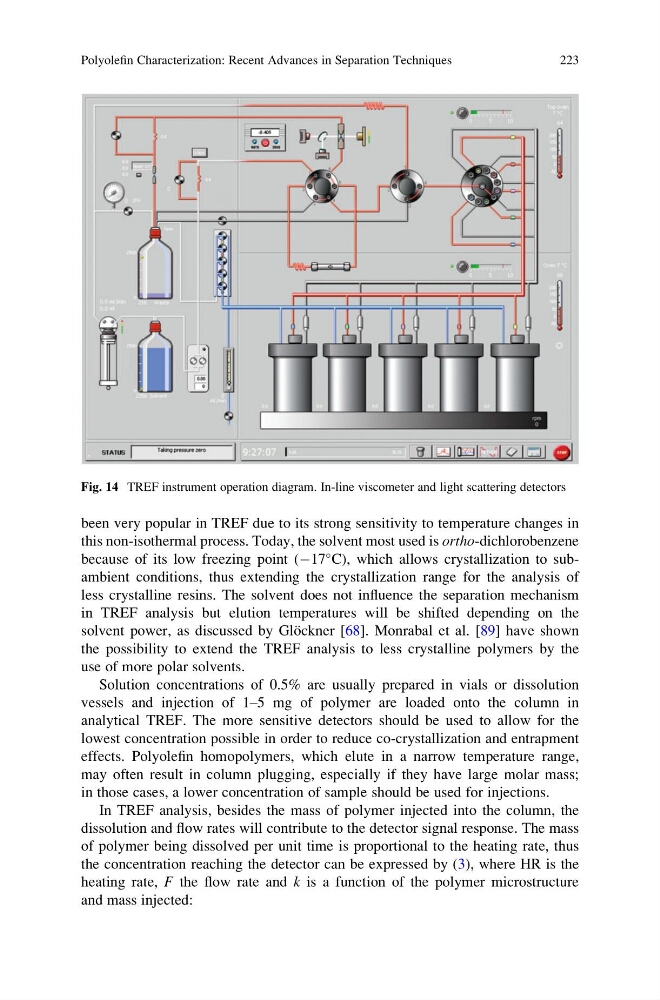
Fig. 14 TREF instrument operation diagram. In-line viscometer and light scattering detectors
Polyolefin Characterization: Recent Advances in Separation Techniques
223
this non-isothermal process. Today, the solvent most used is ortho-dichlorobenzene
because of its low freezing point (À17
C), which allows crystallization to subambient conditions, thus extending the crystallization range for the analysis of
less crystalline resins. The solvent does not influence the separation mechanism
in TREF analysis but elution temperatures will be shifted depending on the
solvent power, as discussed by Glo ¨ckner [68]. Monrabal et al. [89] have shown
the possibility to extend the TREF analysis to less crystalline polymers by the
use of more polar solvents.
Solution concentrations of 0.5% are usually prepared in vials or dissolution
vessels and injection of 1–5 mg of polymer are loaded onto the column in
analytical TREF. The more sensitive detectors should be used to allow for the
lowest concentration possible in order to reduce co-crystallization and entrapment
effects. Polyolefin homopolymers, which elute in a narrow temperature range,
may often result in column plugging, especially if they have large molar mass;
in those cases, a lower concentration of sample should be used for injections.
In TREF analysis, besides the mass of polymer injected into the column, the
dissolution and flow rates will contribute to the detector signal response. The mass
of polymer being dissolved per unit time is proportional to the heating rate, thus
the concentration reaching the detector can be expressed by (3), where HR is the
heating rate, F the flow rate and k is a function of the polymer microstructure
and mass injected:
Fig. 14 TREF instrument operation diagram. In-line viscometer and light scattering detectors
Polyolefin Characterization: Recent Advances in Separation Techniques
223