

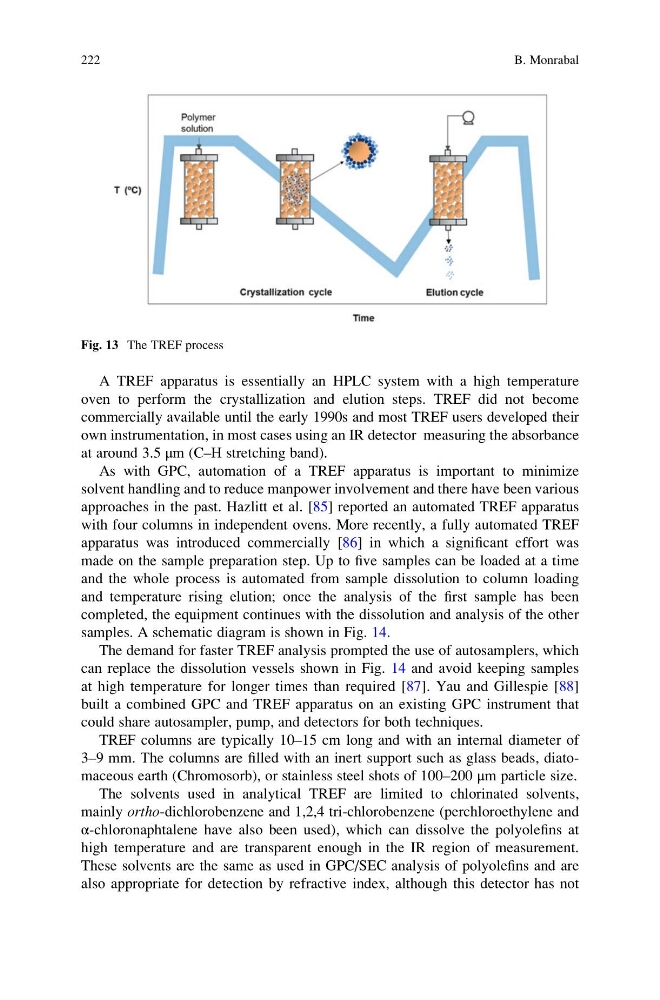
A TREF apparatus is essentially an HPLC system with a high temperature
oven to perform the crystallization and elution steps. TREF did not become
commercially available until the early 1990s and most TREF users developed their
own instrumentation, in most cases using an IR detector measuring the absorbance
at around 3.5 μm (C–H stretching band).
As with GPC, automation of a TREF apparatus is important to minimize
solvent handling and to reduce manpower involvement and there have been various
approaches in the past. Hazlitt et al. [85] reported an automated TREF apparatus
with four columns in independent ovens. More recently, a fully automated TREF
apparatus was introduced commercially [86] in which a significant effort was
made on the sample preparation step. Up to five samples can be loaded at a time
and the whole process is automated from sample dissolution to column loading
and temperature rising elution; once the analysis of the first sample has been
completed, the equipment continues with the dissolution and analysis of the other
samples. A schematic diagram is shown in Fig. 14.
The demand for faster TREF analysis prompted the use of autosamplers, which
can replace the dissolution vessels shown in Fig. 14 and avoid keeping samples
at high temperature for longer times than required [87]. Yau and Gillespie [88]
built a combined GPC and TREF apparatus on an existing GPC instrument that
could share autosampler, pump, and detectors for both techniques.
TREF columns are typically 10–15 cm long and with an internal diameter of
3–9 mm. The columns are filled with an inert support such as glass beads, diatomaceous earth (Chromosorb), or stainless steel shots of 100–200 μm particle size.
The solvents used in analytical TREF are limited to chlorinated solvents,
mainly ortho-dichlorobenzene and 1,2,4 tri-chlorobenzene (perchloroethylene and
α-chloronaphtalene have also been used), which can dissolve the polyolefins at
high temperature and are transparent enough in the IR region of measurement.
These solvents are the same as used in GPC/SEC analysis of polyolefins and are
also appropriate for detection by refractive index, although this detector has not
Fig. 13 The TREF process
222
B. Monrabal
oven to perform the crystallization and elution steps. TREF did not become
commercially available until the early 1990s and most TREF users developed their
own instrumentation, in most cases using an IR detector measuring the absorbance
at around 3.5 μm (C–H stretching band).
As with GPC, automation of a TREF apparatus is important to minimize
solvent handling and to reduce manpower involvement and there have been various
approaches in the past. Hazlitt et al. [85] reported an automated TREF apparatus
with four columns in independent ovens. More recently, a fully automated TREF
apparatus was introduced commercially [86] in which a significant effort was
made on the sample preparation step. Up to five samples can be loaded at a time
and the whole process is automated from sample dissolution to column loading
and temperature rising elution; once the analysis of the first sample has been
completed, the equipment continues with the dissolution and analysis of the other
samples. A schematic diagram is shown in Fig. 14.
The demand for faster TREF analysis prompted the use of autosamplers, which
can replace the dissolution vessels shown in Fig. 14 and avoid keeping samples
at high temperature for longer times than required [87]. Yau and Gillespie [88]
built a combined GPC and TREF apparatus on an existing GPC instrument that
could share autosampler, pump, and detectors for both techniques.
TREF columns are typically 10–15 cm long and with an internal diameter of
3–9 mm. The columns are filled with an inert support such as glass beads, diatomaceous earth (Chromosorb), or stainless steel shots of 100–200 μm particle size.
The solvents used in analytical TREF are limited to chlorinated solvents,
mainly ortho-dichlorobenzene and 1,2,4 tri-chlorobenzene (perchloroethylene and
α-chloronaphtalene have also been used), which can dissolve the polyolefins at
high temperature and are transparent enough in the IR region of measurement.
These solvents are the same as used in GPC/SEC analysis of polyolefins and are
also appropriate for detection by refractive index, although this detector has not
Fig. 13 The TREF process
222
B. Monrabal