

quantitative mass measurements (measuring the heat flow instead of concentration),
and has less sensitivity for less crystalline materials; nevertheless, DSC methods
have been available and used with certain success before solution crystallization
techniques were developed. A short review of the calorimetric techniques used in
this application will be presented in Sect. 4.1.1.
The most comprehensive analytical methods being used today to measure
the CCD are based on a separation process according to crystallizability. They
are performed in solution (higher chain mobility), which result in improved resolution and less co-crystallization effects. In following sections, three separation
techniques to measure the CCD based on crystallizability will be described
(see Sects. 4.1.2, 4.1.3, and 4.1.4):
Temperature rising elution fractionation (TREF)
Crystallization analysis fractionation (CRYSTAF)
Crystallization elution fractionation (CEF)
In the last 5 years, a new chromatographic approach has been developed
to separate polyethylene copolymers by adsorption on a carbon-based column
according to composition, with a significant interest in the characterization of less
crystalline materials (elastomers). This high temperature liquid chromatography
separation process can be performed by solvent gradient or through thermal gradient
and has evolved into the following two techniques:
Solvent gradient interaction chromatography (SGIC)
Thermal gradient interaction chromatography (TGIC)
which will also be described in coming sections (Sects. 4.2.1 and 4.2.2).
4.1 Crystallization-Based Techniques
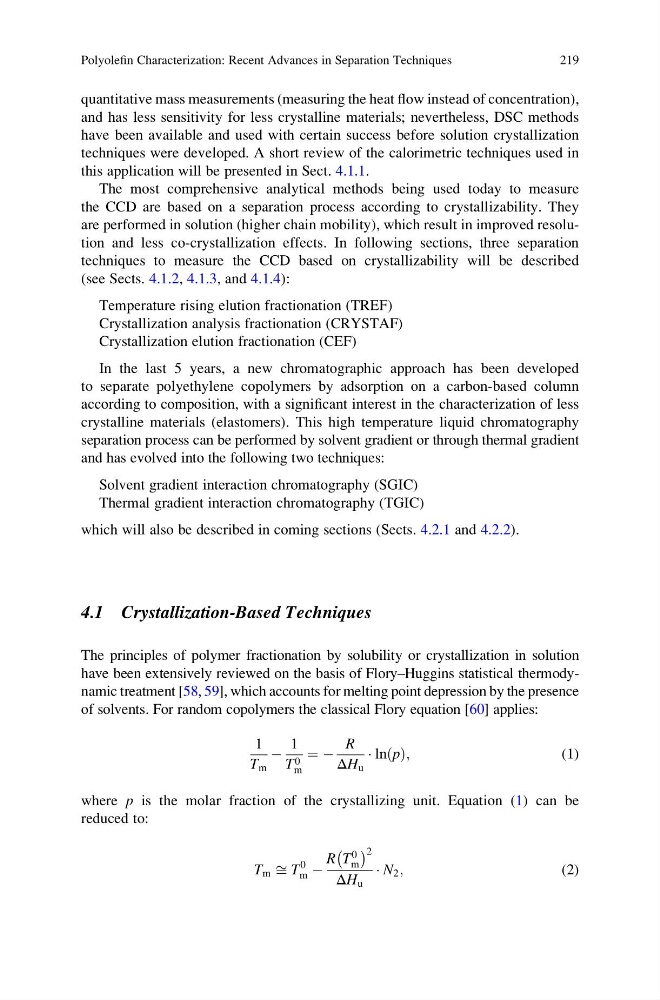
The principles of polymer fractionation by solubility or crystallization in solution
have been extensively reviewed on the basis of Flory–Huggins statistical thermodynamic treatment [58, 59], which accounts for melting point depression by the presence
of solvents. For random copolymers the classical Flory equation [60] applies:
1
T m
À
1
T 0
m
¼ À
R
ΔH u
Á lnðpÞ;
(1)
where p is the molar fraction of the crystallizing unit. Equation (1) can be
reduced to:
T m ffi T
0
m À
R T
0
m
À Á 2
ΔH u
Á N 2 ;
(2)
Polyolefin Characterization: Recent Advances in Separation Techniques
219
and has less sensitivity for less crystalline materials; nevertheless, DSC methods
have been available and used with certain success before solution crystallization
techniques were developed. A short review of the calorimetric techniques used in
this application will be presented in Sect. 4.1.1.
The most comprehensive analytical methods being used today to measure
the CCD are based on a separation process according to crystallizability. They
are performed in solution (higher chain mobility), which result in improved resolution and less co-crystallization effects. In following sections, three separation
techniques to measure the CCD based on crystallizability will be described
(see Sects. 4.1.2, 4.1.3, and 4.1.4):
Temperature rising elution fractionation (TREF)
Crystallization analysis fractionation (CRYSTAF)
Crystallization elution fractionation (CEF)
In the last 5 years, a new chromatographic approach has been developed
to separate polyethylene copolymers by adsorption on a carbon-based column
according to composition, with a significant interest in the characterization of less
crystalline materials (elastomers). This high temperature liquid chromatography
separation process can be performed by solvent gradient or through thermal gradient
and has evolved into the following two techniques:
Solvent gradient interaction chromatography (SGIC)
Thermal gradient interaction chromatography (TGIC)
which will also be described in coming sections (Sects. 4.2.1 and 4.2.2).
4.1 Crystallization-Based Techniques
The principles of polymer fractionation by solubility or crystallization in solution
have been extensively reviewed on the basis of Flory–Huggins statistical thermodynamic treatment [58, 59], which accounts for melting point depression by the presence
of solvents. For random copolymers the classical Flory equation [60] applies:
1
T m
À
1
T 0
m
¼ À
R
ΔH u
Á lnðpÞ;
(1)
where p is the molar fraction of the crystallizing unit. Equation (1) can be
reduced to:
T m ffi T
0
m À
R T
0
m
À Á 2
ΔH u
Á N 2 ;
(2)
Polyolefin Characterization: Recent Advances in Separation Techniques
219