

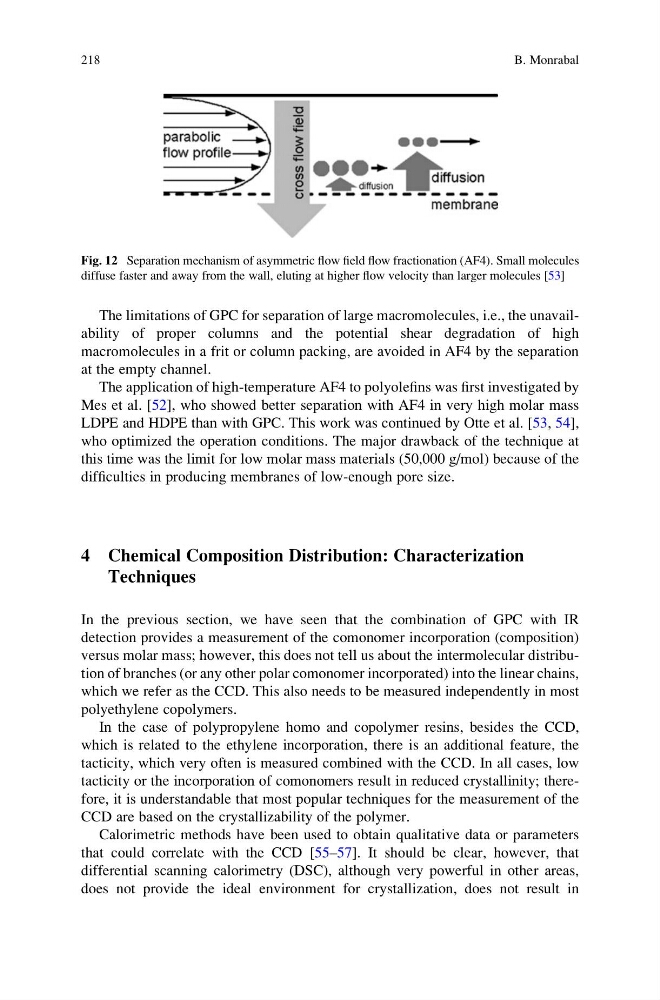
The limitations of GPC for separation of large macromolecules, i.e., the unavailability of proper columns and the potential shear degradation of high
macromolecules in a frit or column packing, are avoided in AF4 by the separation
at the empty channel.
The application of high-temperature AF4 to polyolefins was first investigated by
Mes et al. [52], who showed better separation with AF4 in very high molar mass
LDPE and HDPE than with GPC. This work was continued by Otte et al. [53, 54],
who optimized the operation conditions. The major drawback of the technique at
this time was the limit for low molar mass materials (50,000 g/mol) because of the
difficulties in producing membranes of low-enough pore size.
4 Chemical Composition Distribution: Characterization
Techniques
In the previous section, we have seen that the combination of GPC with IR
detection provides a measurement of the comonomer incorporation (composition)
versus molar mass; however, this does not tell us about the intermolecular distribution of branches (or any other polar comonomer incorporated) into the linear chains,
which we refer as the CCD. This also needs to be measured independently in most
polyethylene copolymers.
In the case of polypropylene homo and copolymer resins, besides the CCD,
which is related to the ethylene incorporation, there is an additional feature, the
tacticity, which very often is measured combined with the CCD. In all cases, low
tacticity or the incorporation of comonomers result in reduced crystallinity; therefore, it is understandable that most popular techniques for the measurement of the
CCD are based on the crystallizability of the polymer.
Calorimetric methods have been used to obtain qualitative data or parameters
that could correlate with the CCD [55–57]. It should be clear, however, that
differential scanning calorimetry (DSC), although very powerful in other areas,
does not provide the ideal environment for crystallization, does not result in
Fig. 12 Separation mechanism of asymmetric flow field flow fractionation (AF4). Small molecules
diffuse faster and away from the wall, eluting at higher flow velocity than larger molecules [53]
218
B. Monrabal
macromolecules in a frit or column packing, are avoided in AF4 by the separation
at the empty channel.
The application of high-temperature AF4 to polyolefins was first investigated by
Mes et al. [52], who showed better separation with AF4 in very high molar mass
LDPE and HDPE than with GPC. This work was continued by Otte et al. [53, 54],
who optimized the operation conditions. The major drawback of the technique at
this time was the limit for low molar mass materials (50,000 g/mol) because of the
difficulties in producing membranes of low-enough pore size.
4 Chemical Composition Distribution: Characterization
Techniques
In the previous section, we have seen that the combination of GPC with IR
detection provides a measurement of the comonomer incorporation (composition)
versus molar mass; however, this does not tell us about the intermolecular distribution of branches (or any other polar comonomer incorporated) into the linear chains,
which we refer as the CCD. This also needs to be measured independently in most
polyethylene copolymers.
In the case of polypropylene homo and copolymer resins, besides the CCD,
which is related to the ethylene incorporation, there is an additional feature, the
tacticity, which very often is measured combined with the CCD. In all cases, low
tacticity or the incorporation of comonomers result in reduced crystallinity; therefore, it is understandable that most popular techniques for the measurement of the
CCD are based on the crystallizability of the polymer.
Calorimetric methods have been used to obtain qualitative data or parameters
that could correlate with the CCD [55–57]. It should be clear, however, that
differential scanning calorimetry (DSC), although very powerful in other areas,
does not provide the ideal environment for crystallization, does not result in
Fig. 12 Separation mechanism of asymmetric flow field flow fractionation (AF4). Small molecules
diffuse faster and away from the wall, eluting at higher flow velocity than larger molecules [53]
218
B. Monrabal