

recently improved by using microscopic technology on the IR beam [48, 49]. In
those cases, the information obtained from the IR spectra (without the presence of
solvent) is superior and very powerful for the qualitative identification of unknown
copolymers and additives, although it demands more time for analysis and method
optimization. On the other hand, GPC-IR with a flow-through cell is being used
for analysis of copolymers of known chemistry and provides better quantitation
in a shorter time and with less manpower requirements.
The combination of proton NMR and GPC was shown to be possible by
Hiller et al. [50], who built a setup to analyze a blend of PE and poly(methyl
methacrylate) (PMMA).
3.2 Asymmetric Flow Field Flow Fractionation
Field flow fractionation (FFF) developed by Giddings [11] in 1966 is a non-column
separation technique that has been shown to be of great value for the separation
of biological macromolecules. The separation takes place by flowing the solution
in a flat channel with no stationary phase, and when being used in the asymmetric
flow field flow fractionation (AF4) mode [51], a cross-flow perpendicular to the
solvent flow is added, as shown in Fig. 12, which leaves through a semipermeable
membrane. A field force against the membrane is formed, with polymer molecules
being driven to different heights in the channel over the membrane depending on
their diffusion coefficients. The smaller molecules, diffusing faster, are positioned
far from the membrane and are flushed at a higher flow velocity than the larger
molecules that stay closer to the membrane, where the flow is lower due to the
channel parabolic flow profile.
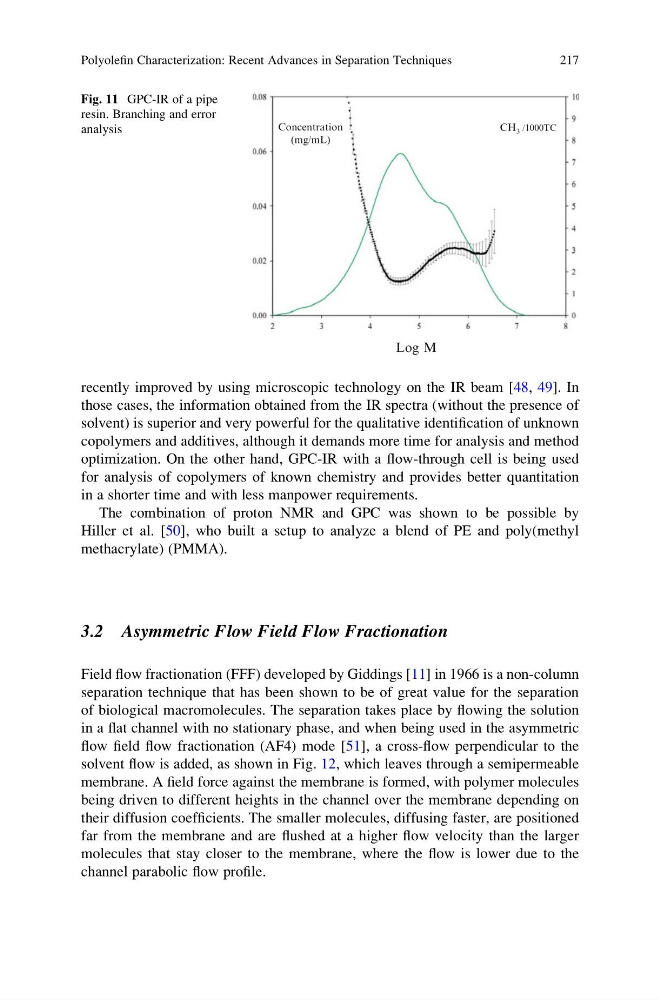
Concentration
(mg/mL)
Log M
CH 3 /1000TC
Fig. 11 GPC-IR of a pipe
resin. Branching and error
analysis
Polyolefin Characterization: Recent Advances in Separation Techniques
217
those cases, the information obtained from the IR spectra (without the presence of
solvent) is superior and very powerful for the qualitative identification of unknown
copolymers and additives, although it demands more time for analysis and method
optimization. On the other hand, GPC-IR with a flow-through cell is being used
for analysis of copolymers of known chemistry and provides better quantitation
in a shorter time and with less manpower requirements.
The combination of proton NMR and GPC was shown to be possible by
Hiller et al. [50], who built a setup to analyze a blend of PE and poly(methyl
methacrylate) (PMMA).
3.2 Asymmetric Flow Field Flow Fractionation
Field flow fractionation (FFF) developed by Giddings [11] in 1966 is a non-column
separation technique that has been shown to be of great value for the separation
of biological macromolecules. The separation takes place by flowing the solution
in a flat channel with no stationary phase, and when being used in the asymmetric
flow field flow fractionation (AF4) mode [51], a cross-flow perpendicular to the
solvent flow is added, as shown in Fig. 12, which leaves through a semipermeable
membrane. A field force against the membrane is formed, with polymer molecules
being driven to different heights in the channel over the membrane depending on
their diffusion coefficients. The smaller molecules, diffusing faster, are positioned
far from the membrane and are flushed at a higher flow velocity than the larger
molecules that stay closer to the membrane, where the flow is lower due to the
channel parabolic flow profile.
Concentration
(mg/mL)
Log M
CH 3 /1000TC
Fig. 11 GPC-IR of a pipe
resin. Branching and error
analysis
Polyolefin Characterization: Recent Advances in Separation Techniques
217