

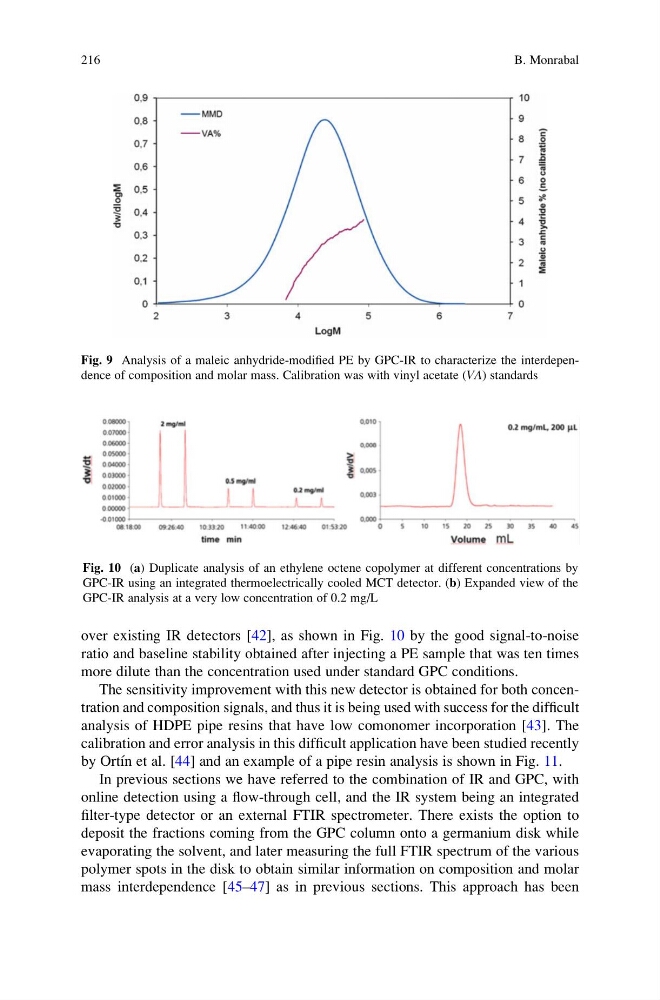
over existing IR detectors [42], as shown in Fig. 10 by the good signal-to-noise
ratio and baseline stability obtained after injecting a PE sample that was ten times
more dilute than the concentration used under standard GPC conditions.
The sensitivity improvement with this new detector is obtained for both concentration and composition signals, and thus it is being used with success for the difficult
analysis of HDPE pipe resins that have low comonomer incorporation [43]. The
calibration and error analysis in this difficult application have been studied recently
by Ortı ´n et al. [44] and an example of a pipe resin analysis is shown in Fig. 11.
In previous sections we have referred to the combination of IR and GPC, with
online detection using a flow-through cell, and the IR system being an integrated
filter-type detector or an external FTIR spectrometer. There exists the option to
deposit the fractions coming from the GPC column onto a germanium disk while
evaporating the solvent, and later measuring the full FTIR spectrum of the various
polymer spots in the disk to obtain similar information on composition and molar
mass interdependence [45–47] as in previous sections. This approach has been
Fig. 9 Analysis of a maleic anhydride-modified PE by GPC-IR to characterize the interdependence of composition and molar mass. Calibration was with vinyl acetate (VA) standards
Fig. 10 (a) Duplicate analysis of an ethylene octene copolymer at different concentrations by
GPC-IR using an integrated thermoelectrically cooled MCT detector. (b) Expanded view of the
GPC-IR analysis at a very low concentration of 0.2 mg/L
216
B. Monrabal
ratio and baseline stability obtained after injecting a PE sample that was ten times
more dilute than the concentration used under standard GPC conditions.
The sensitivity improvement with this new detector is obtained for both concentration and composition signals, and thus it is being used with success for the difficult
analysis of HDPE pipe resins that have low comonomer incorporation [43]. The
calibration and error analysis in this difficult application have been studied recently
by Ortı ´n et al. [44] and an example of a pipe resin analysis is shown in Fig. 11.
In previous sections we have referred to the combination of IR and GPC, with
online detection using a flow-through cell, and the IR system being an integrated
filter-type detector or an external FTIR spectrometer. There exists the option to
deposit the fractions coming from the GPC column onto a germanium disk while
evaporating the solvent, and later measuring the full FTIR spectrum of the various
polymer spots in the disk to obtain similar information on composition and molar
mass interdependence [45–47] as in previous sections. This approach has been
Fig. 9 Analysis of a maleic anhydride-modified PE by GPC-IR to characterize the interdependence of composition and molar mass. Calibration was with vinyl acetate (VA) standards
Fig. 10 (a) Duplicate analysis of an ethylene octene copolymer at different concentrations by
GPC-IR using an integrated thermoelectrically cooled MCT detector. (b) Expanded view of the
GPC-IR analysis at a very low concentration of 0.2 mg/L
216
B. Monrabal