

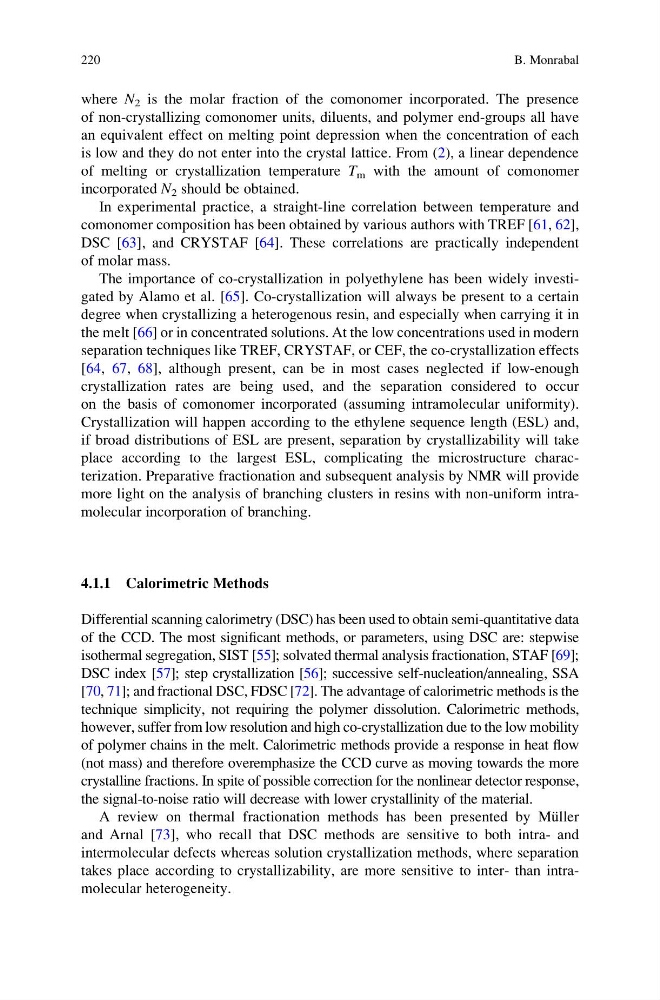
where N 2 is the molar fraction of the comonomer incorporated. The presence
of non-crystallizing comonomer units, diluents, and polymer end-groups all have
an equivalent effect on melting point depression when the concentration of each
is low and they do not enter into the crystal lattice. From (2), a linear dependence
of melting or crystallization temperature T m with the amount of comonomer
incorporated N 2 should be obtained.
In experimental practice, a straight-line correlation between temperature and
comonomer composition has been obtained by various authors with TREF [61, 62],
DSC [63], and CRYSTAF [64]. These correlations are practically independent
of molar mass.
The importance of co-crystallization in polyethylene has been widely investigated by Alamo et al. [65]. Co-crystallization will always be present to a certain
degree when crystallizing a heterogenous resin, and especially when carrying it in
the melt [66] or in concentrated solutions. At the low concentrations used in modern
separation techniques like TREF, CRYSTAF, or CEF, the co-crystallization effects
[64, 67, 68], although present, can be in most cases neglected if low-enough
crystallization rates are being used, and the separation considered to occur
on the basis of comonomer incorporated (assuming intramolecular uniformity).
Crystallization will happen according to the ethylene sequence length (ESL) and,
if broad distributions of ESL are present, separation by crystallizability will take
place according to the largest ESL, complicating the microstructure characterization. Preparative fractionation and subsequent analysis by NMR will provide
more light on the analysis of branching clusters in resins with non-uniform intramolecular incorporation of branching.
4.1.1 Calorimetric Methods
Differential scanning calorimetry (DSC) has been used to obtain semi-quantitative data
of the CCD. The most significant methods, or parameters, using DSC are: stepwise
isothermal segregation, SIST [55]; solvated thermal analysis fractionation, STAF [69];
DSC index [57]; step crystallization [56]; successive self-nucleation/annealing, SSA
[70, 71]; and fractional DSC, FDSC [72]. The advantage of calorimetric methods is the
technique simplicity, not requiring the polymer dissolution. Calorimetric methods,
however, suffer from low resolution and high co-crystallization due to the low mobility
of polymer chains in the melt. Calorimetric methods provide a response in heat flow
(not mass) and therefore overemphasize the CCD curve as moving towards the more
crystalline fractions. In spite of possible correction for the nonlinear detector response,
the signal-to-noise ratio will decrease with lower crystallinity of the material.
A review on thermal fractionation methods has been presented by Mu ¨ller
and Arnal [73], who recall that DSC methods are sensitive to both intra- and
intermolecular defects whereas solution crystallization methods, where separation
takes place according to crystallizability, are more sensitive to inter- than intramolecular heterogeneity.
220
B. Monrabal
of non-crystallizing comonomer units, diluents, and polymer end-groups all have
an equivalent effect on melting point depression when the concentration of each
is low and they do not enter into the crystal lattice. From (2), a linear dependence
of melting or crystallization temperature T m with the amount of comonomer
incorporated N 2 should be obtained.
In experimental practice, a straight-line correlation between temperature and
comonomer composition has been obtained by various authors with TREF [61, 62],
DSC [63], and CRYSTAF [64]. These correlations are practically independent
of molar mass.
The importance of co-crystallization in polyethylene has been widely investigated by Alamo et al. [65]. Co-crystallization will always be present to a certain
degree when crystallizing a heterogenous resin, and especially when carrying it in
the melt [66] or in concentrated solutions. At the low concentrations used in modern
separation techniques like TREF, CRYSTAF, or CEF, the co-crystallization effects
[64, 67, 68], although present, can be in most cases neglected if low-enough
crystallization rates are being used, and the separation considered to occur
on the basis of comonomer incorporated (assuming intramolecular uniformity).
Crystallization will happen according to the ethylene sequence length (ESL) and,
if broad distributions of ESL are present, separation by crystallizability will take
place according to the largest ESL, complicating the microstructure characterization. Preparative fractionation and subsequent analysis by NMR will provide
more light on the analysis of branching clusters in resins with non-uniform intramolecular incorporation of branching.
4.1.1 Calorimetric Methods
Differential scanning calorimetry (DSC) has been used to obtain semi-quantitative data
of the CCD. The most significant methods, or parameters, using DSC are: stepwise
isothermal segregation, SIST [55]; solvated thermal analysis fractionation, STAF [69];
DSC index [57]; step crystallization [56]; successive self-nucleation/annealing, SSA
[70, 71]; and fractional DSC, FDSC [72]. The advantage of calorimetric methods is the
technique simplicity, not requiring the polymer dissolution. Calorimetric methods,
however, suffer from low resolution and high co-crystallization due to the low mobility
of polymer chains in the melt. Calorimetric methods provide a response in heat flow
(not mass) and therefore overemphasize the CCD curve as moving towards the more
crystalline fractions. In spite of possible correction for the nonlinear detector response,
the signal-to-noise ratio will decrease with lower crystallinity of the material.
A review on thermal fractionation methods has been presented by Mu ¨ller
and Arnal [73], who recall that DSC methods are sensitive to both intra- and
intermolecular defects whereas solution crystallization methods, where separation
takes place according to crystallizability, are more sensitive to inter- than intramolecular heterogeneity.
220
B. Monrabal