

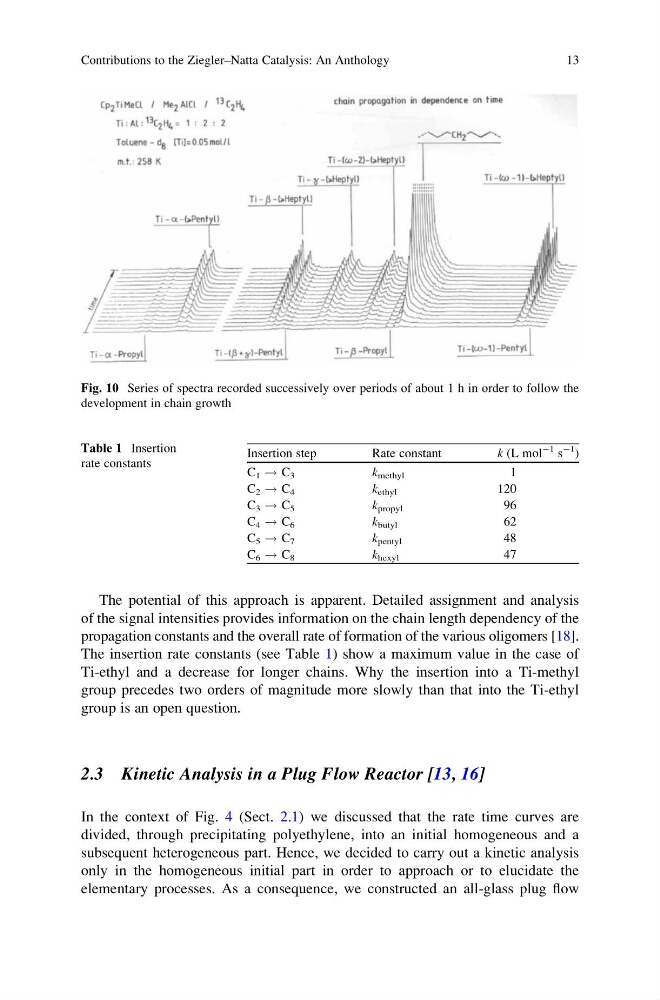
The potential of this approach is apparent. Detailed assignment and analysis
of the signal intensities provides information on the chain length dependency of the
propagation constants and the overall rate of formation of the various oligomers [18].
The insertion rate constants (see Table 1) show a maximum value in the case of
Ti-ethyl and a decrease for longer chains. Why the insertion into a Ti-methyl
group precedes two orders of magnitude more slowly than that into the Ti-ethyl
group is an open question.
2.3 Kinetic Analysis in a Plug Flow Reactor [13, 16]
In the context of Fig. 4 (Sect. 2.1) we discussed that the rate time curves are
divided, through precipitating polyethylene, into an initial homogeneous and a
subsequent heterogeneous part. Hence, we decided to carry out a kinetic analysis
only in the homogeneous initial part in order to approach or to elucidate the
elementary processes. As a consequence, we constructed an all-glass plug flow
Fig. 10 Series of spectra recorded successively over periods of about 1 h in order to follow the
development in chain growth
Table 1 Insertion
rate constants
Insertion step
Rate constant
k (L mol
À1 s
À1
)
C 1 ! C 3
k methyl
1
C 2 ! C 4
k ethyl
120
C 3 ! C 5
k propyl
96
C 4 ! C 6
k butyl
62
C 5 ! C 7
k pentyl
48
C 6 ! C 8
k hexyl
47
Contributions to the Ziegler–Natta Catalysis: An Anthology
13
of the signal intensities provides information on the chain length dependency of the
propagation constants and the overall rate of formation of the various oligomers [18].
The insertion rate constants (see Table 1) show a maximum value in the case of
Ti-ethyl and a decrease for longer chains. Why the insertion into a Ti-methyl
group precedes two orders of magnitude more slowly than that into the Ti-ethyl
group is an open question.
2.3 Kinetic Analysis in a Plug Flow Reactor [13, 16]
In the context of Fig. 4 (Sect. 2.1) we discussed that the rate time curves are
divided, through precipitating polyethylene, into an initial homogeneous and a
subsequent heterogeneous part. Hence, we decided to carry out a kinetic analysis
only in the homogeneous initial part in order to approach or to elucidate the
elementary processes. As a consequence, we constructed an all-glass plug flow
Fig. 10 Series of spectra recorded successively over periods of about 1 h in order to follow the
development in chain growth
Table 1 Insertion
rate constants
Insertion step
Rate constant
k (L mol
À1 s
À1
)
C 1 ! C 3
k methyl
1
C 2 ! C 4
k ethyl
120
C 3 ! C 5
k propyl
96
C 4 ! C 6
k butyl
62
C 5 ! C 7
k pentyl
48
C 6 ! C 8
k hexyl
47
Contributions to the Ziegler–Natta Catalysis: An Anthology
13