

bond (monometallic versus bimetallic mechanisms [22, 23]). In addition, the
presence of a small peak at 30.7 ppm due to central CH 2 groups indicates that
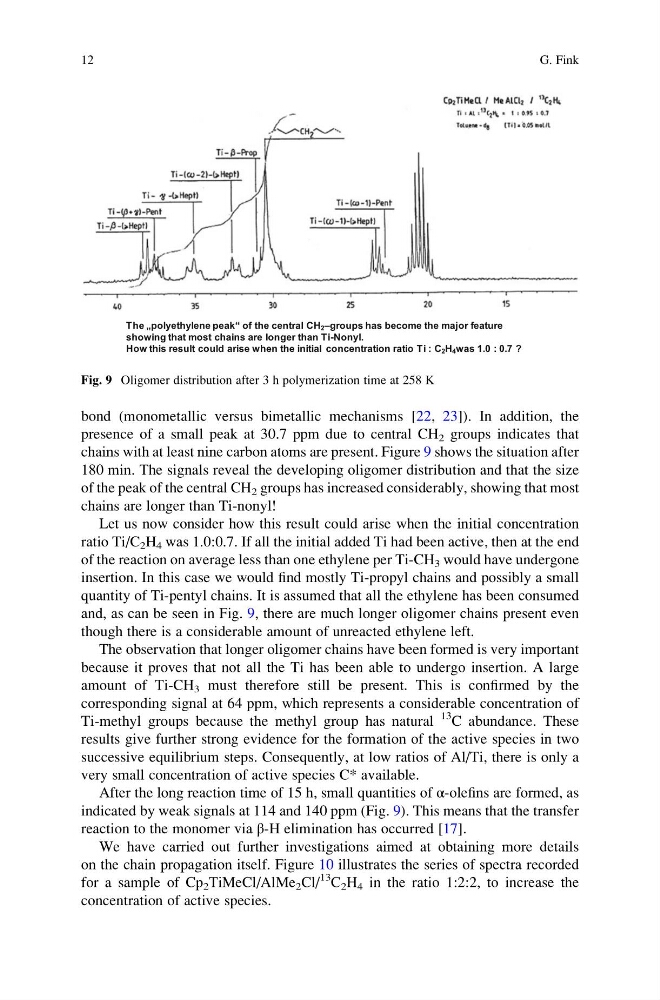
chains with at least nine carbon atoms are present. Figure 9 shows the situation after
180 min. The signals reveal the developing oligomer distribution and that the size
of the peak of the central CH 2 groups has increased considerably, showing that most
chains are longer than Ti-nonyl!
Let us now consider how this result could arise when the initial concentration
ratio Ti/C 2 H 4 was 1.0:0.7. If all the initial added Ti had been active, then at the end
of the reaction on average less than one ethylene per Ti-CH 3 would have undergone
insertion. In this case we would find mostly Ti-propyl chains and possibly a small
quantity of Ti-pentyl chains. It is assumed that all the ethylene has been consumed
and, as can be seen in Fig. 9, there are much longer oligomer chains present even
though there is a considerable amount of unreacted ethylene left.
The observation that longer oligomer chains have been formed is very important
because it proves that not all the Ti has been able to undergo insertion. A large
amount of Ti-CH 3 must therefore still be present. This is confirmed by the
corresponding signal at 64 ppm, which represents a considerable concentration of
Ti-methyl groups because the methyl group has natural
13
C abundance. These
results give further strong evidence for the formation of the active species in two
successive equilibrium steps. Consequently, at low ratios of Al/Ti, there is only a
very small concentration of active species C* available.
After the long reaction time of 15 h, small quantities of α-olefins are formed, as
indicated by weak signals at 114 and 140 ppm (Fig. 9). This means that the transfer
reaction to the monomer via β-H elimination has occurred [17].
We have carried out further investigations aimed at obtaining more details
on the chain propagation itself. Figure 10 illustrates the series of spectra recorded
for a sample of Cp 2 TiMeCl/AlMe 2 Cl/
13
C 2 H 4 in the ratio 1:2:2, to increase the
concentration of active species.
The „polyethylene peak“ of the central CH2–groups has become the major feature
showing that most chains are longer than Ti-Nonyl.
How this result could arise when the initial concentration ratio Ti : C2H4was 1.0 : 0.7 ?
Fig. 9 Oligomer distribution after 3 h polymerization time at 258 K
12
G. Fink
presence of a small peak at 30.7 ppm due to central CH 2 groups indicates that
chains with at least nine carbon atoms are present. Figure 9 shows the situation after
180 min. The signals reveal the developing oligomer distribution and that the size
of the peak of the central CH 2 groups has increased considerably, showing that most
chains are longer than Ti-nonyl!
Let us now consider how this result could arise when the initial concentration
ratio Ti/C 2 H 4 was 1.0:0.7. If all the initial added Ti had been active, then at the end
of the reaction on average less than one ethylene per Ti-CH 3 would have undergone
insertion. In this case we would find mostly Ti-propyl chains and possibly a small
quantity of Ti-pentyl chains. It is assumed that all the ethylene has been consumed
and, as can be seen in Fig. 9, there are much longer oligomer chains present even
though there is a considerable amount of unreacted ethylene left.
The observation that longer oligomer chains have been formed is very important
because it proves that not all the Ti has been able to undergo insertion. A large
amount of Ti-CH 3 must therefore still be present. This is confirmed by the
corresponding signal at 64 ppm, which represents a considerable concentration of
Ti-methyl groups because the methyl group has natural
13
C abundance. These
results give further strong evidence for the formation of the active species in two
successive equilibrium steps. Consequently, at low ratios of Al/Ti, there is only a
very small concentration of active species C* available.
After the long reaction time of 15 h, small quantities of α-olefins are formed, as
indicated by weak signals at 114 and 140 ppm (Fig. 9). This means that the transfer
reaction to the monomer via β-H elimination has occurred [17].
We have carried out further investigations aimed at obtaining more details
on the chain propagation itself. Figure 10 illustrates the series of spectra recorded
for a sample of Cp 2 TiMeCl/AlMe 2 Cl/
13
C 2 H 4 in the ratio 1:2:2, to increase the
concentration of active species.
The „polyethylene peak“ of the central CH2–groups has become the major feature
showing that most chains are longer than Ti-Nonyl.
How this result could arise when the initial concentration ratio Ti : C2H4was 1.0 : 0.7 ?
Fig. 9 Oligomer distribution after 3 h polymerization time at 258 K
12
G. Fink