

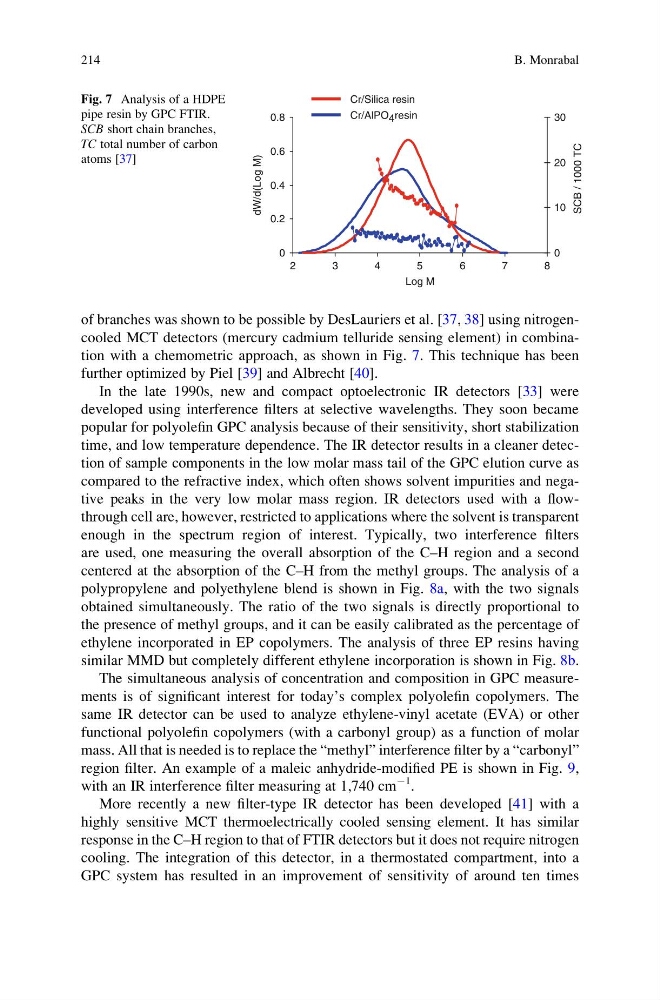
of branches was shown to be possible by DesLauriers et al. [37, 38] using nitrogencooled MCT detectors (mercury cadmium telluride sensing element) in combination with a chemometric approach, as shown in Fig. 7. This technique has been
further optimized by Piel [39] and Albrecht [40].
In the late 1990s, new and compact optoelectronic IR detectors [33] were
developed using interference filters at selective wavelengths. They soon became
popular for polyolefin GPC analysis because of their sensitivity, short stabilization
time, and low temperature dependence. The IR detector results in a cleaner detection of sample components in the low molar mass tail of the GPC elution curve as
compared to the refractive index, which often shows solvent impurities and negative peaks in the very low molar mass region. IR detectors used with a flowthrough cell are, however, restricted to applications where the solvent is transparent
enough in the spectrum region of interest. Typically, two interference filters
are used, one measuring the overall absorption of the C–H region and a second
centered at the absorption of the C–H from the methyl groups. The analysis of a
polypropylene and polyethylene blend is shown in Fig. 8a, with the two signals
obtained simultaneously. The ratio of the two signals is directly proportional to
the presence of methyl groups, and it can be easily calibrated as the percentage of
ethylene incorporated in EP copolymers. The analysis of three EP resins having
similar MMD but completely different ethylene incorporation is shown in Fig. 8b.
The simultaneous analysis of concentration and composition in GPC measurements is of significant interest for today’s complex polyolefin copolymers. The
same IR detector can be used to analyze ethylene-vinyl acetate (EVA) or other
functional polyolefin copolymers (with a carbonyl group) as a function of molar
mass. All that is needed is to replace the “methyl” interference filter by a “carbonyl”
region filter. An example of a maleic anhydride-modified PE is shown in Fig. 9,
with an IR interference filter measuring at 1,740 cm
À1 .
More recently a new filter-type IR detector has been developed [41] with a
highly sensitive MCT thermoelectrically cooled sensing element. It has similar
response in the C–H region to that of FTIR detectors but it does not require nitrogen
cooling. The integration of this detector, in a thermostated compartment, into a
GPC system has resulted in an improvement of sensitivity of around ten times
0
0.2
0.4
0.6
0.8
2
3
4
5
6
7
8
Log M
dW/d(Log M)
0
10
20
30
SCB / 1000 TC
Cr/Silica resin
Cr/AlPO 4 resin
Fig. 7 Analysis of a HDPE
pipe resin by GPC FTIR.
SCB short chain branches,
TC total number of carbon
atoms [37]
214
B. Monrabal
further optimized by Piel [39] and Albrecht [40].
In the late 1990s, new and compact optoelectronic IR detectors [33] were
developed using interference filters at selective wavelengths. They soon became
popular for polyolefin GPC analysis because of their sensitivity, short stabilization
time, and low temperature dependence. The IR detector results in a cleaner detection of sample components in the low molar mass tail of the GPC elution curve as
compared to the refractive index, which often shows solvent impurities and negative peaks in the very low molar mass region. IR detectors used with a flowthrough cell are, however, restricted to applications where the solvent is transparent
enough in the spectrum region of interest. Typically, two interference filters
are used, one measuring the overall absorption of the C–H region and a second
centered at the absorption of the C–H from the methyl groups. The analysis of a
polypropylene and polyethylene blend is shown in Fig. 8a, with the two signals
obtained simultaneously. The ratio of the two signals is directly proportional to
the presence of methyl groups, and it can be easily calibrated as the percentage of
ethylene incorporated in EP copolymers. The analysis of three EP resins having
similar MMD but completely different ethylene incorporation is shown in Fig. 8b.
The simultaneous analysis of concentration and composition in GPC measurements is of significant interest for today’s complex polyolefin copolymers. The
same IR detector can be used to analyze ethylene-vinyl acetate (EVA) or other
functional polyolefin copolymers (with a carbonyl group) as a function of molar
mass. All that is needed is to replace the “methyl” interference filter by a “carbonyl”
region filter. An example of a maleic anhydride-modified PE is shown in Fig. 9,
with an IR interference filter measuring at 1,740 cm
À1 .
More recently a new filter-type IR detector has been developed [41] with a
highly sensitive MCT thermoelectrically cooled sensing element. It has similar
response in the C–H region to that of FTIR detectors but it does not require nitrogen
cooling. The integration of this detector, in a thermostated compartment, into a
GPC system has resulted in an improvement of sensitivity of around ten times
0
0.2
0.4
0.6
0.8
2
3
4
5
6
7
8
Log M
dW/d(Log M)
0
10
20
30
SCB / 1000 TC
Cr/Silica resin
Cr/AlPO 4 resin
Fig. 7 Analysis of a HDPE
pipe resin by GPC FTIR.
SCB short chain branches,
TC total number of carbon
atoms [37]
214
B. Monrabal