

For detection, modern multiangle light scattering (LS) detectors have appeared
on the market for comprehensive molar mass and size measurements, e.g., from
Wyatt Technology (Santa Barbara, CA) [29] as well as single small-angle compact
LS system integrated into the detection block (e.g., from Malvern Instruments,
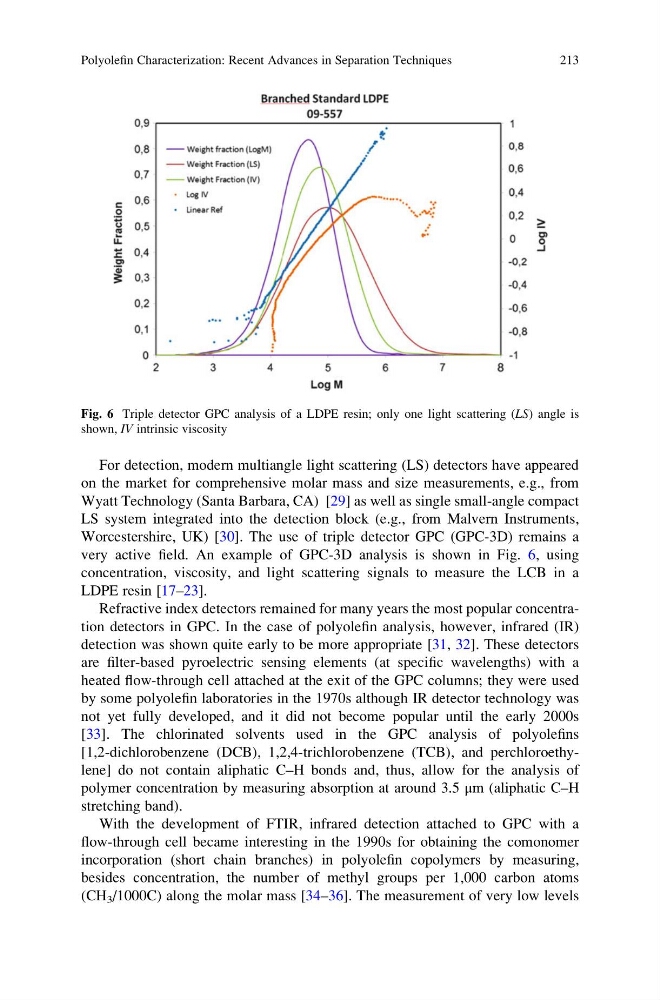
Worcestershire, UK) [30]. The use of triple detector GPC (GPC-3D) remains a
very active field. An example of GPC-3D analysis is shown in Fig. 6, using
concentration, viscosity, and light scattering signals to measure the LCB in a
LDPE resin [17–23].
Refractive index detectors remained for many years the most popular concentration detectors in GPC. In the case of polyolefin analysis, however, infrared (IR)
detection was shown quite early to be more appropriate [31, 32]. These detectors
are filter-based pyroelectric sensing elements (at specific wavelengths) with a
heated flow-through cell attached at the exit of the GPC columns; they were used
by some polyolefin laboratories in the 1970s although IR detector technology was
not yet fully developed, and it did not become popular until the early 2000s
[33]. The chlorinated solvents used in the GPC analysis of polyolefins
[1,2-dichlorobenzene (DCB), 1,2,4-trichlorobenzene (TCB), and perchloroethylene] do not contain aliphatic C–H bonds and, thus, allow for the analysis of
polymer concentration by measuring absorption at around 3.5 μm (aliphatic C–H
stretching band).
With the development of FTIR, infrared detection attached to GPC with a
flow-through cell became interesting in the 1990s for obtaining the comonomer
incorporation (short chain branches) in polyolefin copolymers by measuring,
besides concentration, the number of methyl groups per 1,000 carbon atoms
(CH 3 /1000C) along the molar mass [34–36]. The measurement of very low levels
Fig. 6 Triple detector GPC analysis of a LDPE resin; only one light scattering (LS) angle is
shown, IV intrinsic viscosity
Polyolefin Characterization: Recent Advances in Separation Techniques
213
on the market for comprehensive molar mass and size measurements, e.g., from
Wyatt Technology (Santa Barbara, CA) [29] as well as single small-angle compact
LS system integrated into the detection block (e.g., from Malvern Instruments,
Worcestershire, UK) [30]. The use of triple detector GPC (GPC-3D) remains a
very active field. An example of GPC-3D analysis is shown in Fig. 6, using
concentration, viscosity, and light scattering signals to measure the LCB in a
LDPE resin [17–23].
Refractive index detectors remained for many years the most popular concentration detectors in GPC. In the case of polyolefin analysis, however, infrared (IR)
detection was shown quite early to be more appropriate [31, 32]. These detectors
are filter-based pyroelectric sensing elements (at specific wavelengths) with a
heated flow-through cell attached at the exit of the GPC columns; they were used
by some polyolefin laboratories in the 1970s although IR detector technology was
not yet fully developed, and it did not become popular until the early 2000s
[33]. The chlorinated solvents used in the GPC analysis of polyolefins
[1,2-dichlorobenzene (DCB), 1,2,4-trichlorobenzene (TCB), and perchloroethylene] do not contain aliphatic C–H bonds and, thus, allow for the analysis of
polymer concentration by measuring absorption at around 3.5 μm (aliphatic C–H
stretching band).
With the development of FTIR, infrared detection attached to GPC with a
flow-through cell became interesting in the 1990s for obtaining the comonomer
incorporation (short chain branches) in polyolefin copolymers by measuring,
besides concentration, the number of methyl groups per 1,000 carbon atoms
(CH 3 /1000C) along the molar mass [34–36]. The measurement of very low levels
Fig. 6 Triple detector GPC analysis of a LDPE resin; only one light scattering (LS) angle is
shown, IV intrinsic viscosity
Polyolefin Characterization: Recent Advances in Separation Techniques
213